ACL · 2025 · Conference
Nghia Huynh Nguyen Hieu et al. (FPT Software AI Center) · → Paper · Demo: ✓ · Code: ✓
OZSpeech reformulates optimal transport conditional flow matching to start from a learned prior (rather than Gaussian noise) that closely approximates the target distribution, enabling single-step zero-shot TTS that is 2.7–6.5x faster than SOTA while achieving multi-fold WER improvement and stable intelligibility under noisy prompts.
Problem
Flow-matching TTS systems (E2 TTS, F5-TTS) require many inference steps (32–200) because they must traverse the full path from Gaussian noise to the target speech distribution. This makes them slow at inference and impractical for real-time applications. Additionally, traditional OT-CFM approaches require large training datasets to be robust (F5-TTS needs 95,000 hours), making them unsuitable for low-resource languages. A related problem is that most zero-shot TTS systems degrade substantially when the reference audio prompt is noisy.
Method
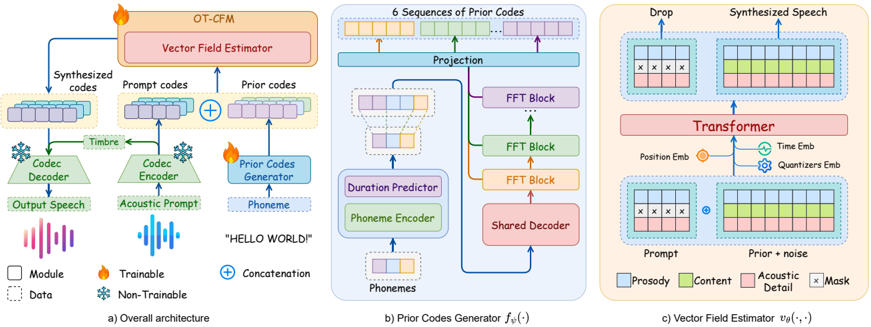
OZSpeech consists of three components:
FACodec (frozen): NaturalSpeech 3’s factorized neural codec decomposes speech into 6 discrete token sequences encoding prosody (1 quantizer), content (2 quantizers), and acoustic details (3 quantizers), plus a separate timbre embedding.
Prior Codes Generator: A cascaded feed-forward transformer that generates prior codes x_pr hierarchically: the first code sequence conditioned on phoneme embeddings, each subsequent sequence conditioned on the previous one. A Duration Predictor (FastSpeech-style) aligns phoneme embeddings to codec token length. A Prior Loss minimizes the negative log joint probability, pushing content codes close to their targets while acoustic codes converge to mean representations.
Vector Field Estimator (OT-CFM): Rather than regressing vectors from Gaussian noise x_0 to data x_1, the estimator regresses from the learned prior x_pr to x_1. The prior time τ is learned implicitly (not fixed), reducing both the number of steps and step size. A folding mechanism models all 6 quantizer sequences simultaneously (rather than sequentially like VALL-E) by concatenating them along the hidden dimension, reducing computation. A quantizer encoding (learned per-quantizer identifier embeddings) prevents cross-quantizer confusion. Anchor Loss regularizes embedding collapse. The acoustic prompt (prosody + acoustic codes, content masked) is concatenated with x_pr as the conditioning signal. Training uses arbitrary-segment prompt selection (not always the beginning) for better generalization.
Key Results
On LibriSpeech test-clean with 3-second prompts (Table 1):
| Model | WER | UTMOS | SIM-O | NFE |
|---|---|---|---|---|
| F5-TTS (95,000h data) | 0.24 | 3.76 | 0.53 | 32 |
| VoiceCraft (9,000h) | 0.18 | 3.55 | 0.51 | — |
| VALL-E (500h) | 0.19 | 3.68 | 0.40 | — |
| OZSpeech (500h) | 0.05 | 3.15 | 0.40 | 1 |
OZSpeech achieves the best WER by a large margin (44–58% relative improvement over the next-best method), consistent across 1s/3s/5s prompt lengths. UTMOS is lower than F5-TTS and VALL-E (3.15 vs. 3.7+) due to codec trade-offs (FACodec balances acoustic and semantic representations). Model size is 145M parameters — only 29–71% of competitors.
Under noisy prompts (Table 4), all baselines degrade dramatically. VALL-E reaches 93% WER at 0 dB SNR. OZSpeech maintains WER at 0.05–0.06 across all SNR levels, which is essentially unchanged from clean conditions. Fine-tuning with noisy prompts further improves acoustic quality metrics.
Novelty Assessment
The reformulation of OT-CFM with a learned prior (replacing Gaussian initialization) is a genuine algorithmic contribution. The single-step paradigm without distillation stages is novel in the flow-matching TTS literature. The noise robustness finding is practically important and underexplored in the field. The trade-off — significantly better intelligibility at the cost of lower perceptual naturalness (UTMOS) — is honest and well-characterized. The codec dependency on FACodec is a limitation for adaptation.
Field Significance
Tip
High — OZSpeech introduces a meaningful algorithmic shift in flow-matching TTS by replacing Gaussian initialization with a learned prior, enabling single-step sampling without distillation. The WER improvement over comparable systems (trained on 190x less data than F5-TTS) and the first systematic study of noisy-prompt robustness in zero-shot TTS open two concrete new directions for the field.
Claims
- Replacing Gaussian noise with a learned prior as the starting point for flow matching reduces the number of required inference steps to one without needing a separate distillation stage. (§3.1, §3.3)
- Flow-matching TTS systems trained on traditional OT-CFM are data-hungry and fail to generalise when retrained on limited data, while neural codec-based systems remain effective with as few as 500 hours. (§4.2, Table 1)
- Zero-shot TTS systems trained exclusively on clean prompts degrade substantially in intelligibility when given noisy reference audio, with autoregressive codec models being especially vulnerable. (§4.4, Table 4)
- Factorised codec representations that balance acoustic and semantic attributes trade perceptual naturalness (UTMOS) for intelligibility (WER) relative to codecs that prioritise acoustic fidelity. (§4.2)
- Fine-tuning a zero-shot TTS model on noise-augmented prompts preserves intelligibility and substantially recovers acoustic quality metrics under low-SNR conditions. (§4.4, Table 4)
Limitations and Open Questions
- UTMOS and speaker similarity lag behind F5-TTS and VoiceCraft; the prior-based approach trades acoustic naturalness for intelligibility and speed.
- Duration predictor rounding errors (integer quantization of phoneme durations) introduce temporal domain artifacts.
- FACodec dependency means reproduction requires NaturalSpeech 3’s codec infrastructure.
- Noise robustness fine-tuning improves non-WER metrics but was validated only on the QUT-NOISE database.
- Future work: multilingual extension, adaptive noise filtering integration.
Wiki Connections
This paper is a significant advance for flow-matching TTS, demonstrating that the “start from learned prior” paradigm can replace multi-step sampling. It directly competes with autoregressive systems on zero-shot-tts while being much faster. The use of FACodec for disentangled factorized speech tokens connects to neural-codec and disentanglement. Comparison to VALL-E 2301.02111 positions it relative to autoregressive-codec-tts. The noise robustness analysis opens a new dimension of evaluation not typically covered by evaluation-metrics standards.
OZSpeech is directly compared to F5-TTS in Table 1 — OZSpeech achieves WER 0.05% vs. F5-TTS’s 0.24% on LibriSpeech test-clean using 190× less training data (500h vs. 95K h) and a single inference step (NFE=1 vs. 32). F5-TTS outperforms OZSpeech on naturalness (UTMOS 3.76 vs. 3.15), highlighting the WER/naturalness trade-off between the two approaches. The two papers represent distinct strategies within the flow-matching paradigm: F5-TTS optimizes the ODE at inference via Sway Sampling; OZSpeech shrinks the integration path via a learned prior.