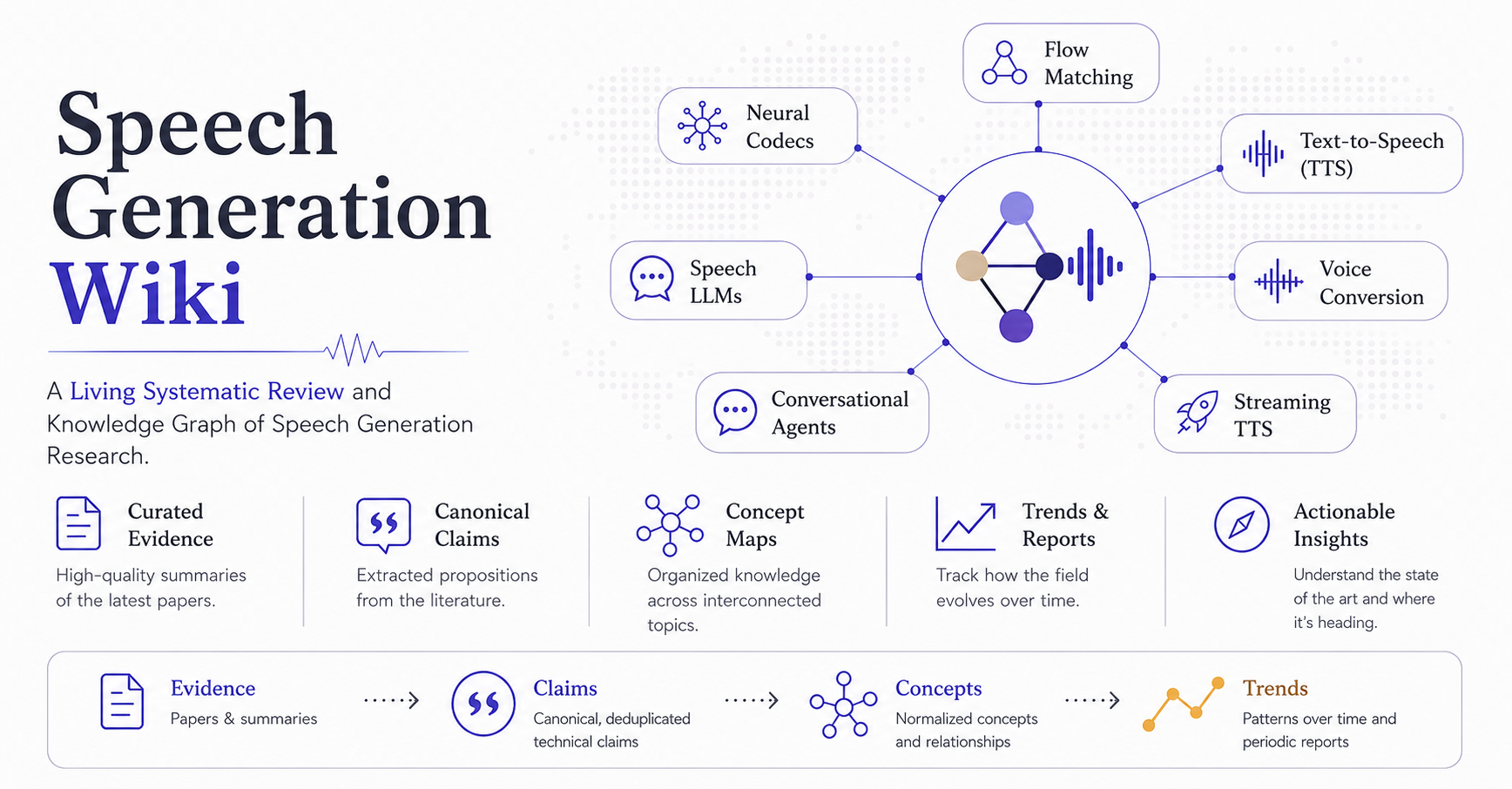
Abstract
A living systematic review and knowledge graph of speech generation research. It brings together 1145 paper summaries across text-to-speech (TTS), voice conversion (VC), spoken conversational agents, and evaluation, and connects them through 23 concept guides. The wiki shows what the current evidence supports, where findings disagree, and how the field changes over time.
There are four main ways to use the wiki:
- Read the Field Overview for the main findings across the field.
- Use the concept catalog to study one method or capability.
- Open the quarterly reports to see what changed during a fixed period.
- Search the paper catalog when you want the underlying evidence.
→ Choose the best place to start
Warning
Coverage and dates. The wiki includes earlier foundational papers, but its quarter-by-quarter record begins with Q3 2025. The current field overview and concept pages cover research published through Q4 2025. The paper catalog also includes newer publications. They are listed for discovery but are not yet reflected in the current summaries.
Start with the field
The Field Overview connects all 23 concepts. It explains the main choices around speech representations, speed, control, voice transfer, evaluation, and spoken interaction. You do not need to start with a specific architecture.
To see what changed during the latest completed period, read Speech Generation — Q4 2025. The report separates publication activity from changes in the evidence. Its Q4 evidence boundary will not change.
Explore a concept
All 23 concepts have a short Overview and a detailed In Depth page. Together they cover generation architectures, speech representations, control, multilingual and zero-shot synthesis, streaming, spoken agents, and evaluation.
Browse the papers
The corpus contains 1145 paper pages from arXiv, Interspeech, ACL, EMNLP, NAACL, ICLR, NeurIPS, ASRU, workshops, and industry technical reports. Search by title, author, system, benchmark, venue, or paper ID.
How to read the dates
The field overview is the current synthesis and will change as new research is added. Quarterly reports are saved historical views and do not change. The Q4 materials cover evidence published through December 31, 2025; the assessment was completed on November 1, 2026.
Paper counts show coverage and research activity. They do not prove that a finding is strong, widely accepted, or widely used.