Speech Generation Wiki
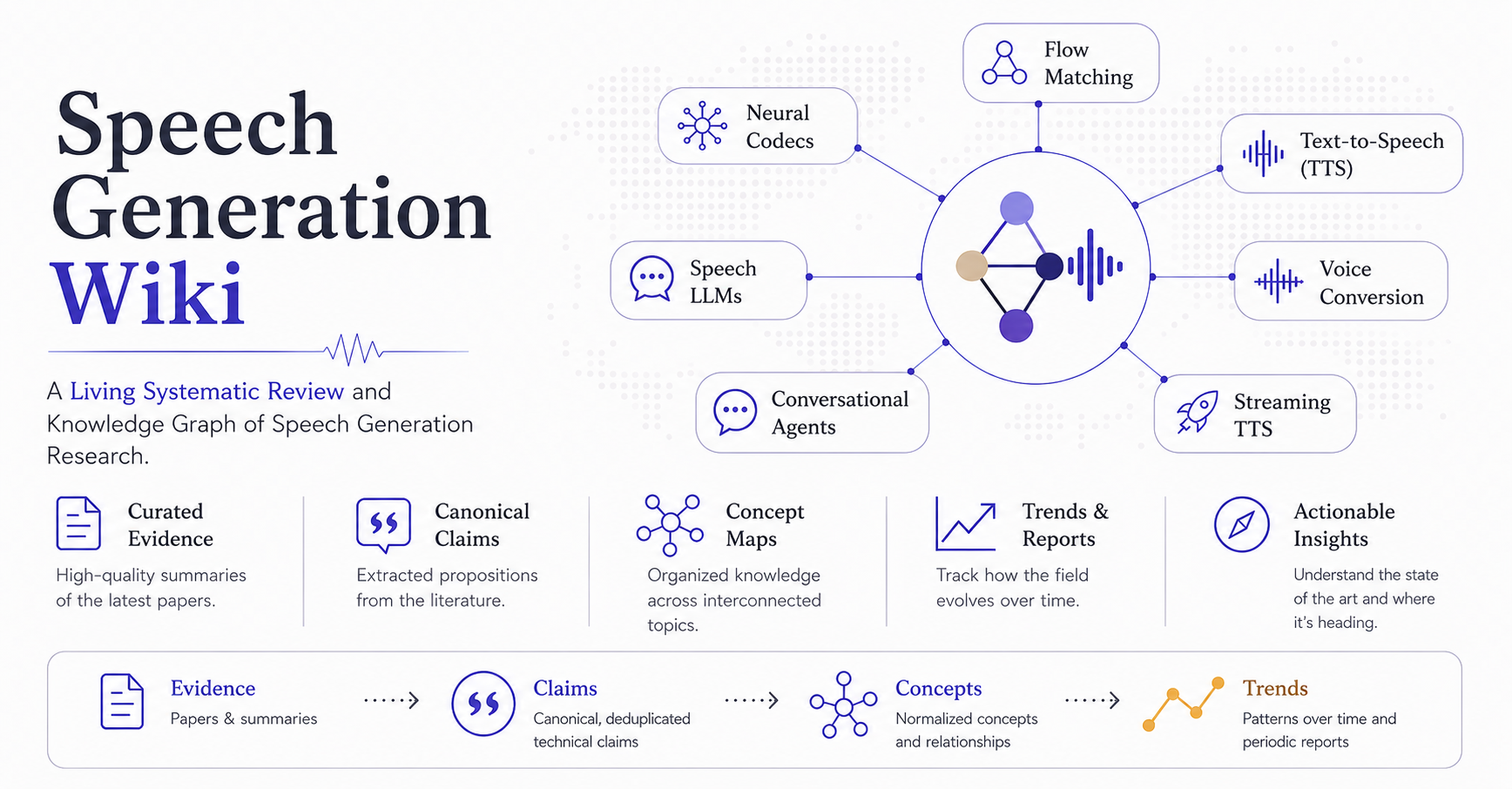
A living systematic review of synthetic speech research, covering text-to-speech (TTS), voice conversion (VC), and spoken conversational agents.
This repository contains the wiki’s published knowledge base: paper pages, structured concept claims, and reader-oriented research reviews. Browse the live site for the rendered version.
How the Knowledge Base Is Organized
The repository offers three complementary ways to read concept-level research:
- Overview — a concise account of the current state, method landscape, trade-offs, and open questions for readers surveying many concepts.
- In Depth — a detailed review of what the integrated literature collectively shows, where findings disagree, and which conclusions remain uncertain.
- Claim YAML — the complete machine-readable record of paper-level claims, evidence roles, method families, caveats, and reassessment state.
The two Markdown formats are editorial projections of the same claim YAML. They select and explain decision-relevant conclusions rather than reproducing the full graph.
papers/{id}.md
    ↓ integration
_claims/{concept}.yaml
    ↓ rendering
concepts/{concept}.md
concepts/{concept}-in-depth.md
Concept conclusions describe the literature integrated into this corpus. They should not be read as claims of exhaustive field coverage.
Work in progress: concept integration and synthesis currently cover research through Q3 2025. The paper catalog may contain later work that has been ingested but not yet incorporated into concept conclusions. Coverage will advance chronologically until it catches up with current research, then continue on a rolling basis.
Start Reading
- Home — project summary and completed concept integrations
- Start Here — reading paths for surveys, deep dives, papers, and structured evidence
- Field Overview — cross-concept synthesis of completed integrations
- Concept Catalog — Overview / In Depth links and integration status
- Paper Catalog — all ingested paper pages
At the current production stage, five of the 23 tracked concepts have completed claim integration and both rendering depths: Flow Matching, Speech-to-Speech Systems, Evaluation Metrics, RLHF for Speech, and Disentanglement. The catalog identifies the remaining concepts as pending.
Planned Coverage and Analysis
The current Q3 2025 boundary is a pipeline milestone, not the intended endpoint. After completing Q3 integration across the concept catalog, the project will continue through Q4 2025 and subsequent periods until the synthesis layer catches up with the research frontier.
The wiki is also planned to extend beyond concept synthesis:
- Time-based reports will compare periods such as Q3 and Q4 2025, showing changes in methods, evidence, evaluation practice, and open questions.
- Venue reports will synthesize research from venues such as Interspeech, NeurIPS, ICLR, and ACL when enough relevant papers are available to support more than a paper listing.
- Citation analysis will identify highly cited and influential papers in the corpus and track movement across periodic snapshots.
Repository Structure
index.md                       Reader-facing landing page
start.md                       Intent-based reading guide
overview.md                    Cross-concept field overview
log.md                         Append-only content operations log

papers/
  index.md                     Full paper catalog
  {id}.md                      One reviewed paper page
  assets/{id}/                 Selected paper figures

_claims/
  {concept}.yaml               Structured concept claim graph and source of truth

concepts/
  index.md                     Concept catalog and integration status
  {concept}.md                 Concept Overview
  {concept}-in-depth.md        Concept In Depth review

venues/                        Venue reports generated on demand
reports/                       Periodic cross-concept reports (deferred)
The former Evidence Dossier format is retired. Readers or agents that need exhaustive
paper-to-claim structure should use _claims/ directly.
Paper Pages
Each full paper page includes:
- a paper card with venue, year, authors, source link, and one-sentence contribution;
- a method summary and selected architecture figure when appropriate;
- key results with paper-local metric provenance;
- an assessment of novelty and field significance;
- two to five generalized claims with source-section citations;
- limitations, open questions, and links to related concepts and papers.
Foundational papers included mainly for citation context may use a shorter Tier 2 page.
Coverage
The corpus draws from arXiv, Interspeech, ACL, EMNLP, NAACL, NeurIPS, ICLR, ASRU, workshops, and technical reports from industry labs. Its main rolling window begins in 2025, with earlier foundational work added through citation discovery. See the paper catalog for the current set; static counts in documentation may lag active ingestion.
Pipeline and Companion Repositories
This repository is the content output of a six-stage pipeline:
Fetch → Filter → Parse → Ingest → Integrate → Render- speech-generation-wiki-infra contains acquisition scripts, parsed-source infrastructure, metadata, schemas, health checks, and shared Claude Code/Codex workflows.
- speech-generation-wiki-site contains the Quartz configuration that publishes this repository to GitHub Pages.
Automated content preserves generation provenance in page frontmatter. Claim status and evidence
relationships are changed in _claims/ through integration and then rendered into Markdown;
rendered concept pages are replaceable outputs rather than the source of truth.
Reporting Errors or Contributing
When reporting a factual issue, identify the paper or concept page and, where possible, the source
section, table, or figure. Do not edit a rendered concept page to change an evidence assessment:
corrections to claims, roles, or support relationships must flow through the corresponding
_claims/{concept}.yaml record in the pipeline.