ACL · 2025 · Conference
Zuo et al. (Zhejiang University) · → Paper · Demo: ✓ · Code: ?
R-VC combines shortcut flow matching with a masked duration transformer to achieve zero-shot voice conversion that transfers the target speaker’s rhythm as well as timbre, reducing inference to two steps while matching ten-step quality.
Problem
Prior zero-shot VC systems treat prosody preservation as a design goal: the converted speech retains the source speaker’s rhythm, which limits style transfer capability and causes timbre leakage when prosodic patterns carry speaker-specific information. A second limitation is inference latency. Flow matching and diffusion models generate higher-quality speech than non-diffusion alternatives, but typically require 10 or more function evaluations, which constrains practical deployment. No prior VC system addressed both problems simultaneously: rhythm transfer to the target speaker and efficient few-step inference.
Method
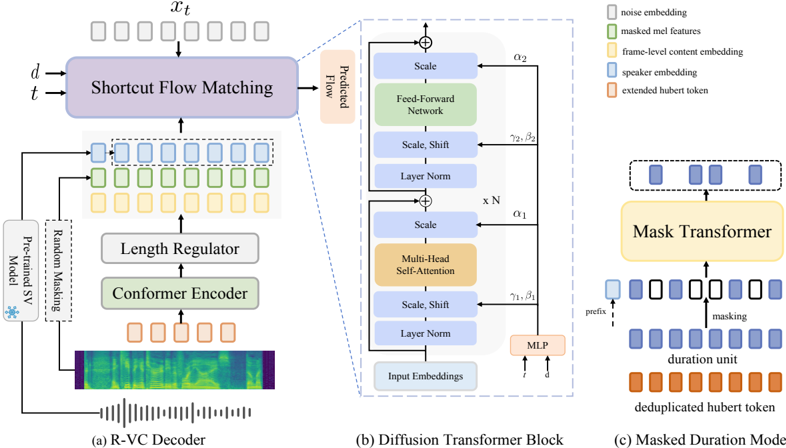
R-VC is a fully non-autoregressive encoder-decoder system with three modules. First, content representation extracts HuBERT discrete tokens from pitch-perturbed source audio using a pretrained HuBERT model and K-Means clustering (50 tokens/second), then deduplicates them to obtain unit-level durations. The data perturbation pipeline applies formant shifting, pitch randomisation, and parametric EQ before tokenisation, stripping content-irrelevant information such as speaker timbre from the content tokens.
Second, a masked generative transformer (Mask Transformer Duration Model) predicts the target duration for each deduplicated content unit. Inspired by masked language model decoding, it uses iterative mask-predict decoding conditioned on the deduplicated content tokens, the unmasked portion of target durations, and a global speaker embedding extracted from a pretrained speaker verification model. This allows the model to adapt source-language phoneme durations to match the target speaker’s speaking rate and rhythm.
Third, a Diffusion Transformer (DiT) decoder with shortcut flow matching generates mel-spectrograms. Standard conditional flow matching requires many ODE integration steps; shortcut flow matching (adapted from Frans et al. 2024 in image generation) conditions the network on both the current noise level and the desired step size, enabling it to jump to the correct intermediate point rather than accumulating discretisation error over large steps. Self-consistency training enforces that one shortcut step equals two consecutive steps of half the size. The DiT uses AdaLN-zero conditioning and receives content embeddings, a randomly span-masked mel-spectrogram prompt, and a global speaker embedding. A HiFiGAN vocoder synthesises the final waveform from the generated mel-spectrogram. Total parameters: 300M (DiT decoder) and 62M (duration model).
Key Results
On the LibriSpeech test-clean zero-shot VC benchmark (2,620 samples, 40 speakers), R-VC with two inference steps achieves QMOS 4.03, SMOS 4.11, SECS 0.930, WER 3.51, and UTMOS 4.1. The 10-step vanilla CFM baseline scores QMOS 4.05, SMOS 4.12, SECS 0.931, UTMOS 4.1, and WER 3.47, confirming near-identical quality at one-fifth the sampling cost. Inference is 2.83x faster than the 10-step baseline.
Among baselines, CosyVoice-VC is the closest competitor in speaker similarity (SECS 0.933) but is trained on 171k hours versus R-VC’s 20k hours, and has substantially worse intelligibility (WER 5.95 versus 3.51). R-VC exceeds all baselines in QMOS and matches or exceeds them in SMOS.
On the ESD emotion style transfer benchmark, R-VC achieves an emotion score of 0.59 versus the best baseline at 0.489 (HierSpeech++), with better WER (6.95 vs 7.94) and UTMOS (3.85 vs 3.78). The rhythm control evaluation shows 90.2% accuracy in matching target speaking rate categories (slow, normal, fast).
Ablations confirm the contribution of each module: removing the duration model drops emotion score by 0.165; removing pitch perturbation degrades WER from 3.51 to 7.28; removing global speaker conditioning from the duration model raises WER from 6.95 to 8.24.
Novelty Assessment
The main novel contributions are: (1) adapting shortcut flow matching from image generation to speech, enabling two-step inference without the performance collapse seen in standard flow matching at low NFE; (2) a masked generative transformer for per-unit duration modeling that actively transfers target speaker rhythm rather than preserving source prosody. Both ideas are adaptations of established techniques (Frans et al. 2024 shortcut models; masked language model decoding from Ghazvininejad et al. 2019) applied in combination to the specific demands of zero-shot VC.
The broader system architecture follows a well-established pattern for VC: SSL-based content tokens, a duration model, and a flow-matching acoustic decoder. The specific choice of DiT over U-Net is supported by ablations showing DiT scales better, but the performance difference at the evaluated sizes is small. The evaluation is fair on standard benchmarks and includes reproduction of several baselines under identical training conditions, which strengthens the comparison.
Field Significance
Moderate — R-VC addresses two real limitations simultaneously: rhythm transfer from the target speaker and efficient few-step inference. The shortcut flow matching approach demonstrates that self-consistency training objectives originally developed for image generation transfer to mel-spectrogram synthesis with minimal modification, which provides a reusable template for latency-reduction in other flow-matching speech systems. The rhythm control capability opens a direction for VC beyond prosody preservation, though the fine-grained duration model’s instability (acknowledged in §7) limits how far this can currently be pushed.
Claims
-
supports: Self-consistency training enables shortcut flow matching to match full-step quality in voice conversion with as few as two inference steps.
Evidence: R-VC at NFE=2 matches NFE=10 across all quality metrics (SECS 0.930 vs 0.931, UTMOS 4.1 vs 4.1, QMOS 4.03 vs 4.05, SMOS 4.11 vs 4.12) while reducing inference time by 2.83x; vanilla CFM degrades sharply below 10 steps. (§4.2, Table 1)
-
supports: Explicit rhythm modeling via a target-conditioned duration model substantially improves emotion style transfer in zero-shot VC.
Evidence: Removing the duration module from R-VC drops the emotion score from 0.59 to 0.425 on the ESD dataset, while also increasing WER slightly; baselines that preserve source rhythm score 0.395-0.489. (§4.3, §4.5, Table 2, Table 4)
-
complicates: Fine-grained duration prediction in non-autoregressive models introduces instability in voice conversion that coarser duration strategies do not fully resolve.
Evidence: R-VC’s masked transformer duration model produces occasional over-extended pronunciations; sentence-level duration as a fallback yields worse WER (9.86 vs 6.95) and UTMOS (3.58 vs 3.85), offering no stability improvement in practice. (§7, Table 4)
-
supports: Data perturbation before discrete content tokenisation reduces timbre leakage more effectively than relying on the self-supervised representation alone.
Evidence: Removing pitch perturbation before HuBERT token extraction degrades WER from 3.51 to 7.28 and speaker similarity from 0.930 to 0.869, confirming that perturbation actively suppresses content-irrelevant speaker information. (§4.5, Table 4)
Limitations and Open Questions
Warning
The masked transformer duration model has a known instability: inaccurate predictions cause over-extended pronunciations. Sentence-level duration as an alternative proved worse in both stability and quality, leaving robust duration modeling as an unresolved challenge.
The system is evaluated only on English (MLS, LibriSpeech, ESD) and English Seed-TTS subsets; generalisation to cross-lingual or multilingual VC is untested. Training data (20k hours) is smaller than top competitors such as CosyVoice-VC (171k hours), which makes speaker similarity comparisons somewhat favourable to R-VC but also means that high-similarity performance on out-of-distribution accents or recording conditions is unknown. The RTF of 0.12 using 2-step inference is faster than most flow-matching competitors but still 20% slower than non-diffusion methods (FACodec-VC RTF 0.10).
Wiki Connections
- Flow Matching — introduces shortcut flow matching for VC, extending the self-consistency training objective from image generation to mel-spectrogram synthesis to achieve two-step inference.
- Voice Conversion — advances zero-shot VC with rhythm transfer, distinguishing R-VC from prior systems that preserve source prosody rather than replicating target speaker rhythm.
- Zero-Shot TTS — the in-context speaker prompting strategy (masked mel + global speaker embedding) parallels zero-shot TTS methods and is evaluated on unseen speakers without fine-tuning.
- Self-Supervised Speech — HuBERT with K-Means discretisation forms the core content representation; data perturbation before tokenisation is shown to reduce timbre leakage from SSL features.
- Prosody Control — the masked generative transformer duration model explicitly controls speech rhythm at the phoneme-unit level, enabling target speaking rate replication with 90.2% category accuracy.
- Speaker Adaptation — combines global speaker embeddings from a speaker verification model with masked mel-spectrogram prompts to capture both time-invariant and time-varying speaker characteristics in zero-shot conversion.