SIGDIAL 2025 · 2025 · Workshop
Miyazawa and Sato (Fairy Devices Inc.) · → Paper · Demo: ✗ · Code: ✗
TRPDformer combines a contrastive predictive coding (CPC) encoder with a causal self-attention transformer to detect transition relevance points (TRPs) in real time from acoustic features alone, enabling spoken dialogue systems to determine response timing without silence thresholding or ASR.
Problem
Conventional spoken dialogue systems determine when to respond by waiting for a pause of fixed duration after the user stops speaking. This approach produces unnaturally timed responses: systems either cut in too early, before the user has finished a turn construction unit, or wait too long after a natural completion point. Prior work on turn-taking prediction either relied on linguistic features extracted from transcriptions (introducing ASR latency), operated in batch mode at the end of utterances, or conflated speaker-change prediction with the distinct task of identifying when a turn shift is permissible — what conversation analysts call the transition relevance point.
Method
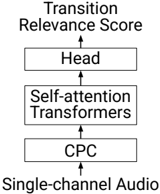
TRPDformer frames TRP detection as a binary sequence labelling problem over continuous audio. A pre-trained CPC model (Rivière et al., 2020) encodes raw audio into representations at 100 Hz; a convolutional downsampling layer then reduces this to 20 Hz. A causal self-attention transformer (embedding dimension 256, four heads) processes these representations, and a time-distributed dense head with a logistic activation predicts a transition relevance score r(t) in the range [0, 1] at 20 ms intervals. Cross-entropy loss is computed within a 1000 ms window centred on the end of each inter-pausal unit (IPU), which avoids the severe class imbalance that would arise from training on the full audio stream.
The paper distinguishes three latency regimes: predictive (L = -240 ms, fires before the IPU end), just-in-time (L = 0), and retrospective (L = +240 ms). This allows the operating point to be tuned based on whether response latency or interruption avoidance is prioritised. A voice activity detection (VAD) baseline triggers on pauses exceeding a configurable threshold.
The architecture is structurally derived from the stereo VAP model of Ekstedt and Skantze, with two modifications: the input is single-channel (user audio only) and the output is a single score rather than stereo voice activity projections. Despite the shared structure, the paper emphasises that TRP detection and VAP address different tasks: VAP predicts who will speak next, while TRP detection identifies when a turn shift is acceptable.
Key Results
On the Corpus of Everyday Japanese Conversation (CEJC, 200 hours, 862 speakers), all TRPDformer variants outperform the VAD baseline across precision-recall space (§5.3, Figure 6). In the fixed reception period condition (S = 1000 ms), all latency variants achieve AUC = 0.83. In the variable reception period condition (where detection must occur before the next IPU onset), the predictive model has a slight advantage. On the validation set, just-in-time achieves AUC = 0.807 and predictive achieves AUC = 0.801, versus AUC = 0.763 for the retrospective variant.
A human preference test (117 stimulus pairs, 40 raters each) found that third-party listeners rated TRPDformer response timing as more natural than the VAD baseline. Even when both models misdetected TRPs, subjects preferred the proposed model, suggesting that the learned score provides a better quality ranking than a fixed pause threshold (§5.5, Figure 8).
Novelty Assessment
The primary contribution is applying CPC-based self-supervised speech features together with a causal transformer to TRP detection, enabling purely acoustic, frame-level inference without ASR. The architecture is a straightforward adaptation of an existing VAP model to a new task, so the structural novelty is limited. The more significant contribution is conceptual: the paper carefully distinguishes TRP detection from speaker-change prediction and from VAP, provides a statistical argument for why a perfect VAP model would underperform at TRP detection (recall ceiling of 0.60 at precision 0.71 in CEJC), and formalises the transition relevance score as a trainable target. The evaluation is limited to one language (Japanese) and one corpus, and the paper does not report real-time processing speed, which is a relevant constraint for deployment.
Field Significance
Moderate — This paper provides a clear methodological baseline for acoustic TRP detection in spoken dialogue systems, situating the problem precisely in relation to the more widely studied VAP and speaker-change prediction tasks. Its value lies in clarifying the task boundary and demonstrating that acoustic-only, causal inference is feasible; the architecture itself adapts established components rather than introducing structural innovations.
Claims
-
supports: Purely acoustic, real-time turn-taking inference is feasible without relying on ASR or linguistic features.
Evidence: TRPDformer achieves AUC = 0.83 on CEJC using only CPC audio representations and a causal transformer, outperforming a VAD baseline with no transcription step. (§5.3, Figure 6)
-
complicates: Voice activity projection models are not directly transferable to transition relevance point detection, even though the tasks appear structurally similar.
Evidence: Statistical analysis of CEJC shows that a theoretically perfect VAP model would achieve at most recall = 0.60 and precision = 0.71 on TRP detection, below TRPDformer’s empirical performance, because speaker shift and TRP are not equivalent events. (§4.2)
-
supports: Learned acoustic response-timing models produce perceptibly more natural dialogue turn-taking than fixed-threshold silence detection.
Evidence: In a preference test with 40 raters per stimulus pair, subjects preferred TRPDformer’s response timing over the VAD baseline, including in cases where both models misdetected TRPs. (§5.5, Figure 8)
-
complicates: Frame-level TRP models trained on spontaneous conversation may not generalise across languages or domains, limiting their direct applicability in multilingual or task-oriented dialogue systems.
Evidence: TRPDformer is trained and evaluated solely on CEJC (Japanese everyday conversation); the paper identifies cross-lingual and cross-domain robustness as open future directions. (§6)
Limitations and Open Questions
Warning
Evaluation is limited to a single language (Japanese) and a single corpus (CEJC). Generalisation to other languages, accents, or task-oriented dialogue domains is untested, and the paper does not report real-time processing latency or robustness to noise — both of which are critical for deployment.
The paper also does not evaluate the downstream effect of TRPDformer on a full spoken dialogue system end-to-end, only on the timing component in isolation via a preference test. Response timing is studied independently of response content quality, and the paper acknowledges that future work should integrate TRPDformer into a complete dialogue system to assess its impact on overall conversational quality.
Wiki Connections
- Self-Supervised Speech — The model uses CPC (contrastive predictive coding) as its core speech encoder, making self-supervised pre-training central to the architecture.
- Evaluation Metrics — The paper uses AUC on precision-recall curves as the primary quantitative metric and introduces a human preference test methodology for evaluating response timing naturalness.
- Subjective Evaluation — A controlled preference test with 40 raters per pair evaluates whether differences in TRP detection are perceptible to human listeners, establishing perceptual validity for the AUC-based evaluation.