arXiv · 2025 · Preprint (Interspeech 2025)
Hu et al. (NVIDIA) · → Paper · Demo: ✓ · Code: ✓
SALM-Duplex introduces a full-duplex speech-to-speech architecture that routes user audio through a pretrained streaming encoder and agent speech through a personalized codec, eliminating the speech pretraining requirement while outperforming Moshi on barge-in, turn-taking, and reasoning benchmarks.
Problem
Full-duplex spoken dialogue systems must handle simultaneous user and agent speech streams in real time, but existing approaches face significant practical barriers: they require extensive speech-text pretraining on top of the LLM backbone, use additional submodules for turn-taking decisions that break end-to-end modeling, and must balance speech perception and generation within a single codec architecture. Cascaded approaches (ASR, LLM, TTS) avoid these issues at the cost of high latency and loss of paralinguistic information. Half-duplex LLM-based models (SpeechGPT, GLM-4-voice) handle turn-based interactions but cannot support user barge-in.
Method
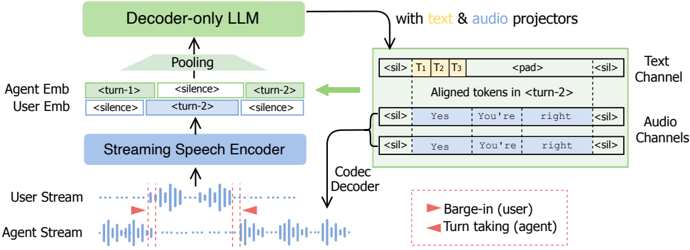
SALM-Duplex uses an asymmetric architecture to handle the two duplex streams independently. User speech passes through a 100M-parameter streaming CTC encoder (NVIDIA FastConformer with 80ms right context) that produces continuous frame-rate embeddings. Agent speech is tokenized by a personalized NanoCodec operating at 0.6 kbps (12.5 Hz frame rate, 4 independent codebooks using FSQ). A 1.1B-parameter TinyLlama serves as the LLM backbone, with its vocabulary extended to include speech codec tokens via zero-initialized embeddings. A modality adapter bridges the continuous encoder output to the LLM input space.
During training, user and agent embeddings are time-aligned and summed as input to the LLM, a channel fusion operation. Both text and speech channels are predicted in parallel via multi-channel next-token prediction, with turn-level alignment between text and speech (rather than word-level alignment). A one-token delay is introduced on the speech channel to allow the text channel to guide generation. Text and speech losses are weighted 3:1.
The asymmetric design enables a key capability absent from prior symmetric codec-only duplex systems: the agent codec can be fine-tuned independently for a target speaker voice without affecting the user input pathway. FSQ independent codebooks allow fully parallel multi-codebook prediction with no inter-codebook delay, keeping generation latency low.
Training data is entirely synthetic, generated by TTS from text sources: question-answering from MS MARCO and Alpaca, ASR-relabeled speech rephrased via Mixtral-8x22B (ASR-QA), multi-turn conversations from UltraChat and an internal SFT dataset (totaling approximately 27k hours). Barge-in behavior is simulated by truncating agent turns at user speech onset and padding with silence.
Key Results
Compared to Moshi on the Impatient evaluation set (designed for frequent user interruptions), SALM-Duplex achieves 94.5% barge-in success rate versus Moshi’s 55.1%, with lower barge-in latency (0.69s vs. 0.81s) and zero false alarms on both systems. On the less adversarial UltraChat set, success rate is 83.0% vs. 56.0%. Speech quality as measured by UTMOS is 4.0 vs. 3.8 (Impatient) and 4.3 vs. 3.9 (UltraChat) (§6.1, Table 2).
On reasoning quality evaluated via GPT scores (gpt-4o-mini), SALM-Duplex consistently outperforms Moshi across all five test sets by large margins: Roleplay 4.6 vs. 1.7, Topic 6.1 vs. 2.8, ASR-QA 7.8 vs. 1.9. Compared to an oracle cascaded system (GT+LLM, which feeds ground-truth user transcriptions directly to TinyLlama), SALM-Duplex performs better on 2 of 5 sets and worse on 3, with the largest gap on UltraChat (3.5 vs. 6.4) (§6.2, Table 3).
Codec personalization (fine-tuning NanoCodec on 21k target-speaker utterances) delivers consistent gains across all metrics. The personalized 0.6 kbps codec outperforms both the 1.2 kbps untuned NanoCodec and Moshi’s 1.1 kbps Mimi: MOS 4.75 vs. 4.54 vs. 4.16, CER 1.36 vs. 3.55 vs. 3.0, SECS 0.94 vs. 0.57 vs. 0.65, and S2S ASR-BLEU 18.7 vs. 16.2 (§6.3, Table 4).
Novelty Assessment
The primary architectural contribution is the channel fusion design: routing continuous user embeddings and discrete codec agent tokens through separate pathways and summing them as LLM input. This asymmetry allows the system to leverage a pretrained streaming encoder for user comprehension, bypassing the need for speech pretraining. The approach combines existing components (TinyLlama, FastConformer, NanoCodec) in a novel structural arrangement rather than introducing new algorithmic primitives.
The codec personalization capability is a genuine practical advantage of the asymmetric design over symmetric codec-only systems such as Moshi: because user and agent pathways are separate, the agent codec can be fine-tuned without touching the user comprehension stack.
The evaluation contribution also has standalone value: the barge-in metrics (success rate, latency, false alarm rate) and the Impatient test set construction (halving silence between user turns to force frequent interruption) provide a more demanding and reproducible benchmark for duplex systems than prior evaluations in controlled conditions.
The comparison baseline is limited to Moshi; other contemporaneous duplex systems (SyncLLM, OmniFlatten, MinMo, SALMONN-Omni) are discussed but not benchmarked quantitatively. The backbone (TinyLlama 1.1B) is modest, and training data is predominantly synthetic TTS, limiting statements about real conversational speech generalization.
Field Significance
Moderate — SALM-Duplex demonstrates that full-duplex spoken language model systems can be constructed without speech pretraining by using a pretrained streaming encoder for user input, materially reducing the data and compute barriers for this class of system. The open-source release of training and inference code provides a reproducible foundation for duplex SCA research that was previously absent from the literature. The proposed barge-in evaluation protocol, including the Impatient test set, introduces a more systematic and adversarial benchmark for duplex conversational behavior.
Claims
-
supports: Full-duplex spoken dialogue systems can be built without speech-text pretraining by routing user audio through a pretrained streaming encoder rather than requiring the LLM to learn audio representations end-to-end.
Evidence: SALM-Duplex skips speech pretraining entirely and instead uses a 100M streaming CTC encoder for user input; it still outperforms Moshi on barge-in success rate (94.5% vs. 55.1%) and reasoning GPT scores across all five evaluation sets. (§3, §6.1, §6.2, Tables 2–3)
-
supports: Asymmetric duplex architectures that separate user and agent speech pathways enable independent specialization, including speaker-specific codec fine-tuning without affecting user comprehension.
Evidence: Personalized 0.6 kbps NanoCodec (fine-tuned on 21k target-speaker utterances) outperforms Moshi’s Mimi at 1.1 kbps and untuned NanoCodec at 1.2 kbps on MOS, CER, and SECS, while operating at roughly half the bitrate. (§3.2, §6.3, Table 4)
-
complicates: End-to-end speech-to-speech models do not consistently match optimal cascaded systems in reasoning quality, even when the cascaded oracle has access to ground-truth ASR transcriptions of user speech.
Evidence: SALM-Duplex outperforms GT+LLM on Roleplay and ASR-QA but underperforms on UltraChat (3.5 vs. 6.4), Topic, and Alpaca; the gap reflects compounding ASR error and limited backbone reasoning capacity at 1.1B parameters. (§6.2, Table 3)
-
supports: Barge-in success rate and latency together constitute more discriminative signals for evaluating full-duplex systems than speech quality metrics such as UTMOS.
Evidence: On the Impatient set, SALM-Duplex and Moshi have zero false alarms each and UTMOS within 0.2 points (4.0 vs. 3.8), yet differ by 39.4 percentage points in barge-in success rate, making success rate the dominant differentiating metric. (§5.2, §6.1, Table 2)
Limitations and Open Questions
Warning
All agent speech in training data is synthesized using a TTS model with a fixed speaker. Generalization to diverse agent voices or real conversational speech has not been demonstrated.
The 1.1B TinyLlama backbone limits reasoning ceiling; the gap to the GT+LLM oracle on complex dialogue tasks suggests ASR error compounds with limited LLM capacity. The quantitative comparison is restricted to Moshi; other contemporaneous duplex systems (OmniFlatten, SALMONN-Omni, MinMo) are discussed in related work but not benchmarked. The hardcoded 0.64s post-user-turn silence used to suppress unexpected agent barge-in may not transfer to naturally paced conversation. Evaluation datasets are largely synthetic, so performance on real recorded conversational speech remains an open question.
Wiki Connections
- Speech-to-Speech — this paper proposes a full-duplex S2S architecture enabling simultaneous listening and speaking, addressing user barge-in and turn-taking for real-time spoken dialogue.
- Spoken Language Model — SALM-Duplex generates agent speech via autoregressive prediction of discrete codec tokens, placing it within the spoken LM paradigm for speech generation.
- Neural Audio Codec — the personalized NanoCodec (0.6 kbps, 4 FSQ codebooks) is a core component and an independently evaluated contribution, with fine-tuning shown to outperform higher-bitrate baselines including Moshi’s Mimi.
- Evaluation Metrics — the paper introduces a systematic duplex evaluation suite (barge-in success rate, barge-in latency, false alarm rate) and the Impatient test set for stress-testing interruption handling under adversarial conditions.
- Speaker Adaptation — codec personalization by fine-tuning on target-speaker utterances achieves strong speaker similarity (SECS 0.94) at half the bitrate of the un-adapted baseline, demonstrating adaptation at the codec tokenizer level.