arXiv · 2025 · Preprint
Li et al. (Institute of Acoustics, Chinese Academy of Sciences / Tencent AI Lab) · → Paper · Demo: ? · Code: ✓
RNDVoC applies range-null space decomposition theory to neural vocoder design, splitting magnitude spectrum reconstruction into a fixed linear range-space projection and a learnable null-space network, achieving BigVGAN-level quality with under 3% of its parameter count.
Problem
Neural vocoders face a persistent parameter-performance tension: GAN-based systems such as BigVGAN achieve strong quality only at very large scale (112M parameters), while the more inference-efficient time-frequency (T-F) domain vocoders have historically produced noticeably lower quality. A secondary problem is interpretability: most end-to-end vocoders treat mel-to-waveform conversion as an opaque black-box mapping, ignoring the known linear structure of the mel-filterbank transformation. This ignorance forces the network to rediscover a relationship that signal processing theory already makes explicit.
Method
RNDVoC (Range-Null Decomposition Vocoder) grounds its design in classical compressive sensing theory. The mel-spectrogram is modelled as a linearly compressed version of the target linear-scale magnitude spectrum, with the mel-filterbank matrix A serving as the compression operator. Following range-null decomposition, the full reconstruction decomposes into two orthogonal components: (1) a range-space module (RSM) that applies the fixed pseudo-inverse A† to transform the mel feature directly into the linear-scale domain, recovering the component that mel compression preserves; and (2) a null-space module (NSM) that learns to generate the remaining spectral detail that cannot be recovered by the linear inversion alone. Phase estimation is delegated entirely to the NSM, since phase information is absent from the mel representation.
The NSM is built around a dual-path architecture. A hierarchical spectral encoding module (HSEM) splits the input spectrum into frequency regions, applying progressively coarser sub-band compression from low to high frequencies (reflecting the uneven distribution of acoustic information across bands). Six dual-path blocks (DPBs) alternate between a cross-band module (CBM) for sub-band interaction via group convolution and a band-mixer for global shuffling, and a narrow-band module (NBM) using ConvNext v2 blocks for temporal modeling. Two parallel decoder branches (HMDM for magnitude, HPDM for phase) reconstruct their respective outputs.
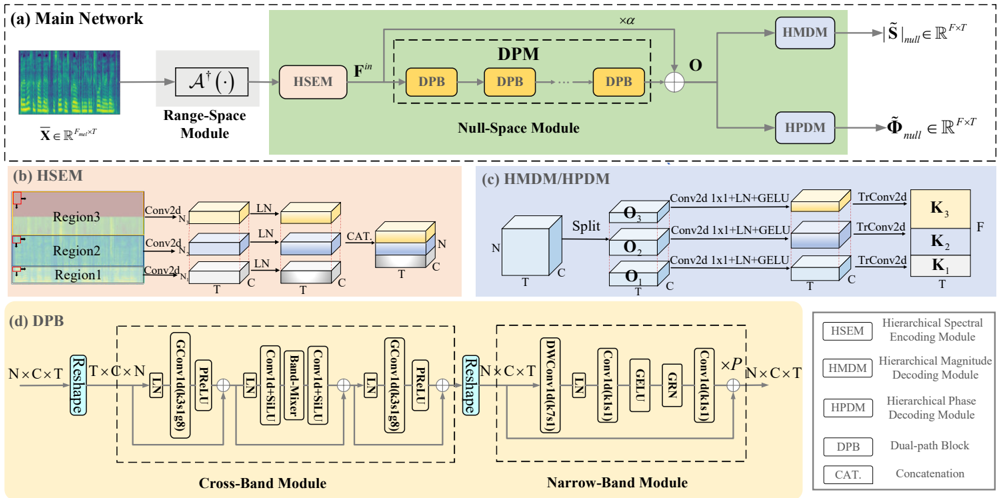
Training uses a multi-component reconstruction loss covering log-amplitude, phase, real-imaginary, mel-consistency, and a newly proposed omnidirectional phase loss that computes phase differentials across all eight neighbouring T-F bins simultaneously via fixed 3x3 convolutional kernels, replacing the sparser anti-wrapping formulations in prior work. Adversarial training uses a multi-period discriminator (MPD) and a multi-resolution spectrogram discriminator (MRSD) with hinge GAN loss. The full model has 3.14M parameters; lightweight variants (RNDVoC-Lite at 0.71M and RNDVoC-UltraLite at 0.08M) are obtained by reducing the DPB count and channel dimensions.
Key Results
On LJSpeech (Table 1), RNDVoC (3.14M parameters, 34.1 GMACs per 5 seconds) achieves PESQ 3.987, surpassing all other T-F domain baselines and matching BigVGAN (112M, 417 GMACs) in M-STFT and periodicity RMSE, at 14.96x real-time speed on CPU. On LibriTTS (Table 2), RNDVoC reaches PESQ 4.226, exceeding BigVGAN trained for 1M steps (4.027) and remaining competitive with BigVGAN trained for 5M steps (4.269). In the MUSHRA listening test on LibriTTS (Table 3), RNDVoC scores 80.74 versus BigVGAN’s 79.33, a statistically significant difference (p < 0.05).
The ultra-lightweight RNDVoC-UltraLite (0.08M parameters) achieves PESQ 3.264 on LJSpeech and 3.499 on LibriTTS, substantially outperforming HiFiGAN-V2 (0.92M) at PESQ 2.848 and 2.308 respectively (Table 5), with only 1.66 GMACs per 5 seconds.
Ablation studies (Table 4) confirm that both the RND decomposition itself and the fixed (non-learnable) mel pseudo-inverse matrices contribute materially: removing the RND mode degrades PESQ from 3.987 to 3.655 and causes near-complete pitch tracking failure (V/UV F1 drops from 0.9714 to 0.1114 in the ablation numbered id3), and making A and A† learnable produces a similar collapse of performance, as the orthogonality constraint is no longer enforced.
Novelty Assessment
The core novelty is the application of range-null space decomposition theory to vocoder design. The decomposition itself is a known signal processing concept, but its mapping onto the mel-to-linear-spectrum reconstruction problem and the resulting architectural split between a fixed linear component and a learnable residual network is a genuine conceptual contribution. The paper explicitly differentiates from FreeV (Lv et al., 2024), which also uses pseudo-inverse mel filtering but treats it as a heuristic trick rather than grounding it in RND theory or enforcing the orthogonality property that the paper shows to be important.
The omnidirectional phase loss is an incremental but practical improvement over prior anti-wrapping phase losses; it extends phase differential computation from two directions to eight without adding learnable parameters, using fixed convolutional kernels.
The dual-path spectral architecture and the hierarchical frequency-region encoding draw on established sub-band modeling patterns from audio processing (notably band-split RNN and ConvNext-based vocoders), combined rather than invented. The primary claim of the paper is efficiency: achieving competitive quality at 2.8% of BigVGAN’s parameter count is a meaningful engineering result that the ablation study supports mechanistically.
Field Significance
Moderate — RNDVoC provides a principled explanation for why pseudo-inverse mel projection helps quality in T-F domain vocoders, converting an empirical observation in FreeV into a theoretically motivated framework. The ultra-lightweight variant (0.08M parameters) may be practically relevant for edge-device deployment. The paper does not change the dominant paradigm (GAN-based T-F vocoders) but advances the Pareto frontier of quality versus parameter count within it.
Claims
-
supports: Explicit incorporation of known linear degradation structure (the mel filterbank) into vocoder design reduces the learning burden on the neural component and improves parameter efficiency.
Evidence: Removing the RND decomposition and replacing it with direct black-box mel-to-spectrum mapping (ablation id3 vs. id1) degrades PESQ from 3.987 to 3.655 and causes near-total pitch tracking failure on LJSpeech. (§4.3, Table 4)
-
supports: Enforcing orthogonality between range-space and null-space components in T-F vocoder design is important; making the decomposition matrices learnable degrades reconstruction quality.
Evidence: Setting A and A† as learnable (ablation id4) degrades PESQ from 3.987 to 3.645 and V/UV F1 from 0.9714 to 0.1164 on LJSpeech, indicating that the learned matrices no longer maintain the orthogonality property. (§4.3, Table 4, Figure 6)
-
supports: T-F domain vocoders can close the quality gap with large-scale time-domain GAN vocoders while remaining substantially more parameter-efficient and faster on CPU.
Evidence: RNDVoC (3.14M parameters) achieves PESQ 4.226 and MUSHRA 80.74 on LibriTTS, matching or exceeding BigVGAN (112M parameters, PESQ 4.027, MUSHRA 79.33) trained for 1M steps, while running at nearly 10x real-time speed on CPU. (§4.3, Tables 1, 2, 3)
-
complicates: The quality advantage of T-F domain vocoders over large-scale time-domain models depends on architectural choices for sub-band modeling; naive T-F vocoders remain inferior to well-tuned time-domain GAN vocoders at equivalent scale.
Evidence: Vocos (13.46M) achieves PESQ 3.522 on LJSpeech while BigVGAN (112M) reaches 4.107; only the proposed hierarchical sub-band design closes this gap at 3.14M parameters. (§4.3, Table 1)
-
supports: Extending phase loss to capture differential relations across all eight adjacent T-F bins improves objective vocoder metrics relative to sparse two-direction anti-wrapping losses.
Evidence: Replacing the proposed omnidirectional phase loss with the prior anti-wrapping formulation (ablation id2) reduces PESQ from 3.987 to 3.892 and MCD from 2.047 to 2.214 on LJSpeech. (§4.3, Table 4)
Limitations and Open Questions
The evaluation is restricted to single-speaker (LJSpeech) and multi-speaker clean-speech (LibriTTS) benchmarks. The paper includes an out-of-distribution spectral visualisation using a singing voice from MUSDB18, but no quantitative generalisation results are reported for singing, emotional speech, or noisy conditions. Whether the orthogonality-based framework degrades gracefully when the mel-filterbank prior is a poor match to the target signal (e.g., non-speech audio, very high-frequency content) is not examined. The MUSHRA listening test involves 35 participants drawn from an audio signal processing background, which may not reflect listener preferences in deployment scenarios with general audiences.
Wiki Connections
- GAN Vocoder — RNDVoC adopts GAN training with MPD and MRSD discriminators and positions itself within the T-F domain branch of GAN vocoder research, extending that branch with a physically motivated decomposition.
- Evaluation Metrics — the paper uses PESQ, MCD, periodicity RMSE, V/UV F1, pitch RMSE, and VISQOL as objective metrics, and MUSHRA as the subjective metric, providing a broad multi-metric comparison across time-domain and T-F domain baselines.
- Subjective Evaluation — MUSHRA listening tests with 35 audio-specialist participants are used to confirm that RNDVoC’s objective improvements over BigVGAN translate to statistically significant perceptual preference.