arXiv · 2025 · Preprint
Kun Xie et al. (Xiaohongshu) · → Paper · Demo: ✓ · Code: ?
FireRedTTS-2 introduces a streaming dual-transformer TTS system with a novel 12.5Hz speech tokenizer that enables sentence-by-sentence multi-speaker dialogue generation with context-aware prosody, suitable for both real-time interactive chat and offline podcast production.
Problem
Existing dialogue TTS systems have two fundamental shortcomings. First, they require the complete dialogue transcript before synthesis and produce a single inseparable mixed audio track containing all voices, making them incompatible with interactive chat where turns are generated incrementally. Second, they suffer from unstable synthesis over long sequences, inaccurate speaker transitions, and prosodic incoherence across turns. Approaches that naively chain monologue TTS systems ignore preceding speech context, losing conversational coherence. There was no open system that unified sentence-by-sentence streaming generation with robust multi-speaker turn management and context-driven prosody.
Method
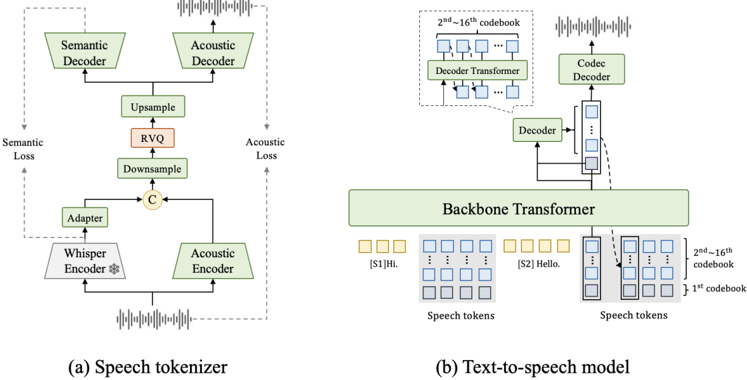
FireRedTTS-2 has two main components: a custom speech tokenizer and a dual-transformer text-to-speech model.
Speech tokenizer. Operating at 12.5Hz — half the frame rate of most open-source tokenizers — the tokenizer uses a pretrained Whisper encoder for semantic feature extraction, an acoustic encoder, 4× downsampling to 12.5Hz, and residual vector quantization (RVQ) with 16 layers of 2048 entries each. Crucially, the quantised features are passed through a semantic decoder that predicts the original Whisper features (explicit semantic supervision), stabilising text-to-token modelling over long sequences. A Vocos-based acoustic decoder reconstructs the waveform and is available in streaming or non-streaming variants. Training is two-stage: non-streaming acoustic decoder on 500k hours, then a frozen encoder with a fully streaming 24kHz decoder on 60k hours of high-fidelity speech.
Text-to-speech model. Input sequences interleave speaker-tagged text and corresponding speech tokens chronologically: [S1]<text><audio>[S2]<text><audio>.... A large backbone decoder-only transformer (Qwen2.5 architecture) predicts first-layer speech tokens; a smaller decoder transformer then predicts the remaining RVQ layers conditioned on both the predicted first-layer token and the backbone’s hidden states. This dual-transformer avoids the delay-pattern’s drawbacks (weak contextual conditioning, high first-packet latency) and achieves under 100ms first-packet latency. Three-stage curriculum training: pretraining on 1.1M hours monologue, post-training on 300k hours 2–5 speaker dialogue data, then task-specific SFT (e.g. 15h emotion corpus for chat, 50h podcast hosts for podcast fine-tuning).
Zero-shot voice cloning is performed by prepending a reference transcript and speech token sequence to the generation context, letting the model condition on the reference without any gradient updates.
Key Results
Speech tokenizer (LibriSpeech test-clean): achieves the best WER (2.16%) among systems with semantic injection, ranking first or second on SPK-SIM (0.87), STOI (0.94), and PESQ, at 12.5Hz — half the frame rate of competitors.
Voice cloning (SeedTTS-eval): CER 1.14% (Mandarin), WER 1.95% (English), closely matching the best published results of 1.12% and 1.83% respectively.
Podcast generation (dialogue-zh / dialogue-en, zero-shot): FireRedTTS-2 achieves the best results across all metrics — lowest CER/WER (2.08% / 3.16%), highest SPK-SIM (0.753 / 0.703), lowest MCD (7.99 / 9.06), and CMOS = 0 (reference, all competitors negative) vs. MoonCast, ZipVoice-Dialog, and MOSS-TTSD.
Podcast fine-tuned naturalness: 28% win + 28% even vs. ground truth recordings, meaning synthesis matches or surpasses human recordings in 56% of trials.
Emotion inference (interactive chat): 76.7–93.3% accuracy across 6 emotions (surprise, sadness, happiness, concern, apology, anger) inferred from implicit contextual cues without explicit emotion labels.
Novelty Assessment
The primary contributions are engineering and training-recipe: the 12.5Hz tokenizer with explicit semantic supervision is the key enabler for stable long-sequence modelling; the dual-transformer architecture is a targeted fix for the delay-pattern’s context and latency limitations. The text-speech interleaved format builds on prior work (cited as approach (3) by the authors), but FireRedTTS-2 is the first to demonstrate it at scale with high quality across monologue and multi-speaker dialogue. The implicit emotion inference from chat history is genuinely novel as a capability, though the mechanism (SFT on curated emotion corpus) is straightforward. Overall this is a strong engineering paper that advances the practical state of the art for conversational TTS rather than introducing a new architectural paradigm.
Field Significance
Tip
High — FireRedTTS-2 is the first system to demonstrate high-quality sentence-by-sentence multi-speaker dialogue generation with under-100ms first-packet latency, establishing a practical template for conversational TTS in both interactive and offline settings. The dual-transformer design provides a concrete architectural alternative to the delay-pattern that addresses its contextual conditioning and latency weaknesses. Its results on podcast generation and emotion inference from implicit context advance the frontier for spoken conversational agents.
Claims
- Reducing speech tokenizer frame rate to 12.5Hz with explicit semantic supervision produces tokens that enable more stable text-to-token modelling over long dialogue sequences than higher-rate tokenizers without semantic injection. (§2.1, §4.1, Table 1)
- A dual-transformer architecture for multi-layer RVQ prediction achieves lower first-packet latency than the delay-pattern while providing stronger contextual conditioning from prior turns. (§2.2)
- Autoregressive TTS systems trained on multi-speaker dialogue data with text-speech interleaved formatting can infer and adjust prosody and emotion from implicit conversational context without explicit emotion labels. (§3.2, §4.3, Table 3)
- Sentence-by-sentence multi-speaker dialogue TTS systems produce more coherent prosody across turns than approaches that concatenate monologue TTS outputs or model a mixed audio track. (§4.4, Table 4)
- Fine-tuning a post-trained dialogue TTS model on as little as 50 hours of speaker-specific data is sufficient to produce synthesis that is perceptually indistinguishable from human recordings in a majority of trials. (§4.4, Figure 4)
Limitations and Open Questions
- Currently limited to 3-minute dialogues with up to 4 speakers; scaling requires extending training corpus.
- English speaker similarity (SIM 0.665) lags Mandarin (0.736), attributed to limited English voice diversity in training data — a data rather than architectural limitation.
- Trails Mimi on PESQ metrics, likely because Mimi was trained on a massive English-only corpus closely matching LibriSpeech.
- Emotion fine-tuning is demonstrated for a single distinctive female voice; generalisation to arbitrary voices and more nuanced emotional transitions is not evaluated.
- No ablation of the semantic supervision contribution vs. the lower frame rate independently.
Wiki Connections
FireRedTTS-2 is a representative of the autoregressive-codec-tts paradigm applied to multi-speaker dialogue, advancing it beyond monologue settings. Its custom tokenizer is a contribution to the neural-codec space, specifically targeting low frame rate with semantic injection. The streaming dual-transformer architecture and <100ms first-packet latency connect directly to streaming-tts. The chat integration mode positions it as a spoken-language-model component. The zero-shot voice cloning evaluation on SeedTTS-eval benchmarks it against zero-shot-tts systems. Implicit emotion inference from context links to emotion-synthesis.
The in-corpus paper ZipVoice-Dialog is a direct competitor evaluated in the podcast generation experiments; FireRedTTS-2 outperforms it on all dialogue-en metrics. Back-linked by MOSS-TTS Technical Report, which cites FireRedTTS-2 as a large-scale AR codec TTS baseline for comparison.