arXiv · 2025 · Preprint
Jiaqi Li et al. (CUHK-Shenzhen / Microsoft) · → Paper · Demo: ✓ · Code: ✓
FlexiCodec is a neural audio codec that pushes semantic token preservation to sub-10 Hz frame rates by using a frozen ASR encoder to guide dynamic adaptive frame merging, achieving 4.15% RVQ-1 WER at 6.25 Hz average frame rate — 7.6x better than a retrained DualCodec baseline. Accepted to ICLR 2026.
Problem
Speech language models and autoregressive TTS systems incur quadratic attention cost proportional to sequence length. Standard codecs (EnCodec 75 Hz, DAC 75 Hz, SpeechTokenizer 50 Hz) produce sequences 10–15× longer than corresponding text. Low-frame-rate alternatives have stagnated around 12.5 Hz (Mimi, DualCodec). Pushing below 12.5 Hz with naive encoder stride increases causes severe semantic degradation: DualCodec retrained to 6.25 Hz reaches 31.5% WER on RVQ-1 reconstruction (vs. 2.1% ground-truth), losing phonetic detail in fixed-resolution downsampling. Two root causes are identified: (1) fixed downsampling discards transient phonetic details equally regardless of content, and (2) SSL features used for semantic distillation retain leaked acoustic/paralinguistic information that prevents effective frame merging.
Method
FlexiCodec uses a dual-stream architecture followed by dynamic frame merging, quantization, and frame unmerging decoding.
Dual-Stream Feature Extraction. Two parallel encoders process 16 kHz waveforms at 12.5 Hz:
- An ASR stream uses a frozen pre-trained SenseVoice-Small (230M, encoder-only Transformer, trained on 300 k hours with CTC loss) to produce semantic features e_s.
- A convolutional codec encoder (CNN blocks with strides [4,4,5,8,2]) produces acoustic features e_a.
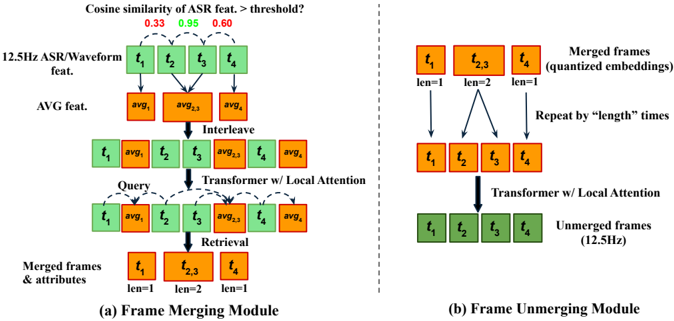
Dynamic Frame Merging Module. ASR cosine similarity between adjacent 12.5 Hz frames guides adaptive merging: contiguous frames with pairwise similarity > threshold τ are averaged into a single merged frame, recording their group length ℓ_k. A local-windowed-attention Transformer refines the merged sequence. At training, τ is sampled uniformly from [0.7, 1.0], enabling the model to learn across a range of frame rates. At τ = 1.0, no merging occurs (12.5 Hz); lower τ produces lower average rates down to 3 Hz.
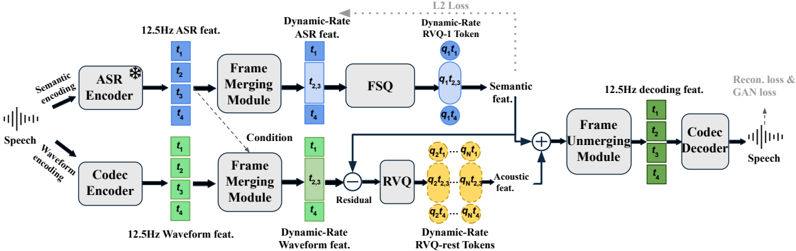
Semantic Quantization (RVQ-1). Finite Scalar Quantization (FSQ) with D=5 dimensions at L=8 levels (32,768 codebook entries) quantizes the compressed ASR features into RVQ-1 semantic tokens with an L2 feature alignment loss.
Acoustic Quantization (RVQ-rest). A residual (waveform features minus ASR features) is quantized by 24-layer RVQ (4,096 entries per layer) to encode fine acoustic detail.
Frame Unmerging and Reconstruction. Frame length attributes expand the merged sequence back to 12.5 Hz; another local-attention Transformer smooths transitions; a mirrored CNN decoder synthesizes waveform.
Training uses 216M parameters on 54 k hours (Librilight-Large), 8 × V100 32 GB GPUs, 800 k steps, with composite loss: multi-scale L1 mel reconstruction + GAN (MPD + MRSD) + RVQ codebook + L2 semantic feature alignment.
FlexiCodec-TTS integrates the codec into an AR (250M, predicts RVQ-1 + frame lengths with two heads) + NAR (300M, CosyVoice-inspired conditional flow matching at 50 Hz mel or 12.5 Hz codec features) framework, trained on 50 k hours (Libriheavy).
Key Results
Codec evaluation (LibriSpeech test-clean):
At 6.25 Hz average frame rate, FlexiCodec achieves RVQ-1 WER of 4.15% vs. DualCodec 31.5% and DAC ~70%+. This is the first codec to reach near-ground-truth semantic preservation (2.1% GT) at below 10 Hz without requiring text transcription.
Across bitrate tiers, FlexiCodec at each rate outperforms or matches same-bitrate baselines on PESQ, UTMOS, and SIM while substantially improving WER(RVQ-1).
Dynamic frame rate ablation: replacing dynamic merging with fixed-stride encoding at 6.25 Hz increases RVQ-1 WER by a relative 26% (4.15 → 5.22) and ASR-probing WER by 21%.
ASR vs. SSL features ablation: switching to w2v-bert-2 SSL features (DualCodec’s choice) causes WER to jump from 4.15 to 27.3 at 6.25 Hz, confirming ASR features are the key enabler.
TTS evaluation (FlexiCodec-TTS with 50 Hz NAR, Librispeech-PC-test-clean):
At 6.25 Hz AR: WER 3.2%, SIM-o 0.65, NMOS 3.32, QMOS 3.40 — competitive with CosyVoice (WER 3.2%, NMOS 3.17). AR RTF is 0.07, representing a 7.3× speedup over CosyVoice’s AR stage. Full system RTF is 0.18 (vs. 0.62 for CosyVoice).
Key finding: lower AR frame rate does not degrade TTS performance — 8.3 Hz and 6.25 Hz AR achieve equal or better WER/SIM-o than 12.5 Hz AR. Higher NAR frame rate (50 Hz mel > 12.5 Hz FlexiCodec features) is important for naturalness.
Phoneme-rate correlation on TIMIT: Pearson r = 0.775 between utterance phoneme rate and FlexiCodec dynamic frame rate, confirming the token boundary adapts to phonetic complexity.
Novelty Assessment
The primary technical novelty is the ASR-feature-guided dynamic frame merging in the low-frame-rate (3–12.5 Hz) regime, combined with controllable inference-time frame rate from a single model. The choice of ASR features over SSL features for semantic decoupling (confirmed by substantial ablation evidence) is a clear and well-supported finding. The Transformer-based frame merging and unmerging modules add incremental benefit. The overall system is a meaningful advance over Mimi and DualCodec: it achieves semantically richer tokens at lower frame rates without requiring text transcription. Accepted to ICLR 2026.
Field Significance
Tip
High — FlexiCodec provides the first practical solution for sub-10 Hz codec tokens that preserve phonetic detail without requiring text transcriptions, removing a longstanding barrier to efficient speech LM training. Its finding that ASR-derived features are decisively superior to SSL features for dynamic frame merging is a concrete, actionable design principle for low-frame-rate codec development. The demonstration that 6.25 Hz AR tokens achieve competitive TTS quality with 7.3× AR speedup strengthens the case for low-frame-rate codecs as the backbone of next-generation speech generation systems.
Claims
- ASR-derived semantic features enable substantially better phonetic preservation at very low codec frame rates than SSL-derived features. (§4.2, Table 5, Appendix D)
- Dynamic frame rate allocation, guided by semantic similarity, improves codec semantic preservation compared to fixed low-frame-rate downsampling by adapting token density to phonetic complexity. (§4.3, Tables 3–4)
- Dynamic codec frame rate correlates strongly with phoneme rate, with the merging boundary approximating syllabic units for typical speech. (§4.3, Figure 4)
- Reducing the AR codec token rate in TTS does not necessarily degrade output quality, and can yield large speedups, provided the NAR stage decodes at sufficient temporal resolution. (Appendix B.2, Table 6)
- Codec RVQ-1 semantic token quality, as measured by reconstruction WER, degrades sharply below 12.5 Hz for SSL-augmented codecs using fixed-rate downsampling. (§4.2, Figure 3)
Limitations and Open Questions
- The codec is trained on English audiobook speech (LibriLight-Large); semantic tokens fail on unseen languages without fine-tuning (multilingual WER(RVQ1) ~100% for Chinese/Korean). The acoustic stream generalizes better.
- Maximum segment length ℓ_k is capped at 8 frames; very long silence regions or unusually slow speech may hit this cap.
- The 216M parameter footprint is larger than simpler codecs (DAC 74M, Mimi 78M), though encoding RTF remains practical (0.018).
- The paper does not address streaming/causal operation; the dual-stream encoder and dynamic merging require full-segment processing.
- TTS subjective evaluations use only 6 expert listeners per system — a limited sample for establishing statistical significance.
Wiki Connections
This paper is a direct contribution to neural-codec, establishing a new state of the art for low-frame-rate semantic preservation. It is highly relevant to autoregressive-codec-tts because low-frame-rate tokens directly reduce AR model computational cost; the finding that 6.25 Hz AR performs comparably to 12.5 Hz is actionable for VALL-E-family systems. The paper connects to spoken-language-model because efficient codec tokens are foundational for audio LLMs. The hierarchical RVQ disentanglement strategy (semantic RVQ-1 vs. acoustic RVQ-rest) relates to disentanglement. In-corpus references include Why SLMs Fail (Wang et al. on SLM coherence failures, which motivates the need for lower-rate semantic tokens) and TaDiCodec (a concurrent 6.25 Hz codec that requires text transcription, which FlexiCodec explicitly addresses).