arXiv · 2025 · Preprint
Zhu Li et al. (University of Groningen) · → Paper · Demo: ? · Code: ?
Uses a speech synthesis testbed to isolate the independent and combined contributions of semantic and prosodic cues to listeners’ perception of sarcasm, conditioning a VITS-based TTS system on LoRA-adapted LLM embeddings and retrieval-augmented prosodic exemplars.
Problem
Sarcasm is a pragmatic phenomenon that frequently lacks explicit lexical markers, so its recognition depends on an interaction between semantic incongruity and prosodic delivery (exaggerated intonation, emphatic stress, lengthened syllables). Corpus-based and behavioral studies of sarcasm struggle to disentangle these two cue types because they are naturally entangled in spontaneous speech and cannot easily be varied independently as controlled stimuli. Expressive TTS research has meanwhile concentrated on broad emotion categories (happiness, anger, sadness); more subtle pragmatic phenomena such as sarcasm remain largely unaddressed, and the few prior attempts to manipulate acoustic correlates of sarcasm directly have been limited by the scarcity of annotated sarcastic speech corpora. The paper’s goal is to use speech synthesis itself as an experimental testbed in which semantic and prosodic information can be independently and jointly manipulated to study their respective and combined contributions to sarcasm perception.
Method
The framework has two conditioning branches feeding a VITS-based synthesizer. For the semantic branch, a LLaMA 3-8B model is adapted with Low-Rank Adaptation (LoRA) on a binary-labeled sarcasm headline dataset, producing token-level “sarcasm-aware” semantic embeddings from the final transformer layer of the fine-tuned model. For the prosodic branch, the same LoRA-adapted encoder’s embedding of the input text is used as a retrieval query against an index of sarcastic utterances built from 80% of the sarcastic samples in MUStARD++ (a multimodal sarcasm corpus drawn from sitcom dialogue); the top-K (K=3) most semantically similar utterances are retrieved by cosine similarity and each is encoded with a frozen WavLM model, pooled into a fixed-length prosody embedding.
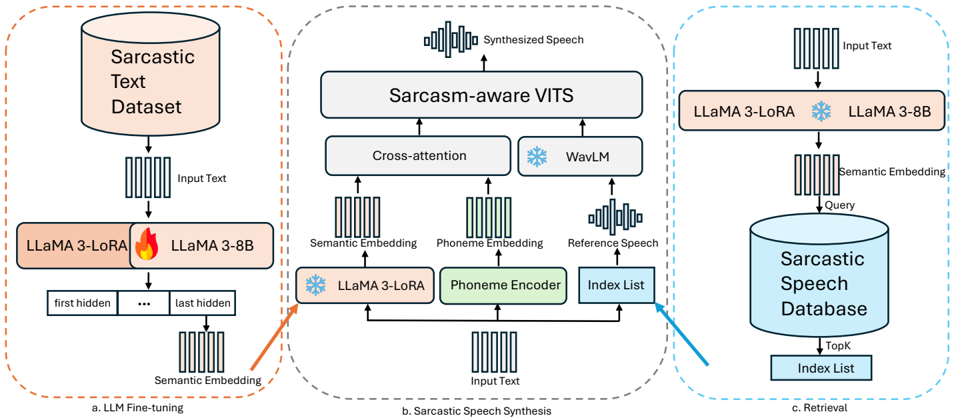
The two conditioning signals are fused inside a VITS backbone (pre-trained on the HiFi-TTS corpus via the Amphion toolkit): phoneme embeddings act as the query in a cross-attention module against the semantic embeddings (key/value), and the resulting phoneme-aligned semantic encoding is then additively combined with a learned linear projection of the summed retrieved prosody embeddings before being passed to the VITS decoder. This yields hidden states jointly conditioned on phonemes, sarcasm-aware semantics, and retrieved prosodic exemplars. The system is evaluated under six conditions: a neutral baseline, semantic-only conditioning with three different text encoders (BERT, untuned LLaMA 3, LoRA-tuned LLaMA 3), prosody-only conditioning (RAG exemplars alone), and the combined semantic+prosody system.
Key Results
On a text-only sarcasm detection probe used to motivate the choice of semantic encoder, LoRA-fine-tuned LLaMA 3 embeddings reach 72.5% F1 versus 67.7% for the original MUStARD++ text baseline, 66.8% for BERT, and 65.5% for untuned LLaMA 3 (Table 1), showing that general-purpose LLM embeddings alone do not capture sarcasm-relevant cues without task-specific adaptation.
For synthesized speech, the combined semantic+prosody system achieves the lowest mel-cepstral distortion among all conditioned systems (9.8 MCD, tied with the unconditioned baseline) and the highest downstream sarcasm-detection F1 from synthesized audio (62.5%, versus 59.9% for the baseline and 60.6% for semantic-only LoRA), while low-level acoustic metrics (MCD, pitch RMSE, energy RMSE) stay roughly flat across all six conditions (Table 2). In a 30-listener perceptual study (8 sentences × 6 systems + ground truth), untuned LLaMA 3 conditioning actively hurt both naturalness (2.0±0.1 NMOS) and perceived sarcasm (2.6±0.2 SMOS) relative to baseline (2.6±0.1 NMOS, 3.2±0.2 SMOS), whereas LoRA-tuned semantic conditioning raised SMOS to 3.8±0.2 without harming naturalness, and RAG prosody conditioning alone raised SMOS to 3.7±0.2; the combined system matched the best individual-cue SMOS (3.8±0.2) at the least-reduced naturalness of the three conditioned systems (2.7±0.1 NMOS). No condition approaches the ground-truth recordings’ SMOS of 4.5±0.2, indicating a sizeable gap between synthesized and natural sarcastic delivery remains.
Novelty Assessment
The individual components (VITS, LoRA-adapted LLMs, WavLM prosody encoding, retrieval-augmented conditioning) are all established techniques; the paper’s contribution is an architectural integration that has not previously been assembled for this purpose: a cross-attention fusion of LoRA-adapted sarcasm-aware semantic embeddings with retrieval-based prosodic exemplars inside a VITS decoder. The retrieval mechanism itself is a meaningful design choice over prior reference-audio style-transfer approaches, since it removes the need for a manually selected reference utterance by automatically retrieving semantically aligned exemplars from a database. The perceptual evaluation is comparatively small in scale (30 listeners, 8 sentences per system, English-only, single conversational corpus), so the numeric gains should be read as a controlled demonstration rather than a robust effect size. The framing of speech synthesis as a scientific instrument for isolating semantic-prosodic interaction in sarcasm perception is itself a conceptual contribution, distinct from the architecture.
Field Significance
Moderate — this paper opens sarcasm as a distinct target for controllable, pragmatics-aware speech synthesis, extending expressive TTS work beyond coarse emotion categories, and demonstrates a concrete retrieval-augmented conditioning mechanism as an alternative to manually selected style-reference audio. The evaluation is limited to one language, one conversational speech corpus, and a small listener panel, so its evidence is best read as an initial demonstration rather than an established result.
Claims
- supports: Retrieval-augmented conditioning on real reference exemplars can substitute for a single manually chosen style-reference utterance in expressive speech synthesis, without a loss in perceived naturalness.
Evidence: Prosody-only conditioning using the top-3 retrieved sarcastic exemplars (WavLM-encoded) raised sarcasm MOS from 3.2±0.2 (baseline) to 3.7±0.2 while naturalness MOS stayed flat at 2.6±0.1. (§Sarcastic Speech Synthesis Results, Table 2)
- supports: Task-specific fine-tuning of a general-purpose LLM is necessary to make its embeddings useful for conditioning expressive speech synthesis; the pretrained embeddings alone are not sufficient and can be actively harmful.
Evidence: Conditioning on untuned LLaMA 3 embeddings degraded both naturalness (2.0±0.1 NMOS, versus 2.6±0.1 for baseline) and perceived sarcasm (2.6±0.2 SMOS, versus 3.2±0.2 for baseline), while the same LLaMA 3 backbone after LoRA fine-tuning raised sarcasm MOS to 3.8±0.2 with naturalness restored to 2.6±0.1. (§Sarcastic Speech Synthesis Results, Table 2)
- supports: Semantic and prosodic cues make complementary, non-redundant contributions to a pragmatic speech phenomenon, and combining them yields effects that neither cue produces alone.
Evidence: The combined LoRA+RAG condition achieved the highest downstream sarcasm-detection F1 from synthesized audio (62.5%) among all six tested conditions and the lowest acoustic distortion (9.8 MCD), while matching the best single-cue SMOS (3.8±0.2) at improved naturalness (2.7±0.1 NMOS) relative to either cue alone. (§Sarcastic Speech Synthesis Results, Table 2)
- complicates: Low-level acoustic fidelity metrics can fail to reflect meaningful differences in a system’s ability to convey pragmatic or paralinguistic intent, so they should not be used as proxies for expressivity.
Evidence: MCD, pitch RMSE, and energy RMSE remained nearly identical across all six conditions (MCD ranging 9.6-10.4) even though sarcasm detection F1 varied from 59.0% to 62.5% and SMOS varied from 2.6±0.2 to 3.8±0.2 across the same conditions. (§Sarcastic Speech Synthesis Results)
Limitations and Open Questions
Warning
The perceptual evaluation involved only 30 listeners rating 8 sentences per system across six systems plus ground truth, in a single language (English), drawn entirely from one sitcom-derived conversational corpus (MUStARD++). No statistical significance testing across conditions is reported, and no synthesized condition approaches the sarcasm MOS of ground-truth recordings (4.5±0.2 versus 3.8±0.2 best synthesized), leaving a substantial and unquantified perceptual gap.
The framework has only been demonstrated for sarcasm and has not been tested on other pragmatic phenomena (humor, irony, understatement) that the authors themselves identify as natural extensions. The retrieval database and LoRA fine-tuning both depend on the scarce, English-only MUStARD++ and News Headlines Sarcasm datasets, so generalization to other languages, domains, or naturally occurring (non-scripted) sarcastic speech is untested. The paper also does not report inference latency or computational overhead introduced by the retrieval step relative to a standard VITS pipeline.
Wiki Connections
- Emotion Synthesis — extends expressive speech synthesis beyond coarse emotion categories (happiness, anger, sadness) to the more subtle pragmatic phenomenon of sarcasm.
- Prosody Control — introduces a retrieval-augmented mechanism that conditions the decoder on prosodic exemplars retrieved from a reference database, rather than a single hand-picked reference utterance or explicit pitch/duration controls.
- Self-Supervised Speech — uses a frozen WavLM encoder as a core component to extract prosody embeddings from retrieved reference utterances.
- Subjective Evaluation — validates its synthesis conditions with a 30-listener MOS study measuring both naturalness and perceived sarcasm expressivity.
- Evaluation Metrics — combines acoustic fidelity metrics (MCD, pitch RMSE, energy RMSE), a downstream sarcasm-detection F1 probe, and subjective MOS/SMOS to triangulate expressivity.
- Integrating Feedback Loss from Bi-modal Sarcasm Detector — builds on this same research group’s prior sarcastic speech synthesis system, replacing its bi-modal detector feedback loss with LoRA-adapted semantic conditioning plus retrieval-augmented prosodic exemplars.