arXiv · 2025 · Preprint
Haowei Lou et al. (University of New South Wales) · → Paper · Demo: ✓ · Code: ✓
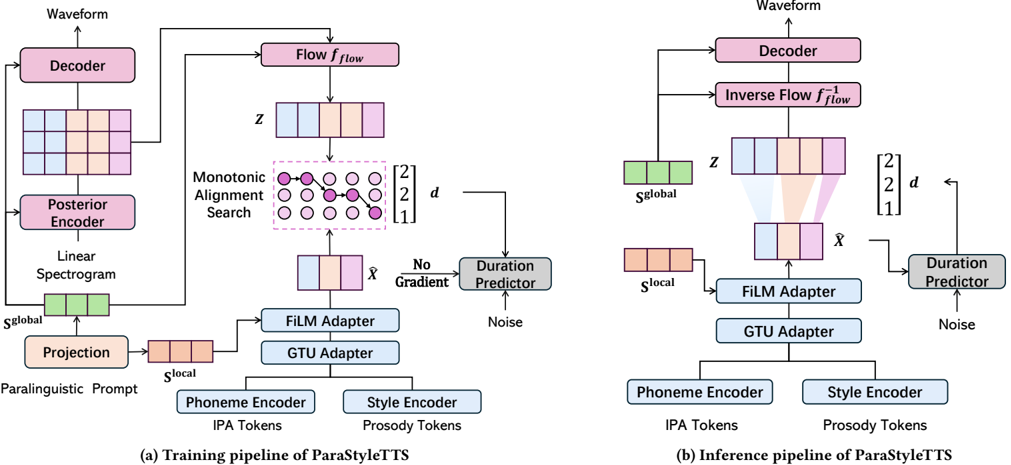
ParaStyleTTS separates prosodic and paralinguistic style control into two distinct adapters within an end-to-end VITS-style TTS model, matching an LLM-based baseline’s expressiveness at roughly 30x lower inference latency.
Problem
Reference-audio-based style control raises privacy and accessibility concerns, and recent LLM-based text-prompted alternatives (e.g., CosyVoice) fuse style and content implicitly inside an autoregressive language model. This entangled, black-box fusion is computationally expensive, hard to interpret, and sensitive to prompt phrasing: the paper shows CosyVoice can flip a described gender or misapply an emotion when the prompt wording changes slightly. Prior phoneme-level style-token approaches (StyleSpeech, LanStyleTTS) control prosody but have no mechanism for sentence-level paralinguistic attributes such as emotion, age, or gender.
Method
ParaStyleTTS extends a VITS-style end-to-end architecture (transformer token encoder, monotonic-alignment-search duration modeling, normalizing-flow-based VAE latent, adversarial waveform decoder) with a two-level style adaptation mechanism that keeps prosodic and paralinguistic control separate and explicit. Phoneme-level prosody (stress in English, tone in Chinese) is extracted via IPA-based tokenization and injected into phoneme embeddings through a Gated Tanh Unit (GTU) fusion. Sentence-level paralinguistic style (age, gender, emotion, accent) is derived by encoding a natural-language descriptive prompt (e.g., “A young female is speaking English with happy emotion”) with a pre-trained MPNet text encoder, then projected into phoneme-level (local) and sentence-level (global) embeddings; the local embedding modulates phoneme representations via Feature-wise Linear Modulation (FiLM), while the global embedding conditions the VAE’s posterior and prior distributions and the waveform decoder throughout generation. The whole model is trained end-to-end with VITS’s combination of reconstruction, adversarial, feature-matching, KL-divergence, and stochastic-duration-predictor losses, on a composite 86k-sample, 108-hour English/Chinese corpus (Baker, LJSpeech, ESD, and captioned Genshin Impact voice data). At inference, the MPNet prompt encoder can be decoupled and its output cached, shrinking the runtime model to 52M parameters. The authors also give a complexity argument: encoding phoneme and style-prompt sequences separately costs O(N² + M²), versus O((N+M)²) for LLM-based approaches that concatenate content and style tokens into one sequence.
Key Results
On a standardized 1,120-sentence intelligibility set (720 Harvard Sentences, 400 TMNews Mandarin sentences), ParaStyleTTS reaches 15.29% WER, I-MOS 4.65, and N-MOS 4.36, close to but slightly behind CosyVoice (10.30% WER, I-MOS 4.75, N-MOS 4.57) and ahead of Spark-TTS and the non-LLM baselines (Table 2). On paralinguistic controllability, ParaStyleTTS beats CosyVoice on every axis tested via automatic classifiers: emotion accuracy 54.00% vs. 47.50%, gender accuracy 100.00% vs. 75.00%, age accuracy 57.50% vs. 21.88% (Table 3). A prompt-phrasing robustness test using ten semantically equivalent gender phrasings shows CosyVoice misclassifying 5 of 10 male-prompted samples as female, while ParaStyleTTS maintains 100%/100% male/female separation across phrasings (Table 6, §5.4). On resource usage (single RTX 3060 Ti, ~2s clips), ParaStyleTTS uses 52.51M parameters, 121.2ms inference, and 763MB CUDA memory without the prompt encoder, versus CosyVoice’s 436.05M parameters, 4076.1ms, and 1852MB, and Spark-TTS’s 506.63M parameters and 7999ms (Table 4) — the source of the paper’s headline 30x/8x/2.5x efficiency claims.
Novelty Assessment
The architectural contribution is a targeted extension rather than a new paradigm: the backbone is VITS, the phoneme-level GTU fusion is carried over directly from the authors’ own prior work (LanStyleTTS), and the new element is the FiLM-based paralinguistic adapter plus the explicit two-level (phoneme vs. sentence) separation of prosody from paralinguistic style. The efficiency gains are real and substantial, but they largely follow from choosing a non-autoregressive, non-LLM design rather than from a novel mechanism — any comparably sized non-LLM TTS model would likely show similar speed and memory advantages over an LLM-based system. The robustness-to-prompt-phrasing result is the paper’s most distinctive empirical finding, since it directly demonstrates a failure mode (entangled semantic-to-acoustic mapping) that is plausible but not usually quantified in prior LLM-style-control papers. Evaluation classifiers for age and gender are trained by the authors themselves on their own data, so the accuracy comparisons are not against an independent, externally validated benchmark.
Field Significance
Moderate — the paper provides a concrete, quantified illustration of a robustness/interpretability-versus-flexibility trade-off between explicit acoustic-centric style adapters and implicit LLM-mediated style fusion, and demonstrates that a non-autoregressive design can match an LLM-based baseline’s perceptual quality while controlling paralinguistic attributes more reliably. Its contribution is incremental relative to the authors’ own prior VITS-style style-adapter line of work rather than a new architectural family.
Claims
- supports: Explicit, disentangled conditioning mechanisms for prosodic versus paralinguistic style can match the perceptual quality of LLM-mediated style fusion while substantially reducing model size and inference cost.
Evidence: ParaStyleTTS reaches I-MOS 4.65 / N-MOS 4.36 versus CosyVoice’s I-MOS 4.75 / N-MOS 4.57, while using 8x fewer parameters (52.51M vs. 436.05M), running 30x faster (121.2ms vs. 4076.1ms), and needing 2.5x less CUDA memory (763MB vs. 1852MB). (§5.1, §5.3, Table 2, Table 4)
- supports: Acoustic-centric conditioning that directly grounds text-prompt embeddings in latent speech features produces more robust style control under paraphrased prompts than approaches that route style through an autoregressive language model’s semantic interpretation.
Evidence: Under ten semantically equivalent gender-describing prompt variants, ParaStyleTTS preserves 100%/100% male/female classification accuracy while CosyVoice misclassifies 5 of 10 male-prompted samples as female. (§5.4, Table 6, Figure 3)
- complicates: Text-prompt-conditioned paralinguistic style control trained on synthetic or category-based captions can still underperform LLM-based systems on raw intelligibility and naturalness, even when it outperforms them on style controllability.
Evidence: ParaStyleTTS trails CosyVoice on both WER (15.29% vs. 10.30%) and MOS (I-MOS 4.65 vs. 4.75; N-MOS 4.36 vs. 4.57) despite winning on all three paralinguistic-controllability metrics. (§5.1, §7, Table 2)
- refines: Fine-grained per-class evaluation of paralinguistic attribute control (rather than aggregate accuracy alone) reveals that emotion classes with overlapping acoustic correlates, such as happiness and surprise, are systematically harder to disentangle than classes with more distinct acoustic signatures.
Evidence: t-SNE visualization of emotion embeddings shows clear cluster separation for sad, neutral, and angry, but noticeable overlap between happy and surprise, attributed to both sharing elevated pitch, faster speech rate, and high energy. (§5.2, Figure 2)
Limitations and Open Questions
Warning
The training and evaluation corpus is limited to two languages (English, Chinese), 38 speakers, and only three paralinguistic style dimensions (emotion, age, gender); style-classifier evaluation is performed with the authors’ own custom CLAP-based age/gender classifier rather than an independently validated benchmark.
The authors acknowledge that ParaStyleTTS still trails CosyVoice on overall intelligibility and subjective naturalness, and note the model currently supports only three paralinguistic style categories, with extension to personality, tone, and energy left to future work (§7). Robustness testing is limited to a single proxy attribute (gender) with ten hand-written phrasing variants; whether the robustness advantage generalizes to other attributes (emotion, age) or to open-ended, unconstrained prompts is not directly tested.
Wiki Connections
- Emotion Synthesis — introduces a sentence-level FiLM-conditioned paralinguistic adapter that controls emotion, gender, and age from text prompts without reference audio.
- Prosody Control — separates phoneme-level prosodic control (stress, tone) via a Gated Tanh Unit adapter from sentence-level paralinguistic control, keeping the two mechanisms explicit and independently trainable.
- Multilingual TTS — trains a single end-to-end model jointly on English and Chinese speech using a shared IPA phoneme inventory with language-specific stress and tone tokens.
- Instruction-Conditioned TTS — conditions generation on free-form natural-language descriptive prompts (e.g., age, gender, accent, emotion) encoded with a pre-trained text encoder, rather than categorical labels or reference audio.
- Disentanglement — explicitly separates prosodic style modeling (phoneme-level GTU fusion) from paralinguistic style modeling (sentence-level FiLM fusion) as two distinct adapters within the same architecture.
- CosyVoice — used throughout as the primary LLM-based baseline for speech quality, paralinguistic controllability, and prompt-robustness comparisons, and is directly critiqued for prompt-phrasing sensitivity.
- Spark-TTS — included as an additional LLM-based baseline for speech quality and resource-usage comparisons.
- emotion2vec — used as the pre-trained emotion recognition model to evaluate the perceptual separability of emotion styles in generated speech.
- FastSpeech 2 — cited as one of the earlier non-autoregressive TTS architectures that established the intelligibility-focused design lineage this work builds on.