arXiv · 2025 · Preprint
Teysir Baoueb et al. (Télécom Paris (LTCI) / Institut Polytechnique de Paris) · → Paper · Demo: ✓ · Code: ?
Improves the GLA-Grad diffusion vocoder by applying its Griffin-Lim phase correction only once, at a carefully chosen point in the reverse process, instead of iteratively, improving out-of-domain robustness while reducing inference cost.
Problem
Diffusion-based vocoders such as WaveGrad and DiffWave produce high-fidelity audio when the conditioning mel spectrogram matches the training distribution, but their reverse process struggles to jointly recover accurate phase and magnitude, and quality degrades when the conditioning diverges from what the model saw during training (mismatched speakers or recording conditions). Retraining-based fixes (FreGrad, PeriodGrad, PeriodWave, Cauchy Diffusion, SWave) address robustness or speed but require new training runs. The predecessor GLA-Grad addressed the out-of-domain robustness problem in a zero-shot, retraining-free way by folding the Griffin-Lim algorithm (GLA) into WaveGrad’s reverse diffusion process, but it must reinitialize and rerun GLA at every iteration of the correction stage, which adds computational overhead and, since GLA replaces the entire noisy iterate y_t rather than just its clean-signal estimate, introduces mismatches with the diffusion process’s own denoising assumptions.
Method
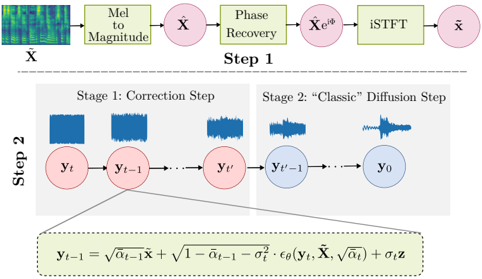
The system, GLA-Grad++, keeps the underlying WaveGrad DDPM-based vocoder unchanged: a mel-spectrogram-conditioned diffusion model trained with an L1 noise-prediction loss (Equation 5), sampled with the WG-6 noise schedule. The contribution is entirely in how phase information from the Griffin-Lim algorithm is used to guide the reverse process.
The mel spectrogram is first mapped to an estimated linear magnitude spectrogram via the pseudo-inverse of the mel filterbank. The Griffin-Lim algorithm is then run once, starting from a random phase, to recover a full time-domain signal x̃ before diffusion sampling begins; unlike GLA-Grad, which reinitializes GLA with the diffusion iterate’s phase at every step of the correction stage, GLA-Grad++ decouples GLA entirely from the diffusion process because the authors observe that in early, highly noisy diffusion steps the phase estimate has little influence on GLA’s convergence. Reverse diffusion sampling is reparameterized (following Song et al.’s DDIM formulation) so that each step separately combines a rescaled predicted-clean-signal term, a directional noise term, and a stochastic term (Equation 8). In a first stage covering the earliest diffusion steps, GLA-Grad++ substitutes x̃ directly for the predicted clean-signal term (predicted y_0) in this equation, rather than overwriting the entire noisy iterate y_t as GLA-Grad does; in a second stage, covering the remaining steps, it reverts to the unmodified diffusion update. The authors motivate the substitution choice by noting that both the predicted y_0 and the GLA-reconstructed x̃ share the same interpretation (“clean speech”), making the swap more consistent with the diffusion process than replacing the full iterate.
Key Results
On LJSpeech (single speaker) and VCTK (multi-speaker, held-out test speakers), GLA-Grad++ is compared against WaveGrad and GLA-Grad baselines using the default WG-6 schedule with a 3-step correction stage. On VCTK, the harder out-of-domain setting, GLA-Grad++ reaches PESQ 3.772 versus 3.453 for WaveGrad and 2.024 for GLA-Grad, and STOI 0.917 versus 0.907 and 0.858 respectively; WARP-Q is comparable to WaveGrad (1.443 vs. 1.439) and better than GLA-Grad’s 1.758. On LJSpeech the same ordering holds for PESQ (3.807 vs. 3.598 vs. 3.460) and STOI, with WARP-Q roughly tied across the three systems. GLA-Grad’s own VCTK numbers are markedly worse than WaveGrad’s, which the authors attribute to its per-step reinitialization of GLA’s phase from a possibly-poor current iterate; GLA-Grad++ avoids this by decoupling GLA from the diffusion trajectory entirely.
Oracle experiments (Table 1) that substitute either the ground-truth magnitude spectrogram or the ground-truth phase into the correction step show both improve over vanilla WaveGrad, with the phase substitution producing the larger gain on both datasets, supporting the paper’s premise that accurate phase, not just magnitude, is the binding constraint.
On inference speed (Table 3, relative to real time on a V100 GPU), GLA-Grad++ is faster than GLA-Grad (37.80 vs. 32.98 on LJSpeech, 35.43 vs. 31.25 on VCTK) because it invokes GLA only once rather than at every step of the correction stage, while remaining close to WaveGrad’s speed (42.02 / 39.53).
A sweep over how many diffusion steps use the corrected signal (Tables 4-5) shows the headline Table 2 setting (3 steps) is not actually optimal: PESQ peaks at 2 steps on both datasets, while WARP-Q is best when GLA alone is used (0 diffusion-corrected steps) and STOI is comparatively flat with a slight VCTK dip. A per-file analysis of the best PESQ timestep (Figure 2) shows the global optimum matches only about half of individual files, and no file ever prefers the plain WaveGrad setting (6 steps).
Novelty Assessment
The contribution is a targeted, training-free change to an existing inference-time correction technique, not a new architecture or training objective: the WaveGrad backbone, its training loss, and its noise schedule are all unchanged from prior work, and the Griffin-Lim algorithm itself is unmodified. What is new is (1) applying GLA once rather than iteratively, decoupling it from the diffusion trajectory, and (2) substituting the corrected signal into the predicted clean-signal term rather than the full noisy iterate, which the authors argue is more consistent with the diffusion process’s own semantics. This is a direct, single-paper-scope refinement of the authors’ own prior GLA-Grad model (ICASSP 2024) rather than a broadly new direction; its comparisons are limited to WaveGrad and GLA-Grad, and the paper is an arXiv preprint without a stated venue acceptance at time of ingest.
Field Significance
moderate — this paper demonstrates that a fixed, training-free correction scheme for diffusion vocoders can be simplified (single GLA application, clean-signal-term substitution) without sacrificing, and in the out-of-domain VCTK setting substantially improving, robustness relative to both the vanilla vocoder and the correction scheme it revises. It also isolates, via oracle experiments, that phase accuracy contributes more than magnitude accuracy to output quality, and shows empirically that the ideal correction length is metric- and file-dependent rather than a single global constant. These are useful, narrowly-scoped engineering findings for phase-aware diffusion vocoding rather than a new modeling paradigm.
Write only what this paper itself demonstrates.
Claims
- supports: Accurate phase reconstruction contributes more to a mel-conditioned diffusion vocoder’s output quality than magnitude-spectrogram accuracy.
Evidence: Oracle experiments that substitute the ground-truth phase and the ground-truth magnitude separately into the correction step show the oracle-phase condition reaches higher PESQ/STOI and lower WARP-Q than the oracle-magnitude condition on both LJSpeech (PESQ 4.040 vs. 3.892) and VCTK (PESQ 4.041 vs. 3.866). (§5.1, Table 1)
- supports: A training-free, single-application spectral-consistency correction injected at a chosen point in the reverse diffusion process can substantially improve out-of-domain robustness of a mel-conditioned diffusion vocoder without retraining.
Evidence: Applying Griffin-Lim once before denoising and substituting only the predicted clean-signal term raises VCTK PESQ from 3.453 (WaveGrad) and 2.024 (GLA-Grad, which applies GLA iteratively) to 3.772, with STOI improving from 0.907/0.858 to 0.917 and WARP-Q remaining comparable to WaveGrad. (§3.2, §5.2, Table 2)
- refines: When injecting an external phase/magnitude correction into a diffusion reverse process, substituting the model’s predicted clean-signal estimate is more consistent and stable than overwriting the entire noisy iterate, because both quantities share the same “clean speech” interpretation.
Evidence: Unlike GLA-Grad, which replaces the full iterate y_t with the corrected signal at every correction step, GLA-Grad++ replaces only the predicted y_0 term; this change reverses GLA-Grad’s degradation relative to the WaveGrad baseline on VCTK (PESQ 2.024 vs. 3.453) into an improvement (PESQ 3.772). (§5.2, Table 2)
- complicates: The ideal duration, in diffusion timesteps, over which an external correction should guide the reverse process is not a fixed constant; it depends on the evaluation metric and varies across individual test files.
Evidence: Sweeping the correction-stage endpoint shows PESQ is maximized at timestep 2 while WARP-Q is best when Griffin-Lim is applied alone (endpoint 0) on both LJSpeech and VCTK, and a per-file histogram of the optimal PESQ timestep shows the global optimum matches only about half of individual files. (§5.4, §5.5, Tables 4-5, Figure 2)
Limitations and Open Questions
Evaluation relies entirely on objective/automatic metrics (PESQ, STOI, WARP-Q); no human listening test (MOS) is reported, so the paper’s quality claims rest on automatic proxies rather than perceptual judgments. Training and evaluation are restricted to English speech (LJSpeech single-speaker, VCTK multi-speaker held-out test set); cross-lingual generalization is untested. The correction-stage endpoint that produces the best PESQ (timestep 2) differs from the default setting used for the paper’s main comparison table (timestep 3), and the paper explicitly notes this default is suboptimal for its own method; it does not yet provide an automatic, per-input method for selecting the endpoint, leaving this as acknowledged future work. Comparisons are limited to WaveGrad and GLA-Grad; other diffusion-vocoder variants discussed in related work (FreGrad, PeriodWave, SpecGrad, Cauchy Diffusion, SWave) are not evaluated head-to-head.
Wiki Connections
- Diffusion TTS — GLA-Grad++ is a mel-spectrogram-conditioned diffusion vocoder built directly on the WaveGrad DDPM formulation, refining a training-free phase-correction technique (Griffin-Lim guidance) within the reverse diffusion process rather than introducing a new architecture.