ASRU · 2025 · Conference
Zhao et al. (Carnegie Mellon University / Renmin University of China) · → Paper · Demo: ✓ · Code: ?
Introduces two uncertainty-driven training techniques for end-to-end singing voice synthesis, differentiable adversarial data augmentation to increase prior uncertainty and a frame-level posterior uncertainty predictor, that improve robustness to long-tail pitch and style scenarios under limited singing-data availability.
Problem
Singing voice synthesis (SVS) is more data-hungry and harder to collect data for than speech: publicly available singing corpora are scarce, licensing professional recordings is difficult, and MIDI-score annotation requires expert effort. This data scarcity causes SVS models to underperform specifically in long-tail scenarios, high-pitch phrases, rare singing styles, and underrepresented vocal techniques, that a small corpus poorly represents. Prior data augmentation and corpus-expansion approaches for SVS deliberately keep augmented data close to the original distribution to preserve generation quality, which limits how much additional variation, and therefore how much additional gradient signal, they can provide for hard-to-model regions.
Method
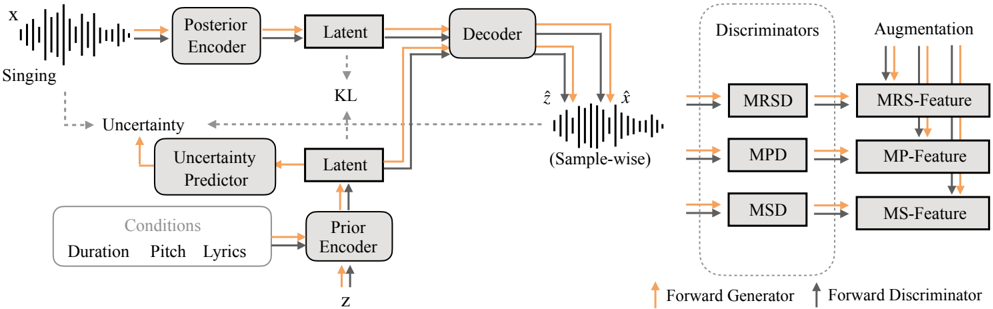
The paper builds on VISinger2, an end-to-end SVS model combining a conditional VAE (posterior and prior encoders producing latents that a shared decoder reconstructs into waveform) with GAN-based adversarial training (multi-period, multi-scale, and multi-resolution-spectrogram discriminators). Two uncertainty-driven additions are introduced on top of this frozen architecture. First, differentiable data augmentation (adapted from StyleGAN-style augmentation in image generation) applies masking or additive-noise perturbations directly to the discriminators’ extracted features, rather than to the raw generated waveform, during both the generator’s and discriminator’s forward passes; because the augmentation is differentiable and applied symmetrically to both real (posterior) and fake (prior) feature pairs, the generator’s target output distribution is left unchanged even as feature-level variation increases, which the paper frames as increasing prior uncertainty (the model’s exposure to more diverse real-fake feature pairings). Second, a lightweight posterior uncertainty predictor (two 1D convolutional layers plus a fully connected layer) takes the prior frame-level latent and predicts a per-frame uncertainty score, supervised by the L2 reconstruction error between the ground-truth waveform and the model’s own reconstruction; this uncertainty prediction loss is added to training so the model is explicitly pushed to allocate more learning capacity toward frames it currently reconstructs poorly. Training proceeds in stages: the baseline is trained first, augmentation can be applied from scratch, and the uncertainty predictor is added partway through training (once the base model already produces reasonable output, since its supervision signal depends on that).
Key Results
On the Opencpop Mandarin singing corpus, adding differentiable noise augmentation alone (B+D) improves pitch and timbre metrics over the VISinger2 baseline (Log F0 RMSE 0.174 to 0.159, MCD 7.876 to 7.67). Adding the uncertainty predictor alone (B&U) improves subjective MOS across lyrics, melody, and overall naturalness. Combining both (B&U&(U+D)) is the strongest overall configuration, achieving the most best-or-second-best scores across all 8 evaluated metrics, including the largest MOS gain (3.46 to 3.67 overall), which the authors emphasize is notable because the VISinger2 baseline is already a strong, SOTA SVS system. An ablation across augmentation types (masking, additive noise, and their combination) finds additive noise alone performs best, generalizing better than masking or combining both. On the smaller, Japanese Ofuton-P corpus (roughly 20% the size of Opencpop), the combined strategy again improves pitch accuracy (Log F0 RMSE), semitone accuracy, voiced/unvoiced prediction, and pseudo-MOS, though MCD shows a slight degradation, which the authors attribute to a pitch-versus-timbre trade-off.
Novelty Assessment
Both techniques adapt established ideas, differentiable augmentation from StyleGAN-style image-generation training, and posterior-uncertainty prediction from target-speaker-extraction and general uncertainty-estimation literature, to the specific setting of end-to-end SVS training, where neither had previously been applied according to the paper’s related-work review. The application-level novelty is genuine: prior SVS augmentation work explicitly avoided introducing large distributional perturbations to preserve output quality, whereas this method’s insight is that stronger perturbation is safe specifically when confined to the discriminator’s feature space during adversarial training rather than applied to the generated output directly, and the paper backs this with a direct ablation isolating augmentation type.
Field Significance
moderate — The paper addresses a genuine and specific bottleneck in SVS (long-tail performance degradation under data scarcity) with two concretely validated, easily integrable training-time techniques that improve a strong existing baseline across pitch, timbre, duration, and human-perceived naturalness metrics, and that generalize to a second, much smaller corpus in a different language. Its contribution is scoped to training methodology for a specific baseline architecture (VISinger2-style CVAE+GAN models) rather than a new generative paradigm, and evaluation remains limited to two single-singer corpora.
Claims
- supports: Applying differentiable, StyleGAN-style data augmentation inside the adversarial training loop’s discriminator feature space, rather than to the generated waveform directly, can improve pitch and timbre fidelity in singing voice synthesis without shifting the model’s target output distribution.
Evidence: Adding differentiable noise augmentation to VISinger2’s discriminator and generator forward passes improves Log F0 RMSE from 0.174 to 0.159 and MCD from 7.876 to 7.67 on Opencpop, while augmentation is applied only to discriminator-extracted features, not the generated waveform. (§IV-D, Table 1)
- supports: Explicitly predicting a singing voice synthesis model’s frame-level posterior uncertainty, supervised by reconstruction error, and combining it with adversarial training improves perceived naturalness beyond either technique alone.
Evidence: The combined strategy achieves the highest overall MOS (3.67 vs. 3.46 for the baseline) and the most best-or-second-best scores across all 8 evaluation metrics on Opencpop, exceeding either component applied individually. (§IV-D, Table 1)
- supports: Among differentiable augmentation strategies for adversarial singing-voice-synthesis training, additive noise perturbation to discriminator features generalizes better than time/frequency masking or their combination.
Evidence: In an ablation comparing noise, masking, and combined noise+masking augmentation, additive noise alone achieves the highest number of best-or-second-best scores across the 8 evaluation metrics on Opencpop. (§V-A, Table 2)
- complicates: Uncertainty-driven training improvements for singing voice synthesis do not transfer uniformly across all objective metrics when applied to a smaller-scale corpus in a different language; pitch and duration metrics can improve while spectral-distortion metrics slightly degrade.
Evidence: On the Japanese Ofuton-P corpus (roughly 20% the size of Opencpop), the combined strategy improves Log F0 RMSE, semitone accuracy, VUV, and Sheet-SSQA relative to baseline, but shows a slight MCD degradation, attributed to a pitch-versus-timbre trade-off. (§V-B, Table 3)
Limitations and Open Questions
Evaluation is limited to two single-singer corpora (Opencpop, Ofuton-P), so the techniques’ behavior on multi-singer or more diverse-style corpora remains untested. Ofuton-P’s MCD degradation under the combined strategy is noted but not fully resolved; the authors describe it only as a likely pitch-versus-timbre trade-off without further investigation. The authors explicitly identify exploring the collective effect of these uncertainty-based techniques with other existing augmentation methods as future work, suggesting the current combination has not been tested against the full space of prior SVS augmentation approaches.
Wiki Connections
- GAN Vocoder — the differentiable augmentation technique is applied directly within VISinger2’s adversarial training loop, operating on features extracted by its multi-period, multi-scale, and multi-resolution-spectrogram discriminators.
- Subjective Evaluation — reports lyrics, melody, and overall naturalness MOS from a 20-listener study across four training-strategy configurations.