arXiv · 2026 · Preprint
Minhyeok Yun et al. (Kwangwoon University) · → Paper · Demo: ✓ · Code: ✓
Introduces a lightweight flow-matching module that refines inference-time latent samples in a cVAE-based singing voice synthesizer to better match the posterior latents seen during training, improving expressive detail without redesigning the decoder.
Problem
cVAE-based singing voice synthesis (SVS) systems such as VISinger2 learn a score-conditioned prior and a recording-conditioned posterior over a latent variable that captures expressive, performance-specific variability beyond the musical score. The decoder is trained on posterior latents inferred from real recordings, but at inference it must decode from prior samples conditioned only on the score. Standard KL regularization between prior and posterior is often insufficient to fully align a highly variable, multi-modal posterior with a simpler prior, leaving a residual train-inference mismatch. Because pitch and duration targets are enforced separately, this mismatch does not show up as gross errors, but instead weakens fine expressive detail such as vibrato-like modulation, micro-prosody, and subtle timbral variation.
Method
FM-Singer augments a VISinger2-style cVAE SVS backbone (prior encoder, posterior encoder, and a GAN-based waveform generator) with a latent-space conditional flow matching (CFM) module inserted between the prior and the decoder. Given a prior sample z_p ~ p(z|c) and a posterior sample z_q ~ q(z|x), training uses the standard flow-matching recipe: a straight-line interpolation z_t = (1-t)z_p + t z_q with target velocity u_t = z_q - z_p, and a neural vector field v_θ trained to regress u_t with an L2 loss. At inference, only z_p is available; the model solves the ODE dz/dt = v_θ(z,t), z(0) = z_p using a DOPRI5 solver (tolerance 1e-5, max step 0.1, at least 10 integration steps) to obtain a refined latent ẑ before decoding. The vector field itself is a compact convolutional residual stack (hidden dimension 192, four dilated depth-separable convolution blocks with geometrically increasing dilation, dropout 0.1), so the refinement step operates only in latent space and does not modify the decoder.
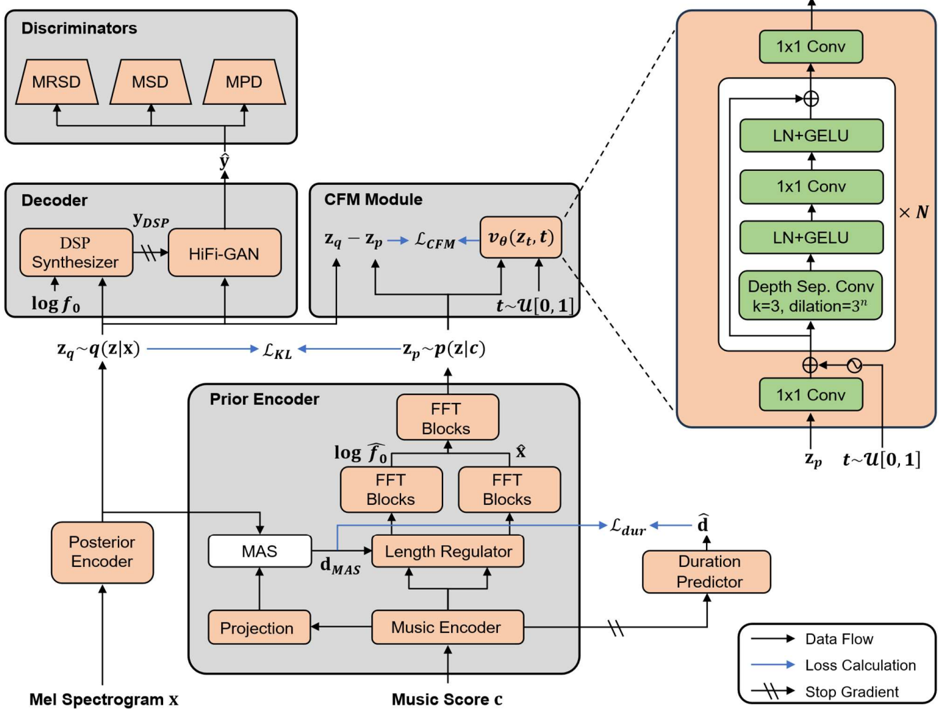
The full training objective combines KL regularization between prior and posterior, the CFM regression loss, adversarial GAN losses (least-squares adversarial loss, feature matching, mel-spectrogram reconstruction) against three discriminators (multi-period, multi-scale, multi-resolution spectrogram), a MAS-based duration loss using note-boundary-constrained monotonic alignment search, a DSP-consistency loss, and auxiliary pitch/mel prediction losses on the prior encoder.
Key Results
On the Korean dataset (70k training steps), FM-Singer improves MOS to 4.039 (±0.06) versus 3.347 (±0.07) for VISinger2 and 3.569 (±0.07) for a no-flow-refinement ablation (VISinger2 NF), while reducing MCD (4.815 vs. 6.328/5.784) and F0-RMSE (35.8 vs. 39.4/39.1). On the Chinese OpenCpop benchmark (500k steps, objective evaluation only), MCD drops to 2.703 versus 3.587 (VISinger2) and 2.939 (VISinger2 NF), with F0-RMSE at 25.2 versus 26.7/25.5. A direct latent-distance analysis shows the refinement reduces the mean distance between condition-derived and posterior latents by roughly 45%, with consistent reductions at the median and 90th percentile. Synthesis speed overhead from the added refinement step is small: CPU real-time factor drops from 2.07x (VISinger2) to 1.95x (FM-Singer), and GPU real-time factor from 15.56x to 14.97x.
Novelty Assessment
The authors are explicit that the contribution is not a new flow-matching objective but a specific application: using flow matching purely as a plug-in latent-transport bridge between an existing cVAE prior and posterior, without touching the decoder. That framing is accurate: every component (flow matching per Lipman et al., the cVAE backbone per VISinger2, and the GAN discriminator setup per established vocoder practice) is an established technique, and the contribution is the specific composition. The ablation against VISinger2 NF (identical backbone, no flow refinement) is the right comparison to isolate the effect, and the result is consistent across two languages and two independent metrics. However, TechSinger, the other flow-matching-based SVS system discussed in related work, is explicitly excluded from quantitative comparison because its conditioning pipeline could not be matched without re-engineering, so the paper does not establish how this refinement compares to other flow-matching approaches to expressive singing synthesis. Diffusion-based singing synthesis baselines are likewise discussed but not compared empirically.
Field Significance
Moderate, the paper provides further evidence that lightweight, latent-space flow matching can reduce train-inference distribution mismatch in VAE-based generative speech models without redesigning the decoder, extending a pattern already visible in end-to-end flow/diffusion refinement pipelines to a narrower, attachable-module setting. Its scope is narrow: singing-specific, evaluated against a single backbone family, and its architectural contribution is small relative to the amount of existing machinery it assembles.
Claims
- supports: Latent-space flow matching can reduce train-inference distribution mismatch in VAE-based generative speech models without modifying the decoder.
Evidence: An ablation isolating the refinement step (FM-Singer vs. VISinger2 NF, identical backbone) shows consistent MOS, MCD, and F0-RMSE improvements attributable specifically to the added flow-matching module. (§IV.E, Table 2)
- supports: Reducing the distance between condition-derived and posterior latents correlates with improved expressive naturalness in singing voice synthesis.
Evidence: Direct latent-distance measurements show a roughly 45% mean reduction in distance to posterior latents after refinement, alongside a 0.7-point MOS gain over the same-backbone ablation without refinement. (§IV.E, Table 4)
- complicates: KL regularization alone is insufficient to align prior and posterior latent distributions in cVAE-based speech synthesis when the posterior is highly multi-modal.
Evidence: The paper motivates the added flow-matching module by noting that KL regularization in the base cVAE backbone leaves residual latent mismatch that degrades fine expressive detail, requiring an explicit additional transport mechanism. (§III.A)
- complicates: Cross-system comparability of flow-matching-based refinement techniques for singing voice synthesis is limited by pipeline-specific conditioning requirements.
Evidence: TechSinger, a flow-matching-based technique-controllable SVS system, is excluded from quantitative comparison because its conditioning pipeline cannot be matched to the paper’s datasets and evaluation protocol without substantial re-engineering. (§IV.B)
Limitations and Open Questions
Warning
Subjective MOS evaluation was conducted only on the Korean dataset; perceptual quality on the Chinese OpenCpop benchmark is inferred from objective metrics (MCD, F0-RMSE) alone and has not been verified by human listeners.
- Korean and Chinese results come from two separately trained models on different datasets rather than a shared multilingual system, so the generalization claim rests on parallel single-language training rather than demonstrated cross-lingual transfer.
- No empirical comparison against TechSinger (another flow-matching-based SVS system) or against diffusion-based singing synthesis baselines such as DiffSinger, both discussed only in related work.
- The authors themselves note that the refinement uses only a linear interpolation probability path and no explicit technique or style conditioning in the vector field, and flag distillation or other low-step approximations as future work to reduce ODE integration cost.
Wiki Connections
- Singing Voice Synthesis and Conversion — proposes a flow-matching-based latent refinement module attached to a cVAE backbone specifically to address the train-inference latent mismatch that degrades expressive detail in singing synthesis.
- Flow Matching — applies conditional flow matching not as the primary generative mechanism but as a lightweight post-hoc latent-space transport step bridging a cVAE’s prior and posterior.
- GAN Vocoder — its waveform generator follows established GAN vocoder practice (least-squares adversarial loss, multi-period/multi-scale/multi-resolution-spectrogram discriminators) inherited from VISinger2.
- Subjective Evaluation — reports a 5-point MOS listening test with 95% confidence intervals, though restricted to a single language due to evaluation-budget constraints.
- WaveNet — the posterior and prior encoders are implemented with convolutional residual blocks inspired by WaveNet’s dilated-convolution design.
- Flow Matching for Generative Modeling — adopts the straight-line conditional flow matching training objective from this paper directly for the latent refinement module.
- HiFi-GAN — follows established multi-period/multi-scale discriminator practice for the GAN-based waveform generator.