arXiv · 2026 · Preprint
Henry Li Xinyuan et al. (Johns Hopkins University) · → Paper · Demo: ✓ · Code: ✓
Extends a closed-set linear speech-content factorization method to an open-set setting, enabling zero-shot voice conversion and a training-efficient, speaker-agnostic acoustic feature for TTS, using only least-squares linear algebra with no additional neural training.
Problem
Prior work showed that WavLM feature spaces have a useful geometric property: frames belonging to the same phoneme cluster tightly across speakers, which enabled training-free voice conversion methods such as kNN-VC and Speech Content Factorization (SCF). SCF in particular projects content-aligned WavLM features from a fixed pool of speakers into a shared low-rank content representation via SVD, then reconstructs speaker-specific features through per-speaker linear transformation matrices. This gives high-quality VC without training a neural network, but SCF is closed-set: computing or reconstructing the content-factorized representation requires the target speaker to have been part of the original SVD-derived speaker pool. That restriction makes SCF impractical for open-set VC or timbre-prompted TTS on large, diverse, crowd-sourced corpora (e.g. CommonVoice, Emilia), where recomputing the factorization for every new speaker is prohibitively expensive and many speakers lack enough data to be included in the first place.
Method
Universal Speech Content Factorization (USCF) extends SCF’s linear factorization to unseen speakers by decoupling two steps: (1) a single, speaker-agnostic linear mapping W from any speaker’s WavLM features to the shared content space, fit once via least-squares over a fixed speaker pool, and (2) a per-speaker transformation matrix S_m, derived analytically from only a small amount (as little as a few seconds) of previously-unseen target-speaker speech.
The paper tests three formulations for W. W1 directly targets the SVD content factors U after factoring out the singular-value magnitudes Σ, which the authors argue prevents the least-squares objective from treating content dimensions unequally. W2 instead solves for a matrix that approximately inverts the known speaker transformation matrices S_j (from the closed-set SVD-derived speakers) toward the identity. W3 exploits an assumed linear separability of content and speaker-timbre subspaces to show that the Moore-Penrose pseudoinverse of any single closed-set speaker’s transformation matrix approximately serves as a universal content mapping, requiring no explicit optimization at all. Given W, the speaker-specific reconstruction matrix S_m for an unseen speaker m is recovered in closed form from a small set of that speaker’s WavLM frames via S_m ≈ (X'_m W)† X'_m.
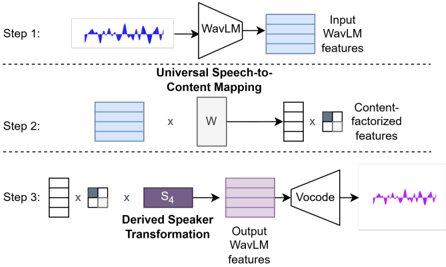
At inference, VC proceeds by projecting source speech into the shared content space with W, then reconstructing it in the target speaker’s acoustic space with the target’s derived S_m, followed by a WavLM-based vocoder (vocoder identity not specified in the paper). Because every step is linear algebra (SVD, least-squares, pseudoinverse), no gradient-based training or neural network is required beyond the pretrained WavLM encoder and vocoder already used by prior SSL-space VC methods.
As a secondary application, the paper trains a flow-matching TTS model (following the ZipVoice architecture and training recipe) using USCF features as the target acoustic representation instead of mel filterbank features, testing whether a speaker-suppressed but content-preserving feature space makes for a better or more efficient synthesis target.
Key Results
On LibriSpeech VC (20 source, target, and two held-out speaker sets of 20 each), USCF W1 reaches WER 2.7%, UTMOS 2.805, and speaker-similarity cosine 0.524, broadly competitive with kNN-VC (WER 3.16, UTMOS 2.855, Spk Sim 0.666), LinearVC (WER 2.69, UTMOS 2.765, Spk Sim 0.621), and closed-set SCF (WER 2.18, UTMOS 2.886, Spk Sim 0.603), and clearly ahead of SeedVC, a diffusion-transformer zero-shot VC baseline, on WER (2.7 vs. 6.24) (§4.1, Table 1). Speaker similarity is consistently the weakest metric for USCF relative to the closed-set and SSL-structure baselines; a control experiment with partially open-set SCF (open-set source, closed-set target) recovers closed-set-level speaker similarity, isolating the content-to-speaker transformation step (not the content mapping itself) as the source of the gap (§4.1). In a MOS/SMOS listening test, listeners show no statistically significant preference between USCF and kNN-VC, LinearVC, or SCF, and disfavor only SeedVC (§4.1, Table 2).
Among the three universal mappings, W1 offers the most balanced trade-off, W2 favors speaker similarity at the cost of quality and content preservation, and W3 favors content preservation but is weaker on speaker similarity; W3’s performance is stable (WER SD 0.10%, UTMOS SD 0.015 across 10 runs) regardless of which closed-set speaker’s transformation it is derived from (§4.1). A phoneme/speaker-ID probing analysis on TIMIT shows USCF matches WavLM on phoneme classification while removing substantially more speaker information (Spk EER 36.4% vs. WavLM’s 21.77%, at rank 75) than either raw WavLM or ContentVec, and this speaker-information removal persists even at rank 1024, ruling out low-dimensionality as the explanation (§4.2, Table 3). USCF is stable across ranks 50-100 but degrades below rank 50 (§4.3.1, Table 4), and target-speaker similarity degrades sharply below 500 WavLM frames (~10 seconds) of target speech, with diminishing returns beyond 2000 frames (~40 seconds) (§4.3.2, Table 5). In the downstream TTS experiment, a flow-matching model trained with USCF target features reaches 11.44% ASR WER in 25 epochs, versus 27.93% WER at 39 epochs for mel filterbank features and 11.92% WER at 33 epochs for kNN-VC-normalized mel filterbank features (§4.4, Table 6), indicating comparable or better intelligibility with less training time.
Novelty Assessment
The contribution is a focused algorithmic extension rather than a new architecture: USCF takes SCF’s existing linear factorization and derives a closed-form, least-squares route to generalize it to unseen speakers, contributing three concrete formulations (W1, W2, W3) with different quality/speaker-similarity trade-offs and an analytical closed-set-to-open-set adaptation step. No neural network is trained at any point, which is itself notable given that most competing zero-shot VC systems (SeedVC, prior diffusion/flow approaches) require substantial neural training. The evaluation is reasonably thorough for a short paper (objective and subjective VC metrics, a phoneme/speaker probing analysis, rank and data-efficiency ablations, and a downstream TTS feature-quality test), though the TTS application in §4.4 is a single-configuration proof of concept rather than a systematic study, and the paper does not report the vocoder used to reconstruct waveforms from output WavLM features.
Field Significance
Moderate — this paper closes a practical gap in the SSL-space VC line of work (kNN-VC, LinearVC, SCF) by removing the closed-set restriction without introducing any additional model training, and provides a concrete demonstration that a speaker-suppressed linear feature space can serve as a more training-efficient TTS acoustic target than mel filterbanks. Its speaker-similarity trade-off relative to closed-set methods leaves room for follow-up work, and the paper itself frames the current formulations as a step toward more stable or lower-data-requirement variants.
Claims
- supports: A speaker-agnostic linear mapping can be fit once via least-squares over a fixed pool of speakers and then reused, without retraining, to project the WavLM features of entirely unseen speakers into a shared phonetic-content space.
Evidence: USCF’s universal mapping W is fit only on speakers from two held-out LibriSpeech sets, yet is applied unmodified to disjoint source and target speaker sets at test time, achieving WER as low as 2.31-2.7%. (§2.2, §4.1, Table 1)
- supports: Per-speaker acoustic reconstruction from a shared content representation can be estimated in closed form from a very small amount of target-speaker speech, without gradient-based adaptation.
Evidence: The speaker transformation matrix S_m is derived analytically via a pseudoinverse from as few as 500 WavLM frames (~10 seconds) of target speech, with only modest further gains up to ~40 seconds and sharp degradation below 10 seconds. (§2.3, §4.3.2, Table 5)
- complicates: Removing the closed-set constraint from a linear speech-content factorization degrades target speaker similarity relative to the closed-set version, even though content preservation and naturalness are largely retained.
Evidence: USCF W1’s speaker-similarity cosine (0.524) trails closed-set SCF (0.603), kNN-VC (0.666), and LinearVC (0.621); a partially open-set SCF control isolates the content-to-speaker transformation step, not the universal content mapping, as the source of this degradation. (§4.1, Table 1)
- supports: A linear, speaker-suppressed, content-preserving SSL-derived feature can serve as a more training-efficient acoustic target for TTS than mel-spectrogram features.
Evidence: A flow-matching TTS model trained with USCF target features reaches lower ASR WER (11.44%) in fewer epochs (25) than the same architecture trained on raw mel filterbank features (27.93% WER, 39 epochs), and matches speaker-normalized mel features while training faster. (§4.4, Table 6)
- complicates: Reducing the rank of a linear content-factorized representation trades off against reconstruction quality below a moderate threshold, even though very high ranks provide no additional benefit.
Evidence: USCF is stable for rank 50-100 (WER 2.69-2.7%, UTMOS 2.738-2.805) but degrades sharply at rank 20-30 (WER up to 3.98%, UTMOS down to 2.388), while doubling rank from 75 to 1024 in the phoneme/speaker probing task does not change phoneme classification accuracy. (§4.2, §4.3.1, Tables 3-4)
Limitations and Open Questions
Warning
USCF trades away speaker similarity relative to the closed-set method it extends and to several training-based baselines; the paper’s own control experiment localizes this gap to the open-set content-to-speaker transformation step, but does not resolve it (§4.1).
The paper does not report which vocoder converts output WavLM features back to a waveform, leaving a gap in reproducibility for the final synthesis step. The downstream TTS experiment (§4.4) uses a single architecture (ZipVoice-style flow matching) and a single training corpus (LibriSpeech), so the generality of USCF as a training-efficient acoustic target for other TTS architectures or noisier, larger-scale corpora (the CommonVoice/Emilia-style motivating scenario from the introduction) is untested. The authors note as future work that simple neural methods might yield a more stable universal mapping or reduce the amount of target-speaker speech required for the S_m derivation, and that USCF could be extended toward zero-shot, style-conditioned, timbre-agnostic TTS training.
Wiki Connections
- Voice Conversion — extends a closed-set linear SSL-space VC method (SCF) to an open-set, zero-shot setting without any additional neural training.
- Disentanglement — the least-squares mapping W explicitly separates phonetic content from speaker-timbre information within the WavLM feature space, verified by phoneme and speaker-ID probing.
- Self-Supervised Speech — the entire method operates on frozen, pretrained WavLM features rather than features learned end-to-end for the VC task.
- Flow Matching — demonstrates that USCF features can replace mel filterbanks as the training target for a flow-matching TTS model built on the ZipVoice architecture, improving WER and training efficiency.
- Speaker Adaptation — derives a target speaker’s acoustic reconstruction transform analytically from only a few seconds of that speaker’s speech, without gradient-based fine-tuning.
- Subjective Evaluation — reports MOS and SMOS listening tests comparing USCF against kNN-VC, LinearVC, closed-set SCF, and SeedVC.
- LinearVC — USCF is a direct open-set extension of the closed-set Speech Content Factorization method and universal mapping introduced in this paper, which also serves as a primary baseline.
- SeedVC — used as the diffusion-transformer zero-shot VC baseline; USCF outperforms it on WER and is preferred in the subjective listening test.
- ZipVoice — provides the flow-matching TTS architecture and training recipe used to test USCF features as an acoustic training target.