arXiv · 2026 · Preprint
Shuozhe Cheng et al. (Independent Researcher) · → Paper · Demo: ✗ · Code: ✗
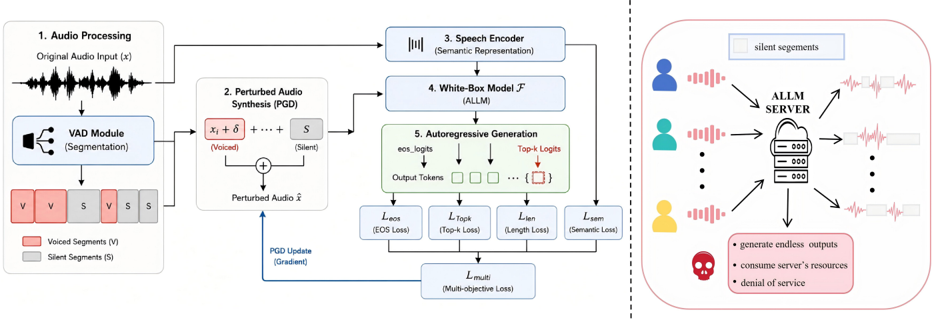
A white-box adversarial perturbation, limited to voiced regions and bounded at ℓ∞ ≤ 10⁻⁴, stops end-to-end speech LMs from emitting their end-of-sequence token, so they keep generating audio tokens until the 1,024-token cap in 83–87% of attacked inputs.
Problem
Denial-of-service (DoS) attacks on text LLMs make a model generate very long outputs, which wastes compute and blocks service for other users. Text attacks work through the prompt: adversarial suffixes, complex queries, or reasoning decomposition. These methods depend on editable discrete tokens. They do not carry over to end-to-end speech LMs, which take a continuous waveform as input. Prior speech-side DoS work (SlothSpeech) targeted ASR models and only suppressed the EOS logit. The authors argue that this single objective does not control the full generation process of a speech LM, and that pushing EOS down too hard can destabilize decoding or change the semantics instead of lengthening the output.
Method
The threat model is white-box: the attacker has the target model’s weights and gradients, but can only add a small perturbation to the input audio. The input length stays the same. A VAD splits the input into voiced and silent segments. Perturbations σᵢ are optimized only on the voiced segments, which are then concatenated back with the unchanged silent segments. Optimization uses projected gradient descent (PGD) for 200 iterations per sample with an ℓ∞ bound of ε = 10⁻⁴. The perturbation is initialized with Gaussian noise.
At each iteration, the perturbed audio passes through the target model’s speech encoder and autoregressive decoder. The attack records the EOS logit, the top-k logits, and the total generation length at every decoding step. It then minimizes a sum of four losses:
- Weighted EOS loss. EOS logits are averaged with per-step weights. A step gets zero weight when its EOS logit is non-positive. Otherwise the weight is w_high·exp(κt/N), so later steps, where EOS becomes more likely, count more (w_high = 4, κ = 4).
- Length loss. A differentiable expected length, built from per-step EOS probabilities as a termination distribution, is pushed toward N_max through (N_max − E[L])²/N_max.
- Top-k loss. Raising the mean of the top-k logits (k = 3) lowers EOS indirectly. The authors say it also keeps the output coherent.
- Semantic loss. One minus the cosine similarity between speech-encoder features of the clean and perturbed audio. It keeps the perturbation from working by changing the input’s meaning.
No model is trained. The method is an input-optimization procedure, and N_max is set to 1,024 tokens because of compute limits.
Key Results
The attacked models are LFM2.5-Audio-1.5B (called “Liquid Audio” in the tables) and Fun-Audio-Chat-8B. Both are end-to-end spoken-dialogue models that output speech. Qwen2-Audio-7B-Instruct is reported in the appendix. Each condition uses 100 clips sampled from OpenSLR and QCRI. The attack success rate is the share of inputs whose generated audio-token sequence reaches the 1,024-token cap.
Under top-k sampling (Table 1), the attack reaches a success rate of 0.87 on LFM2.5-Audio and 0.84 on Fun-Audio-Chat. Clean and random-noise inputs score 0.00. Average output length rises from 198.34 to 941.88 tokens on LFM2.5-Audio and from 213.57 to 920.24 tokens on Fun-Audio-Chat. The proposed method has the highest success rate and the longest outputs in every row of Table 1. Its margin over the EOS-only “Simple Loss” baseline is small: 0.87 vs 0.79 and 0.84 vs 0.77. Text DoS attacks applied to the audio setting do much worse. Crabs reaches 0.34 and 0.36, and ExtendAttack reaches 0.29 and 0.48. Peak GPU memory rises from 8.89 to 10.78 GB on LFM2.5-Audio and from 20.26 to 21.93 GB on Fun-Audio-Chat. The prose gives 17.26 GB for the clean Fun-Audio-Chat input, but Table 1 reports 20.26 GB.
Greedy decoding gives similar results (Table 4): success rates of 0.86, 0.84 and 0.85 on LFM2.5-Audio, Fun-Audio-Chat and Qwen2-Audio. This suggests the attack does not depend on sampling randomness. On Qwen2-Audio with top-k sampling (Table 5), the attack reaches 0.83 against 0.80 for Simple Loss, with 913.07 output tokens. In black-box transfer to a different model (Figure 6), success falls to 7–13%.
The loss ablation (Table 2, ablation setting not stated) has a full-objective result of 0.84 success, 950.24 tokens and 4.75 response quality. Response quality is a 1–5 score from a GPT-5.5 judge that compares the text responses to clean and adversarial inputs. Removing the EOS loss drops the success rate to 0.12 and the length to 289.43 tokens. Removing the length loss gives 0.79, and removing the top-k loss gives 0.80 with quality 4.46. Removing the semantic loss gives 0.83 and 937.81 tokens, and quality drops to 3.92. The prose says this removal “slightly improves” success and length, but the table shows slightly lower values. Without VAD, the success rate is the same (0.84) and quality drops to 4.52. For κ (Table 3), κ = 4 gives the highest success rate on LFM2.5-Audio (87%) and Fun-Audio-Chat (84%), and ties κ = 3 on Qwen2-Audio (83%).
The waveform analysis (Figure 3) shows that attacked outputs keep speech content similar to clean responses. The extra length comes mostly from long low-energy silent stretches between speech fragments. The attack is robust to small added noise (Figure 4a), but MP3 compression weakens it (Figure 4b).
Novelty Assessment
The new element is the attack objective. It combines a step-weighted and sign-gated EOS loss, a differentiable expected-length loss, a top-k logit loss, and a semantic-preservation loss. The attack applies them to end-to-end speech LMs that generate speech. PGD, VAD-masked perturbations, and EOS-logit suppression all come from prior work: SlothSpeech used EOS suppression on ASR, and VAD masking comes from earlier audio adversarial work. The paper’s increment is putting them together for spoken-dialogue models and adding the length and top-k terms.
Under top-k sampling, the improvement over the EOS-only baseline is modest: 3 to 8 points of success rate across the reported models (7 to 11 points under greedy decoding). The evaluation is also thin. It covers two main models plus one in the appendix, 100 clips per dataset, a vaguely specified dataset pair (“OpenSLR and QCRI”), a 1,024-token cap, and white-box access only. Stealthiness is argued through the ε bound and an LLM judge of text responses. No human listening test checks whether the perturbation is perceptible. No defense besides compression is tested.
Field Significance
Moderate — The paper shows that end-to-end spoken-dialogue models can be pushed into long, silence-filled speech generation by small input perturbations aimed at the termination decision. This is a resource-exhaustion risk that is specific to autoregressive speech output. It is an early data point on the security of speech LMs, but the white-box setting, small evaluation, and weak transfer limit how far its findings generalize.
Claims
- supports: The end-of-sequence decision in autoregressive speech LMs is a single point of failure that small input perturbations can exploit to force runaway speech generation.
Evidence: With an ℓ∞ bound of 10⁻⁴ on voiced regions, success rates reach 0.87 and 0.84 on two spoken-dialogue models and 0.83 on Qwen2-Audio. Outputs grow from about 200 tokens to over 900 tokens, while clean and random-noise inputs never reach the cap. (§Main Result, Table 1; §Evaluation under Qwen2-Audio, Table 5)
- refines: Forcing long generation in speech LMs works better when EOS suppression is combined with length and token-distribution objectives, though EOS suppression does most of the work.
Evidence: Removing the weighted EOS loss drops success from 0.84 to 0.12. Removing the length or top-k loss costs only 4–5 points, and under top-k sampling the full objective beats the EOS-only baseline by 3–8 points on each model. (§Ablation Study, Table 2; Table 1; Table 5)
- complicates: Prompt-based DoS strategies designed for text LLMs transfer poorly to speech LMs, which take continuous audio input.
Evidence: Crabs and ExtendAttack reach success rates of only 0.29–0.48 on LFM2.5-Audio and Fun-Audio-Chat, against 0.84–0.87 for gradient-based perturbation. (§Main Result, Table 1)
- complicates: When a speech LM is forced past its normal stopping point, it fills the extra decoding steps mostly with silence rather than extra content. So output duration alone can understate how degraded the response is.
Evidence: Waveforms of attacked outputs show sparse speech fragments separated by long flat silent regions, and the transcribed responses stay close to the clean responses. (§Output Audio Analysis, Figure 3)
- complicates: White-box adversarial perturbations against speech LMs transfer weakly across models and are fragile under lossy compression.
Evidence: Cross-model transfer gives 7–13% success against 81–87% white-box, and MP3 compression reduces attack effectiveness. (§Attack Transferability, Figure 6; §Limitation, Figure 4b)
Limitations and Open Questions
Warning
The attack is white-box only, evaluated on 100 sampled clips per dataset with a 1,024-token cap, and its stealthiness is never checked by human listeners. Perceptibility rests on the ε bound, and “semantic preservation” rests on an LLM judge of the text responses.
- Black-box transfer is weak (7–13%), so the practical threat to closed, API-served speech LMs is not established.
- MP3 compression reduces the attack (Figure 4b). The authors note that resampling, filtering, or added noise could have the same effect, but they evaluate no defense besides compression.
- The “OpenSLR and QCRI” datasets are not identified more precisely, and the input prompts or tasks are not described.
- The reported numbers have some inconsistencies: the clean Fun-Audio-Chat memory figure (17.26 GB in the prose vs 20.26 GB in Table 1), the white-box Fun-Audio-Chat success rate (81% in Figure 6 vs 0.84 in Table 1), and the semantic-loss ablation, described as improving success and length although Table 2 shows slight decreases. The appendix text also refers to Tables 3 and 4 where Tables 4 and 5 hold the results.
- The model or configuration used for the Table 2 ablation is not stated.
- Memory overhead is modest (about 8% on Fun-Audio-Chat). Most of the cost of the attack is longer decoding time, which is not measured directly.
Wiki Connections
- Spoken Language Model — Feeds adversarial audio into existing end-to-end speech LMs and measures how their generation behaves under attack.
- Speech-to-Speech — The main targets are spoken-dialogue models, and the attack is measured on the length and waveform of their generated speech responses.
- Fun-Audio-Chat — One of the two main attacked models (Fun-Audio-Chat-8B), with a success rate of 0.84 under top-k sampling.
- DrVoice — The reference the paper cites for Fun-Audio-Chat-8B.
- Qwen2-Audio — The third attacked model (Qwen2-Audio-7B-Instruct), reported in the appendix with a success rate of 0.83, and a source and target in the transfer experiment.