ICLR · 2025 · Conference
Baade et al. (University of Texas at Austin) · → Paper · Demo: ? · Code: ✓
A self-supervised bootstrapping pipeline that compresses SSL speech representations into syllable-rate discrete units (as low as 5 Hz, 60 bps), enabling a 90M-parameter speech language model to match or outperform systems up to 13B parameters while reducing training compute by 30x and inference latency by 4x.
Problem
Speech language models built on the generative spoken language modeling (GSLM) paradigm have relied on discrete tokens produced by SSL encoders such as HuBERT operating at 25–50 tokens per second — far above the 2–5 words per second of natural speech. This mismatch inflates sequence lengths, increases training and inference costs, and may impede the learning of semantic structure. Prior approaches to coarser tokenization (SD-HuBERT, VG-HuBERT) produced syllable-like boundaries but either required expensive feature-similarity-matrix computations, did not achieve low enough bitrates for practical speech LM training, or suffered from poor unit-to-text alignment when used for resynthesis.
Method
The paper introduces two complementary algorithms and combines them into a SpeechLM training pipeline.
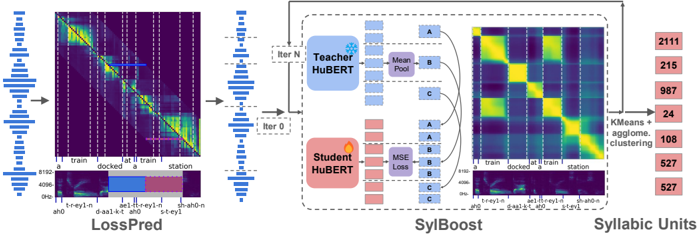
LossPred operates on a frozen HuBERT student-teacher pair. A sliding masked span is applied to the input waveform and the cross-entropy losses of the student model are recorded into a loss prediction matrix C, where entries represent the probability of predicting teacher labels given which portion of the word context is masked. The min-cut algorithm from Shi & Malik (2000) is then applied to C to extract k syllable-like segment boundaries, where k is set proportional to utterance length to give controllable unit rate.
SylBoost takes those initial noisy boundaries as pseudo-labels and iteratively sharpens the feature space of a pre-trained SSL encoder (HuBERT or Data2Vec2) via student-teacher distillation. The training objective minimises mean squared error between each student feature frame and the mean of teacher features within its assigned boundary group. After two iterations, discrete units are obtained by mean-pooling features over boundary groups and applying K-Means followed by Agglomerative Clustering. The paper also replaces the slow min-cut extraction step with an efficient dynamic-programming algorithm that reduces boundary extraction real-time factor (RTF) from 0.0114 to 0.00205 (Table 4 in §5.3).
The resulting SylBoost units, operating at 5–8.33 Hz with 2k–16k cluster vocabulary, are fed into SyllableLM, an autoregressive transformer decoder language model following the OPT architecture (90M or 300M non-embedding parameters). Token-to-speech decoding cascades SyllableLM outputs through an interleaved vocoder that interleaves SylBoost units with TWIST-tokeniser units for waveform reconstruction.
Key Results
On unit quality, SylBoost (Data2Vec2, 5 Hz) achieves F1-50 of 73.2 on unsupervised syllabic boundary detection, outperforming SD-HuBERT (66.1) and the feature-similarity baseline (47.3) (Table 1, §5.3). On unit-to-text resynthesis, the best SylBoost configuration reaches WER 7.0% at 81 bps — substantially lower bitrate than the TWIST tokeniser upper bound of 6.3% WER at 175 bps (Table 5, §5.3).
On spoken language modelling, the 90M SyllableLM (6.25 Hz, 8k units) achieves 72.1 sWUGGY and 62.9 sBLIMP, outperforming TWIST at 125M, 350M, 1.3B, and 7B parameter scales on sBLIMP, and surpassing AudioLM-300M on sWUGGY (Table 6, §5.6). Compute cost is 70–75 GPU hours compared to an estimated 2,900 hours for AudioLM and 295 hours for TWIST-300M. Inference throughput is 4.5x faster than TWIST-90M at equal parameter count due to the shorter token sequences (Table 4, §5.3). In human preference tests, raters preferred SyllableLM-300M continuations over TWIST-1.3B by a margin of 42.2% vs 26.6% (§A.5).
Novelty Assessment
LossPred is genuinely novel: using the loss surface of a masked prediction model as an unsupervised segmentation signal — rather than attention maps or feature similarity — is a distinct methodological contribution. SylBoost’s iterative distillation objective (pooling teacher features over segmentation groups) is also a new formulation, extending the noisy-student-teacher paradigm to temporal grouping in speech. The efficient dynamic-programming boundary extractor is a practical engineering contribution that removes a key scalability bottleneck from prior work.
The autoregressive SpeechLM component is not novel; it directly follows the TWIST / AudioLM paradigm and uses the OPT architecture unchanged. The interleaved vocoder decoding strategy is borrowed from Song et al. (2024). The paper’s contribution is the tokenisation layer, not the language model on top. Comparisons against Moshi-7B are on different training data (7M hours vs 55k hours), making that baseline less informative than it appears. The evaluation is limited to English audiobook speech (LibriSpeech / LibriLight), and the units’ behaviour on spontaneous speech, multiple speakers, or other languages is untested.
Field Significance
Tip
High — SyllableLM demonstrates that aggressive temporal compression of speech representations (down to 5 Hz) enables a small speech LM to be competitive with systems more than 100x larger in parameter count while drastically reducing training and inference cost. The LossPred insight — that the loss surface of a masked prediction model encodes latent syllabic structure — provides a principled, architecture-agnostic method for unsupervised speech segmentation. This positions the work as a meaningful step toward making speech language modelling computationally tractable at scale.
Claims
-
supports: Reducing the token rate of speech representations below 10 Hz is sufficient to preserve semantic content adequate for spoken language modelling, while substantially improving training and inference efficiency.
Evidence: SyllableLM at 6.25 Hz, 90M parameters, matches or exceeds TWIST models up to 13B parameters on sBLIMP semantic understanding benchmarks, with 30x less training compute and 4.5x faster inference than an equal-sized TWIST baseline. (§5.6, Table 6)
-
supports: The loss surface of a masked-prediction SSL model encodes latent syllabic segmentation boundaries discoverable without additional supervised signal or cross-modal supervision.
Evidence: LossPred, applied to a frozen HuBERT student-teacher pair without any training, achieves F1-50 of 59.6 on syllabic boundary detection, outperforming the feature-similarity-based baseline (47.3) while requiring no fine-tuning. (§3.1, Table 1)
-
supports: Iterative student-teacher distillation over pseudo-syllabic boundaries progressively sharpens SSL encoder representations toward syllable-level organisation.
Evidence: SylBoost applied to HuBERT improves boundary detection F1 from 60.1 (LossPred initialisation) to 70.2 after two iterations; applying it to Data2Vec2 reaches 73.2, each iteration producing a measurable gain over the previous. (§5.3, Table 2)
-
complicates: Low-frequency speech units that improve semantic modelling efficiency may sacrifice robustness to speaker rate variation.
Evidence: SylBoost unit counts collapse under audio speedups of 0.5x and 0.6x relative to original length, performing comparably to SD-HuBERT only at mild speedups (0.8x–0.9x range), while showing greater robustness to slowdowns. (Appendix A.5, Table 11)
-
complicates: Units optimised for semantic modelling in audiobook speech may lose paralinguistic information, limiting applicability to domains requiring prosodic or tonal fidelity.
Evidence: The authors note that low-frequency SylBoost units may lose paralinguistic features such as tone, and the entire evaluation is conducted on audiobook data (LibriSpeech / LibriLight); performance on spontaneous or multi-speaker speech is not reported. (§6)
Limitations and Open Questions
Warning
All training and evaluation uses English audiobook data (LibriSpeech, LibriLight). Generalisation to spontaneous conversational speech, other languages, or multi-speaker settings is not demonstrated.
The interleaved vocoder decoding pipeline introduces a dependency on the TWIST tokeniser and vocoder for resynthesis, meaning the system is not fully end-to-end and unit bitrate for the final waveform is partially bounded by TWIST’s own quality ceiling (WER 6.3%). The efficiency gains in the SpeechLM do not fully apply to the decoding pipeline, which involves an additional language model. Scaling beyond 300M parameters was not attempted due to compute constraints, leaving open whether the efficiency advantage persists at very large model scales. The base encoder quality (Data2Vec2 vs newer models like w2v-BERT 2.0) is acknowledged as a confounding factor in cross-model comparisons.
Wiki Connections
- Spoken Language Model — SyllableLM is a speech-only generative language model trained on syllable-rate discrete units, directly extending the GSLM paradigm with a new tokenisation strategy.
- Self-Supervised Speech — the LossPred and SylBoost methods both depend on pretrained HuBERT and Data2Vec2 SSL encoders as the backbone for boundary extraction and feature distillation.
- Neural Audio Codec — the paper contrasts its semantic syllabic units with acoustic codec tokens (e.g., EnCodec, SoundStream) and uses TWIST-tokeniser units as the resynthesis intermediate, situating the work within the broader codec-based speech generation ecosystem.
- Autoregressive Codec TTS — SyllableLM’s SpeechLM component is an autoregressive transformer decoder operating on discrete units, following the paradigm established by VALL-E and AudioLM for codec-conditioned generation.
- Evaluation Metrics — the paper evaluates unit quality via syllabic F1, resynthesis WER/CER, and language model quality via sWUGGY, sBLIMP, and tStoryCloze, providing a multi-level evaluation framework for speech LM unit assessment.