Interspeech · 2025 · Conference
Yu Pan et al. (Kyushu University / University of Tokyo / EverestAI Ximalaya) · → Paper · Demo: ✓ · Code: ?
ClapFM-EVC couples a contrastive language-audio pretraining model (EVC-CLAP) with a flow-matching decoder to enable emotional voice conversion steered by either reference speech or free-form natural language prompts, with adjustable emotion intensity.
Problem
Emotional voice conversion systems have historically relied on either reference speech clips or fixed categorical labels to specify the target emotion. Both paradigms constrain flexibility: categorical labels cover only a small discrete set of states, while reference speech requires the user to find an appropriate exemplar. Beyond the conditioning limitation, GAN- and autoencoder-based EVC systems exhibit inconsistencies in emotion diversity, speech naturalness, and overall audio quality that diffusion- and flow-matching-based approaches in adjacent TTS work have since addressed. The additional challenge of intensity control — allowing users to dial in how strongly an emotion is expressed — has been handled only partially in prior work, typically by retrofitting a scalar multiplier into an already-constrained representation.
Method
ClapFM-EVC is a two-stage, any-to-one EVC framework. The first stage trains EVC-CLAP, an emotional contrastive language-audio pretraining model that aligns speech and text emotional representations in a shared 512-dimensional latent space. Audio is encoded with a pre-trained HuBERT model and text with XLM-RoBERTa. Rather than using hard one-hot labels, EVC-CLAP is trained with a symmetric KL-divergence loss (symKL-loss) against soft labels that blend categorical emotion labels and natural language prompt labels. This allows the model to represent emotional nuance across a continuum rather than a discrete set.
The second stage is AdaFM-VC, the voice conversion backbone. Content representations are extracted from source speech via a pre-trained ASR model (HybridFormer) as Phonetic Posteriorgrams (PPGs). A FuEncoder module fuses PPGs with emotional embeddings from EVC-CLAP. Central to FuEncoder is an adaptive intensity gate (AIG), a learnable scalar applied to the emotional embedding before fusion, giving the user direct control over expression strength. The fused features are passed to a conditional flow-matching (CFM) decoder — 6 CFM blocks using ResNet, multi-head self-attention, and FiLM conditioning — that generates the target Mel-spectrogram from Gaussian noise via an optimal-transport flow. A pre-trained BigVGAN vocoder converts the spectrogram to audio.
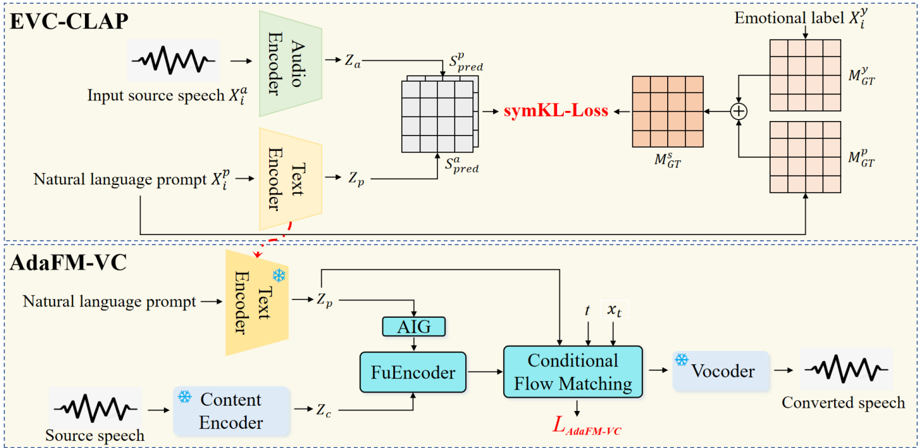
At inference, the target emotion embedding can be obtained in three ways: from a reference speech clip directly, from a natural language prompt, or via retrieval from a pre-built reference corpus using a natural language query. This three-mode design means the system degrades gracefully when reference audio is unavailable.
Key Results
Against three baselines (StarGAN-EVC, Seq2seq-EVC, MixEmo) on an internal Mandarin test set, ClapFM-EVC substantially outperforms all comparators across both speech quality and emotion similarity dimensions (Table 1). The strongest prior system, MixEmo, achieves nMOS 2.98 and EECS 0.65; ClapFM-EVC reaches nMOS 4.09 (±0.09) and EECS 0.82 — a 37.2% relative improvement in naturalness and 26.2% in automatic emotion similarity. UTMOS rises from 2.09 to 3.68, a 49.2% relative gain. CER drops from 8.93% to 6.76%.
An ABX preference test comparing reference-speech-driven versus prompt-driven conversion found that 57.4% of 47 participants expressed no preference between the two modes, with 19.1% favouring the prompt-driven output, suggesting the natural language conditioning is effective without a meaningful quality penalty.
Ablation results confirm that soft-label training (categorical labels + symKL-loss) and the AIG module are each individually necessary: removing categorical labels causes EECS to drop from 0.79 to 0.66; replacing symKL with KL causes a 10.1% EECS decline; removing AIG degrades both nMOS (4.01 to 3.62) and EECS (0.79 to 0.74).
Note
All evaluations use a proprietary internal Mandarin corpus not publicly available. Baseline comparisons are restricted to systems that accept reference speech; the prompt-driven comparison is conducted only as a within-system ABX test against ClapFM-EVC’s own reference mode. Cross-system comparisons are not conducted in the natural language prompt setting.
Novelty Assessment
The core ideas — CLAP-style contrastive alignment, flow-matching decoders, and PPG-based content extraction — are all established techniques. The novelty lies in their systematic composition for EVC: adapting CLAP-style training with symKL-loss and soft multi-source labels to the emotion alignment problem, and introducing the AIG module as an explicit intensity knob within the FuEncoder. The three-mode inference (reference, prompt, retrieval) is a practical contribution that adds usability without requiring new training. The architecture is a reasonable and well-motivated combination of existing components rather than a fundamentally new model family. The primary contribution is engineering integration with a targeted training-objective refinement (symKL + soft labels).
Field Significance
Moderate — ClapFM-EVC advances the case that natural language prompts can replace or complement reference speech as a conditioning signal in emotional voice conversion, supporting a broader trend of instruction-conditioned speech manipulation. The flow-matching backbone brings EVC quality noticeably above prior GAN and autoencoder baselines on the authors’ benchmark. However, the evaluation is limited to a single proprietary Mandarin speaker corpus and the baseline set does not include more recent diffusion- or flow-matching-based EVC systems, limiting the generalisability of the quantitative claims.
Claims
- Natural language prompts can control emotional voice conversion at parity with reference speech for the majority of listeners, reducing reliance on hard-to-source reference audio. (§3.2.2)
- Flow matching produces noticeably higher speech naturalness and audio quality in emotional voice conversion than GAN and autoencoder baselines. (§3.2.1, Table 1)
- Combining categorical emotion labels with free-form prompt labels through soft-label contrastive training improves emotion embedding quality over prompt-only or label-only training. (§3.3, Table 2)
- An explicit scalar intensity gate applied to emotional embeddings before content-emotion fusion improves both naturalness and emotion similarity in converted speech. (§3.3, Table 2)
Limitations and Open Questions
Warning
The system is trained and evaluated entirely on a proprietary internal Mandarin corpus. No open-source data or model weights are released, and no cross-lingual or multi-speaker generalisation is tested.
Comparisons are restricted to older GAN and autoencoder baselines (StarGAN-EVC, Seq2seq-EVC, MixEmo); no diffusion-based or recent flow-matching EVC systems are included, so the claimed state-of-the-art position cannot be verified against the most competitive contemporaries. The evaluation is any-to-one (fixed target speaker identity), leaving any-to-any EVC performance unaddressed. Emotion coverage is limited to seven categorical classes; whether the natural language conditioning generalises to subtler or blended emotional states is untested.
Wiki Connections
This paper advances voice-conversion and emotion-synthesis by introducing a dual-modality conditioning framework. The flow-matching decoder places it within the flow-matching paradigm. The CLAP-based alignment of speech and text emotional features connects to self-supervised-speech representation learning. The natural language prompt interface is closely related to instruction-conditioned-tts. The AIG module addresses intensity control within disentanglement of content, speaker, and affective attributes.