Interspeech · 2025 · Conference
Ye-Xin Lu et al. (University of Science and Technology of China) · → Paper · Demo: ✗ · Code: ✗
NR-LauraTTS integrates a lightweight codec-domain speech denoiser — operating on discrete acoustic tokens rather than waveforms — into an LLM-based zero-shot TTS system, recovering near-clean-prompt synthesis quality from noisy audio prompts at only 1.10G additional FLOPs vs. 38.93G for a comparable waveform-domain SE model.
Problem
LLM-based zero-shot TTS systems (VALL-E, NaturalSpeech 3, LauraTTS) use discrete acoustic tokens as audio prompt representations and exploit in-context learning to preserve the speaker’s acoustic environment. This strength becomes a weakness when the audio prompt contains environmental noise: the model faithfully reproduces the noise in the synthesized output. Applying waveform-domain speech enhancement (SE) models before the TTS front-end partially mitigates this, but state-of-the-art SE models (CMGAN, MP-SENet) introduce signal artifacts that harm speaker identity information in the enhanced prompt, resulting in lower speaker similarity. Additionally, waveform-domain SE at 38.93G FLOPs is computationally expensive.
Method
LauraTTS backbone: An LLM-based zero-shot TTS model using Encodec (FunCodeec implementation: 16 kHz, 32 VQs, codebook 1024, downsampling 640). LauraTTS predicts only the first two RVQ groups of the target tokens autoregressively, then reconstructs the waveform via a one-step codec vocoder conditioned on the text prompt.
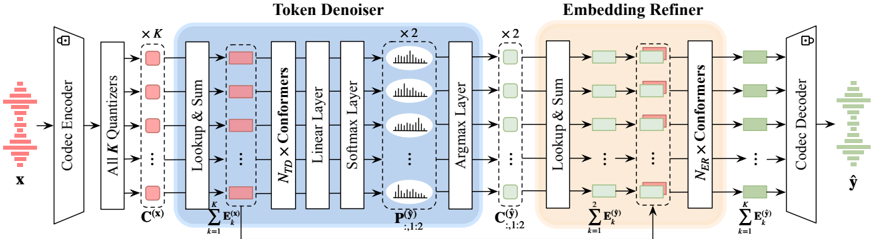
Codec Denoiser (the novel component): A two-stage model operating entirely in the discrete acoustic token domain:
-
Token Denoiser: 12 Conformer blocks. Takes all K=32 groups of noisy acoustic tokens, sums their codebook embeddings, and predicts the first two groups of clean acoustic tokens via cross-entropy loss. Prediction of only the first two groups is motivated by LauraTTS’s architecture (first two groups encode essential speaker properties) and by the empirical finding that predicting more groups increases complexity without improving SE metrics.
-
Embedding Refiner: 6 Conformer blocks. Takes the predicted first two clean token embeddings concatenated with the full noisy embedding sum, and predicts the summed acoustic embedding across all 32 VQ groups. This is supervised by an L1 + Frobenius norm loss against the clean summed embedding.
Training: teacher-forcing with random substitution of predicted tokens by clean ground-truth tokens. The codec denoiser is trained on LibriTTS-R + DNS Challenge 2022 noise (SNR −5 to +15 dB), independently of LauraTTS. At inference, the token denoiser output is fed directly as the acoustic prompt to LauraTTS.
Key Results
Speech enhancement task (DNSMOS P.835, 1s signals):
| Method | SIG | BAK | OVRL | FLOPs |
|---|---|---|---|---|
| CMGAN | 3.54 | 4.05 | 3.26 | 31.68G |
| MP-SENet | 3.56 | 4.09 | 3.30 | 38.93G |
| Codec Denoiser | 3.62 | 4.11 | 3.36 | 9.96G |
The codec denoiser outperforms both waveform-domain baselines in all DNSMOS dimensions at 3x lower compute.
Noise-robust zero-shot TTS task (subjective + objective):
| System | Prompt | MOS | SMOS | SECS | WER | +FLOPs |
|---|---|---|---|---|---|---|
| LauraTTS | Clean | 4.03 | 3.99 | 0.827 | 2.33% | — |
| LauraTTS | Noisy | 3.46 | 2.80 | 0.642 | 21.37% | — |
| LauraTTS + MP-SENet | Noisy | 4.01 | 3.85 | 0.811 | 2.54% | 38.93G |
| NR-LauraTTS | Noisy | 4.02 | 3.98 | 0.827 | 2.44% | 1.10G |
NR-LauraTTS achieves SECS of 0.827 — matching LauraTTS with clean prompts exactly — while LauraTTS+MP-SENet reaches only 0.811 due to SE artifacts corrupting speaker identity. The +1.10G overhead is negligible compared to 38.93G for waveform-domain SE.
Novelty Assessment
Operating speech enhancement in the discrete acoustic token domain is conceptually clean and practically effective. The codec bottleneck (VQ discretization) acts as an information filter that removes noise during quantization, giving the denoiser a structurally advantageous starting point. The finding that predicting only the first two RVQ groups is sufficient (and that predicting more degrades results) is well-motivated by the hierarchical information structure of RVQ codecs. The compute comparison (1.10G vs. 38.93G) is a strong practical argument. The approach is architecture-specific to LauraTTS/Encodec; generalization to other LLM-TTS systems with different codec architectures is not demonstrated but seems feasible.
Field Significance
Moderate — This paper introduces a targeted solution to a concrete practical failure mode of LLM-based zero-shot TTS: noise sensitivity from audio prompts. The codec-domain denoising idea — exploiting the VQ bottleneck as an implicit noise filter — is architecturally novel within the SE literature and provides a more computationally efficient and speaker-preserving alternative to waveform-domain SE. The contribution is narrow in scope (specific to LauraTTS and Encodec) but the underlying principle generalises to any codec-LM system that uses audio prompts for in-context learning.
Claims
- LLM-based zero-shot TTS systems are more sensitive to noise in audio prompts than speaker-embedding-based approaches, because their in-context learning mechanism preserves the acoustic environment of the prompt. (§1)
- Performing speech enhancement in the discrete acoustic token domain outperforms waveform-domain SE methods in both speech quality and computational efficiency, achieving higher DNSMOS scores at roughly one-third the FLOPs. (§4.1, Table 1)
- Waveform-domain speech enhancement introduces artifacts that degrade speaker identity in the enhanced prompt, resulting in lower speaker similarity in downstream zero-shot TTS compared to codec-domain denoising. (§4.2, Table 3)
- Predicting only the first two RVQ groups of clean acoustic tokens is sufficient for effective token-domain speech enhancement; predicting more groups increases complexity without improving quality. (§4.1, Table 2)
- The VQ bottleneck of neural codecs acts as an implicit noise filter during quantization, providing a structural advantage for denoising in the token domain relative to signal-domain methods. (§4.1)
Limitations and Open Questions
- Specific to LauraTTS + Encodec (FunCodeec); adaptation to other codecs (DAC, SoundStream, EnCodec original) requires retraining.
- Training uses synthetic noise (DNS Challenge 2022 + WHAM!); real-world noise types (music, babble, room impulse responses) may not be fully covered.
- No ablation on LauraTTS model size or the effect of codec VQ count K on denoiser difficulty.
- Intelligibility (WER 2.44%) is slightly worse than clean-prompt LauraTTS (2.33%), though close.
- No evaluation of the codec denoiser on other TTS or SE tasks beyond the paired experiment.
Wiki Connections
This paper advances zero-shot-tts by addressing the noise robustness gap of LLM-based systems, complementing prior work on noise-robust zero-shot TTS via speaker encoders. The codec denoiser design is closely related to neural-codec research on the hierarchical information structure of RVQ tokens. The LauraTTS backbone connects to autoregressive-codec-tts systems (VALL-E family). The token-domain SE finding — that the VQ bottleneck filters noise — is an underexplored property of neural codecs relevant to disentanglement research on codec representations.