Interspeech · 2025 · Conference
Nadav Har-Tuv et al. (Hebrew University of Jerusalem) · → Paper · Demo: ✓ · Code: ✓
PAST is an end-to-end speech tokenizer that achieves state-of-the-art phonetic representation and speech reconstruction without relying on any external SSL model, by integrating supervised phoneme and character-level CTC losses directly into an EnCodec-based RVQ architecture augmented with a transformer encoder.
Problem
Existing hybrid speech tokenizers (SpeechTokenizer, X-Codec, Mimi) that aim to capture both phonetic and acoustic information all depend on pretrained self-supervised learning (SSL) models (HuBERT, WavLM) as phonetic teachers. This creates several problems: (1) SSL pseudo-labels are not explicitly optimized for phonetic discrimination, so the distilled phonetic content may be noisy or semantically incomplete; (2) SSL model training requires vast unlabeled data, is computationally expensive, and creates dependency on external models; (3) the distillation process may encode cross-vector properties irrelevant to phonetics. Purely acoustic tokenizers (EnCodec, SoundStream) achieve high reconstruction fidelity but encode minimal phonetic structure, making them poor foundations for speech language models.
Method
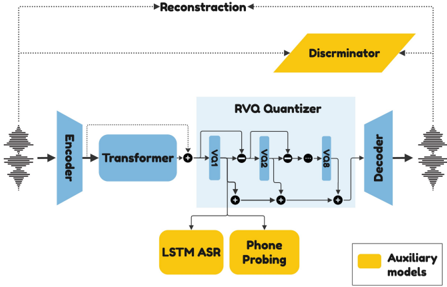
PAST builds on EnCodec’s convolutional encoder-decoder with RVQ quantization and adds two components:
Transformer encoder. Inserted between the convolutional encoder and the RVQ module, an 8-layer transformer encoder (hidden size 768, 16 attention heads, feed-forward 2048) models sequence-level dependencies. To stabilize training and prevent the transformer from being bypassed, a stochastic skip-connection is used: during training the input to the RVQ is sampled from (a) transformer output only (p=0.3), (b) skip (encoder output, p=0.1), or (c) their average (p=0.6). During inference, only the average is used.
Supervised auxiliary heads on the first RVQ codebook (VQ1). Two auxiliary loss heads operate on the first-codebook output ẑ₁:
- CTC character match: a BiLSTM head with linear projections applies CTC loss against character transcriptions obtained via Wav2Vec2 alignment. CTC is shown to be the dominant phonetic supervision signal in ablations.
- Phoneme classification: a linear projection applies cross-entropy against TIMIT phoneme labels (10% of training batch).
Training data is LibriSpeech (960h) + TIMIT (5h phoneme-labeled). Training uses 2 × A100 GPUs for 400k steps. The model has 185M parameters total (68M in the transformer, 4M in auxiliary heads), with 8 RVQ codebooks at 50Hz frame rate.
Streamable variant. PAST-Streamable replaces the transformer with a causal self-attention and unidirectional LSTM, uses left-only padding, and operates with a 20ms look-ahead window. This enables real-time applications.
Key Results
Phonetic metrics (PNMI, ABX, WER on discrete tokens, DASB benchmark): PAST achieves PNMI=0.75 (vs. SpeechTokenizer 0.72, X-Codec 0.40), ABX-within 2.82 (vs. SpeechTokenizer 3.43), WER test-clean 15.7% (vs. SpeechTokenizer 18.5%, X-Codec 17.1%), WER test-other 36.8% (vs. SpeechTokenizer 41.3%). PAST-Streamable also surpasses baselines: PNMI=0.74, ABX-within 3.05, WER clean 14.3%.
Reconstruction (LibriSpeech test-clean): PAST SISNR=4.84, VISQOL=4.40, PESQ=3.55 — all substantially better than SpeechTokenizer (SISNR=0.44, PESQ=3.15) and X-Codec (SISNR=-7.12). Only EnCodec (the pure acoustic topline) exceeds PAST on reconstruction (SISNR=7.49, PESQ=3.88).
Speech language modeling (sWUGGY, identical 300M LM trained per tokenizer): PAST achieves 71.8/57.5 (Inter/OOV) vs. SpeechTokenizer 63.7/55.6, X-Codec 55.1/52.9, and even k-means HuBERT 67.9/55.4.
Ablation over components: CTC loss is the single most important addition (ABX-within drops from 21.2 to 4.42 with CTC added alone); phoneme classification adds further modest gains; the transformer encoder is necessary to avoid reconstruction degradation when CTC is added.
Novelty Assessment
The key insight — that supervised phonetic data (CTC on characters + phoneme classification) can replace SSL pseudo-label distillation in hybrid tokenizers — is well-supported and practically impactful. It simplifies the pipeline (no external SSL model needed), potentially lowers cost for low-resource languages (only 965h of labeled data needed), and achieves better performance. The stochastic skip-connection to prevent transformer bypass is a practical training-stability contribution. The streamable variant is a useful engineering contribution for real-time applications. The approach is a direct challenge to the prevailing assumption that SSL pseudo-labels are necessary for hybrid tokenization.
Field Significance
Moderate — PAST demonstrates that direct phonetic supervision via CTC and phoneme classification is a viable and more effective alternative to SSL pseudo-label distillation in hybrid speech tokenizers, simplifying the pipeline while improving both phonetic representation and reconstruction quality. The result provides a cleaner design point for the codec-level foundation of speech language models, though scalability to multilingual and low-resource settings remains an open question.
Claims
- Supervised phonetic data (CTC and phoneme classification) can replace SSL pseudo-label distillation as the phonetic supervision signal in hybrid speech tokenizers, achieving superior phonetic representation without requiring a pretrained SSL model. (§3.3, §5.1, Table 1)
- CTC character-match loss is the dominant driver of phonetic encoding quality in RVQ-based tokenizers, contributing more than phoneme classification alone. (§5.3, Table 4)
- A transformer encoder inserted before the RVQ quantizer improves phonetic representation, but requires stochastic skip-connection dropout during training to prevent the network from bypassing it. (§3.2, §5.3, Table 5)
- Hybrid tokenizers that optimize phonetic encoding via direct supervision can approach pure acoustic codecs in reconstruction quality while substantially surpassing SSL-distilled baselines. (§5.1, Table 2)
- Speech tokenizers that better encode phonetic structure yield stronger downstream speech language model performance on lexical discrimination benchmarks. (§5.2, Table 3)
Limitations and Open Questions
PAST requires labeled phoneme/character data, which constrains multilingual scalability — the paper explicitly acknowledges this and targets it as future work. PAST’s reconstruction quality (SISNR=4.84) falls below pure EnCodec (SISNR=7.49), reflecting the phonetic-acoustic trade-off. The model is 185M parameters, larger than some baseline tokenizers, partly due to the transformer encoder. Evaluation is English-only on clean speech; robustness to noise, accents, and spontaneous speech is not assessed.
Wiki Connections
PAST is a direct contribution to the neural-codec concept, advancing the state of art in hybrid tokenizers. It competes with and improves over SpeechTokenizer (a key prior work in neural-codec). The CTC and phoneme supervision approach connects to self-supervised-speech — PAST argues for replacing SSL with explicit supervision. The streamable variant extends streaming-tts applicability to codec-level tokenization. As a foundation for speech language models, it is foundational to the autoregressive-codec-tts paradigm.