EMNLP · 2025 · Conference
Zhengyan Sheng et al. (University of Science and Technology of China / Alibaba Group) · → Paper · Demo: ✓ · Code: ?
Proposes UniSpeaker, the first framework to unify speaker generation from arbitrary combinations of voice-description modalities (face image, text description, reference speech, relative voice-attribute edits) into a single speaker-embedding space for downstream text-to-speech and voice conversion.
Problem
Zero-shot speech synthesis conditioned on a reference speech clip works well when an ideal reference recording is available, but many use cases (virtual character voiceover, character design from a description or portrait) have no reference speech at all. Prior work has explored generating a speaker’s voice from a single alternative modality, such as a face image or a text description, by aligning that modality’s representation with a speaker embedding. However, each of these systems handles its modality in isolation: face-driven, text-driven, and attribute-editing approaches are separate models trained on separate, small paired datasets. This creates two problems: paired multimodal-to-speech data is scarce, producing a sparse timbre space and poor voice diversity, and the mapping between a modality (e.g., a face) and a voice is inherently one-to-many, so absolute descriptions alone under-constrain the desired voice and existing systems lack any mechanism to jointly coordinate multiple modalities or refine the result once generated.
Method
UniSpeaker builds on CosyVoice’s frozen backbone: an autoregressive LLM that predicts semantic tokens from text or source speech, and a conditional flow matching (CFM) model that converts semantic tokens plus a speaker embedding into a Mel-spectrogram. Because CosyVoice’s semantic tokens already separate content and prosody from speaker identity relatively cleanly, the authors treat it as an ideal backbone for injecting a new, non-speech-derived speaker embedding without touching the LLM.
Three modality-specific encoders extract representations for each supported voice-description modality: MTCNN + FaceNet for face images, T5 for text descriptions, and a pretrained speaker-verification network (CAM++) for reference speech. These representations are projected into a shared latent space by a Multimodal Voice Aggregator (MVA) built around a novel module the authors call KV-Former: a lightweight transformer in which the modality representations act as attention queries against a shared bank of learnable key-value vectors, forming an information bottleneck that forces the different modalities toward a common, coordinated voice representation. The MVA’s output speaker embedding is fed into the frozen CFM in place of the usual reference-derived speaker embedding.
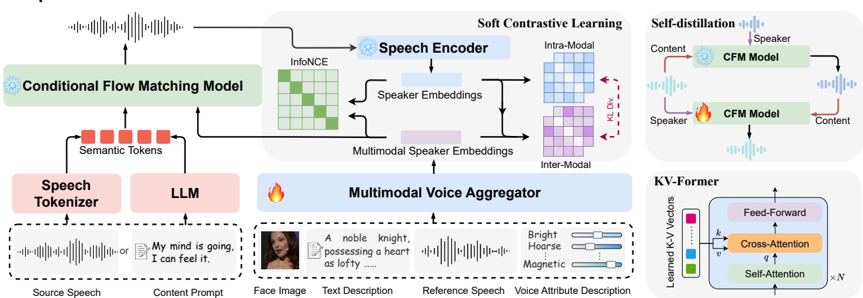
Training the MVA on the CFM’s flow-matching objective alone converges slowly and produces voice mismatches, so the authors add Soft Contrastive Learning (SoftCL): an InfoNCE-style inter-modal alignment loss between each modality’s embedding and speech-derived speaker embeddings (“speech-anchoring,” avoiding the need for parallel data between non-speech modalities), plus an intra-modal consistency term that uses the similarity distribution among speech-only speaker embeddings as a soft target for the corresponding cross-modal similarity distribution, with a negative-disentanglement re-weighting so that positive pairs do not dominate the soft-label distribution. A separate self-distillation stage addresses a failure mode the authors observe empirically: without it, the frozen CFM tends to extract speaker identity from the semantic-token stream itself (leaking source-speaker identity) rather than from the injected speaker embedding, since it was trained with a Mel-spectrogram prompt that dominates over the speaker-embedding signal. To fix this, the model first generates converted speech using its own outputs (source semantic tokens plus a randomly sampled speaker embedding, no Mel prompt) and is then fine-tuned to reconstruct the original source speech from the converted speech’s semantic tokens and the original speaker embedding, with the Mel-spectrogram prompt removed entirely. This increases the dominance of the speaker-embedding input relative to the semantic-token stream at inference time. The system also supports relative voice-attribute editing (following prior work, VoxEditor): given two reference speech samples and a text description of how one differs from the other, an MLP predicts an interpolation weight between the two speakers’ embeddings, allowing continuous, text-guided voice adjustment.
Training used four NVIDIA V100 32GB GPUs for 30K steps with AdamW (learning rate 1e-5, 10K warmup steps), an 8-layer MVA with 128 key-value slots and 768-dim attention (§5.1, Table 8).
Key Results
UniSpeaker was benchmarked against 11 task-specific expert models across five tasks (FaceTTS, FaceVC, TextTTS, TextVC, and attribute editing/AVE) on a newly constructed Multimodal Voice Control (MVC) benchmark, measuring voice suitability (Speaker Similarity with Target, SST; Speaker Similarity Consistency, SSC; MOS-Match), voice diversity (Speaker Similarity Diversity, SSD), and speech quality (WER, MOS-Nat) (§4, Table 2). UniSpeaker outperformed every modality-specific baseline on SST and SSD across all five tasks, e.g., FaceTTS SST rose from 10.97% (best baseline, SYNTHE-SEES) to 12.48%, while SSD (lower is better, indicating more diverse voices) dropped from 30.78–32.17% down to 14.09%. WER also improved sharply relative to baselines (e.g., FaceTTS WER 4.01% vs. 7.09–9.14% for baselines), attributed to keeping the CFM backbone frozen. MOS-Nat matched or exceeded baselines in four of five tasks, trailing CosyVoice-Instruct only slightly on TextTTS (3.87 vs. 3.91), which the authors attribute to the CFM occasionally learning noise patterns from the multimodal training data.
Ablations (§5.3, Table 3) show that removing the KV-Former-based MVA (replaced implicitly with a simpler aggregation) and removing SoftCL each degrade SST, SSD, and SSC, with SoftCL removal producing the largest quality drop, particularly for edge-case speakers (e.g., very young or elderly faces default toward young-adult-sounding voices). Removing self-distillation reduces SST substantially (e.g., FaceTTS 44.30% to 38.49% on the internal ablation split, VC 39.37% to 31.07%), confirming it is necessary for the speaker embedding (rather than the semantic tokens) to dominate voice control at inference. A data-scaling study (§5.3, Figure 3) shows FaceVC/FaceTTS performance improving monotonically with more multimodal training data, while SSC is comparatively insensitive to data scale. A multimodal fusion experiment (§5.5, Table 4) shows that combining face and text embeddings through the MVA (SST 22.13%, MOS-Match 3.97) outperforms either modality alone (Face: SST 10.71%, Text: SST 19.26%), evidence that the shared voice space genuinely coordinates modalities rather than just concatenating them.
Novelty Assessment
The core novelty is architectural: KV-Former is a new (if structurally simple) cross-attention aggregation module for pulling together heterogeneous speaker-relevant modalities into one embedding via a shared, learnable key-value bottleneck, combined with a specific training recipe (SoftCL’s negative-disentangled soft-label distillation, plus the self-distillation fine-tuning stage) that is shown by ablation to matter substantially, not just cosmetically. The individual components draw on established ideas from other domains (Q-Former-style aggregation, ImageBind-style modality anchoring, InfoNCE contrastive alignment, self-distillation), so the contribution is an integration and adaptation of these ideas to the specific problem of coordinating multiple, mismatched speaker-description modalities without parallel data, rather than a wholly new modeling paradigm. The introduction of the first public multimodal voice control benchmark, spanning five distinct tasks with defined suitability/diversity/quality metrics, is a separate and valuable contribution on its own, since no prior common evaluation protocol existed for comparing face-driven, text-driven, and attribute-editing voice control systems.
Field Significance
High
High — This paper is the first to demonstrate that a single trained model can coordinate voice control from multiple, structurally different description modalities (face, text, reference speech, relative attribute edits) rather than requiring one bespoke model per modality, and it establishes the first shared benchmark for comparing such systems. Both the unification result and the benchmark give the sub-area a concrete point of comparison it previously lacked.
Claims
- supports: A frozen zero-shot TTS/VC backbone whose semantic tokens already separate content and prosody from speaker identity can be repurposed as a general-purpose speaker-control interface for modalities the backbone was never trained on, by learning only a lightweight adapter that produces a compatible speaker embedding.
Evidence: Freezing CosyVoice’s LLM and CFM while training only the MVA adapter allows the system to accept face, text, and attribute-edit conditioning while matching or exceeding CosyVoice-Instruct’s own speech quality (MOS-Nat) on the text-conditioned task. (§5.2, Table 2)
- supports: Aligning heterogeneous conditioning modalities to a shared speaker-embedding space through a common set of learnable key-value vectors, rather than training separate pairwise alignment models per modality, improves both how well the generated voice matches the intended description and how diverse the resulting voices are.
Evidence: Ablating the KV-Former-based MVA reduces SST and SSC and increases SSD (worse diversity) across FaceTTS and FaceVC compared to the full system. (§5.3, Table 3)
- complicates: Injecting a non-reference-derived speaker embedding into a flow-matching TTS backbone that was originally trained with a strong reference-audio (Mel-spectrogram) prompt is undermined by the backbone’s tendency to keep leaking speaker identity from the semantic-token stream unless an explicit disentangling training stage is added.
Evidence: Without the self-distillation fine-tuning stage, SST drops substantially on both the FaceTTS-style ablation split and the VC task (e.g., 39.37% to 31.07% for VC), and a preliminary experiment integrating face embeddings directly into an unmodified CosyVoice CFM produced almost no speaker conversion at all (SSIM ≈ 4.8). (§5.3, Table 3; §A.3)
- complicates: Multimodal, one-to-many voice-description modalities such as face images or short text descriptions carry substantially coarser speaker information than a Mel-spectrogram prompt derived from real reference audio, so systems built on this kind of conditioning should be expected to under-perform true voice-cloning quality even when the alignment mechanism itself is effective.
Evidence: Comparing CFM speaker control with and without the Mel-spectrogram prompt on zero-shot voice conversion shows the Mel-spectrogram prompt carries substantially more voice information than the speaker embedding alone, motivating the paper’s own framing of coarse speaker embeddings as sufficient only as an alignment anchor. (§A.1, Table 5)
- supports: A soft, distribution-matching contrastive objective that treats within-modality (e.g., speech-to-speech) similarity as a soft target for cross-modal similarity, rather than enforcing hard one-to-one contrastive pairs, better handles the natural one-to-many correspondence between a voice-description modality and plausible voice identities.
Evidence: Removing SoftCL (leaving only standard flow-matching training of the MVA) degrades SST, SSD, and SSC across every ablated task, with the largest effect on edge-case speakers such as elderly or very young faces defaulting to young-adult-sounding voices. (§5.3, Table 3)
Limitations and Open Questions
The ~1000 hours of multimodal-paired training data (LRS3-TED, LibriTTS-P, VCTK-R, and an internally collected speaker-description dataset) is explicitly noted by the authors as insufficient for broad generalization, and the data-scaling ablation (§5.3, Figure 3) shows performance still improving with more data at the largest scale tested, meaning the reported numbers likely understate the ceiling of the approach and may not generalize to face styles or description phrasings outside the training distribution.
The face-conditioning pathway is trained and evaluated only on realistic photographic face images (LRS3-TED-derived, with an out-of-domain Asian-face test set); the authors note that stylized or non-photorealistic images (e.g., illustrations, avatars) are out of scope for the current model. The paper also does not report a way to jointly and adaptively weight more than two modalities at once beyond the simple two-modality interpolation experiment; combining three or more modalities with learned (rather than fixed or manually interpolated) weighting is left to future work. No model parameter count is reported, and code availability is not stated beyond the release of speech samples and the MVC benchmark on the project’s demo site.
Wiki Connections
- Speaker Adaptation — introduces a unified adapter that controls a frozen backbone’s target-speaker identity from face, text, reference-audio, or attribute-edit inputs rather than the usual single reference clip.
- Voice Conversion — evaluates FaceVC and TextVC as dedicated voice-conversion tasks with speaker-similarity metrics (SST, SSC, SSD) and a separate zero-shot VC comparison against FreeVC and FACodec.
- Zero-Shot TTS — builds directly on CosyVoice’s zero-shot TTS backbone, extending its conditioning beyond reference-speech prompts to arbitrary combinations of non-speech modalities.
- Disentanglement — applies a dedicated self-distillation fine-tuning stage specifically to separate speaker identity from the content/prosody carried in semantic tokens, shown by ablation to be necessary for effective non-speech-derived speaker control.
- Instruction-Conditioned TTS — supports natural-language voice-attribute editing (e.g., “sounds more magnetic”) that interpolates between two reference speakers’ embeddings under text guidance, extending prior text-prompt voice control work (VoxEditor).
- CosyVoice — used as the frozen backbone LLM and conditional flow matching model; UniSpeaker’s semantic-token disentanglement argument and self-distillation stage are motivated directly by analyzing CosyVoice’s speaker-encoding behavior.
- VALL-E — cited as the representative large-scale neural codec language model approach to zero-shot TTS that the paper contrasts with CosyVoice’s semantic-token design for speaker disentanglement.
- Seed-TTS — the self-distillation technique UniSpeaker applies to improve speaker disentanglement is adapted from this paper’s approach.
- Audiobox — referenced as prior text-based style/attribute control work for speech generation that UniSpeaker’s text-driven voice control builds on and differentiates from (prosody/style control vs. speaker identity control).
- NaturalSpeech 3 — its FACodec is used as a zero-shot voice conversion baseline in the appendix comparison against CosyVoice and FreeVC.