arXiv · 2024 · Preprint
Philip Anastassiou et al. (ByteDance) · → Paper · Demo: ✓ · Code: ✗
Seed-TTS is a large-scale autoregressive TTS foundation model from ByteDance that achieves human-parity naturalness and speaker similarity in zero-shot in-context learning, and introduces self-distillation for timbre disentanglement and REINFORCE-based post-training to further improve robustness, speaker similarity, and controllability.
Problem
Prior zero-shot TTS systems based on codec language modeling (e.g., VALL-E, VALL-E variants, NaturalSpeech 2/3, Voicebox) still fell substantially short of human speech quality, typically scoring below -1 CMOS against human speech in subjective evaluations. Autoregressive LM-based systems also suffered from robustness issues: hallucinations, repetitions, and instability under challenging text inputs. Additionally, attribute disentanglement (separating timbre from content and prosody) required specialized loss functions or architectural modifications that were difficult to integrate into a general-purpose foundation model.
Method
Seed-TTS is an autoregressive transformer built around four components: a speech tokenizer, a token language model, a token diffusion model, and an acoustic vocoder. The speech tokenizer converts speech into a sequence of tokens; the paper investigates both continuous and discrete tokenizers, noting that tokenizer design is critical to overall system quality. The language model (trained on paired text+speech token sequences) autoregressively generates speech tokens conditioned on text and an audio prompt. A diffusion transformer then refines these tokens into continuous vocoder features in a coarse-to-fine manner. Finally, a BigVGAN-style acoustic vocoder produces the waveform.
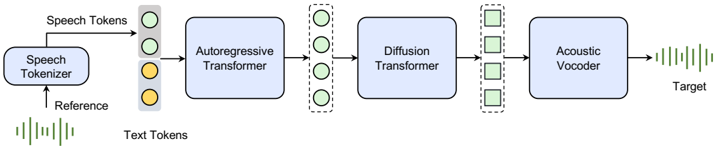
The system follows a three-stage LLM-style training recipe: large-scale pre-training on proprietary data (much larger than prior systems), speaker fine-tuning + instruction fine-tuning (enabling emotion control via IFT), and RL-based post-training. For post-training, REINFORCE is used with two reward configurations: Seed-TTS-RL-SIM-WER (WER + speaker similarity as rewards) and Seed-TTS-RL-SER (speech emotion recognition accuracy as reward). DPO is also explored.
Self-distillation for timbre disentanglement: Speaker perturbation is applied to the diffusion module during generation to produce synthetic pairs (S_ori, S_alt) sharing content and prosody but differing in timbre. The diffusion model is then retrained to recover S_ori’s vocoder embeddings given S_alt’s token sequence and S_ori’s timbre reference — forcing it to ignore timbre in the token stream and rely only on the explicit timbre embedding. This enables zero-shot voice conversion without architectural changes.
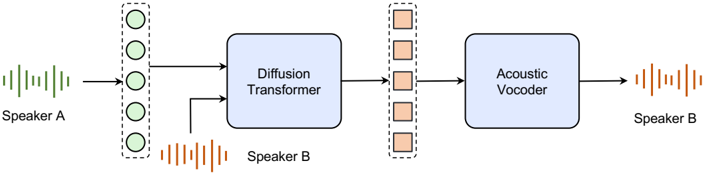
Seed-TTSDiT (NAR variant): A fully diffusion-based architecture (Diffusion Transformer / DiT) that directly maps Gaussian noise to vocoder latents conditioned on text, audio prompt, and a total duration signal. Unlike earlier NAR systems, it skips per-phoneme duration prediction, instead estimating total duration and letting the model dynamically align text to audio. Supports content editing (masking and infilling) and speaking rate editing.
For deployment, causal diffusion architecture enables streaming with low first-packet delay. Consistency distillation and flow matching reduce diffusion inference steps. GQA, paged attention, flash attention, and model quantization are applied to the LM component.
Key Results
Zero-shot ICL (Table 1, 10):
- Seed-TTS ICL: EN WER 2.249, SIM 0.762, CMOS -0.07 vs. human (effectively indistinguishable)
- Seed-TTS ICL: ZH WER 1.115, SIM 0.796, CMOS -0.08 vs. human
- Seed-TTSDiT: EN WER 1.733, SIM 0.790 — superior SIM to the autoregressive variant
RL post-training (Tables 7, 8, 9):
- RL-SIM-WER reduces EN WER from 2.249→1.945, ZH WER 1.115→1.002, ‘Hard’ set 7.585→6.423
- CMOS of RL-SIM-WER vs. ICL: +0.14 preference win
- RL-SER improves emotion control from (0.46, 0.44, 0.53, 0.13) to (0.91, 0.80, 0.78, 0.82) across angry/happy/sad/surprise
Voice conversion (Table 6, self-distillation):
- Without self-distillation: SIM 0.491 EN, 0.636 ZH
- With self-distillation: SIM 0.753 EN, 0.791 ZH — far exceeding DiffVC (0.311) and HierSpeech++ (0.387)
Speaker fine-tuning (Table 3):
- SFT CMOS +0.37 over ICL baseline
Deployed model (Table 5):
- Latency 0.028× offline, RTF 0.132×, with CMOS only -0.02 vs. offline model
ASR data utility (Table 2): ASR model trained on synthetic Seed-TTS LibriSpeech data achieves WER within 0.31% absolute of real-data baseline on clean sets.
Novelty Assessment
Several genuinely novel contributions: (1) The self-distillation scheme for timbre disentanglement is elegant — no architectural changes, no new loss functions, purely data-driven via perturbation-generated pairs. (2) Systematic RL post-training applied to a TTS foundation model, empirically demonstrating reward hacking analogous to LLM RLHF. (3) Seed-TTSDiT’s end-to-end diffusion approach without per-phoneme duration prediction — estimating total duration only and learning local alignment implicitly — is a distinct architectural stance. (4) The paper is the first to demonstrate CMOS within 0.1 of human speech in a zero-shot in-the-wild setting, representing a credible milestone.
The work is primarily engineering-at-scale: the largest training dataset, largest model, and most comprehensive evaluation regime among contemporaneous TTS systems. The individual technical components (codec LM, diffusion refinement, RL fine-tuning) each have prior art; the contribution is their integrated execution at this scale.
Field Significance
Tip
High — Seed-TTS establishes a credible human-parity milestone in zero-shot TTS, providing a reference point that prompted a wave of subsequent systems to adopt Seed-TTS-Eval as their primary benchmark. Its self-distillation scheme for timbre disentanglement and REINFORCE-based post-training demonstrate that techniques from LLM alignment transfer directly to speech generation, opening a methodological direction for post-training in TTS. The public evaluation set (Seed-TTS-Eval) provides a standardised benchmark for cross-system comparison that the field has broadly adopted.
Claims
- Autoregressive codec language models trained at sufficient scale can generate zero-shot speech with naturalness and speaker similarity indistinguishable from human speech as measured by CMOS. (§3.1, Table 1)
- Self-distillation on perturbation-generated pairs is an effective method for timbre disentanglement in TTS systems, achieving large speaker similarity gains in voice conversion without modifying model architecture or loss functions. (§4.1, Table 6)
- Reinforcement learning post-training with objective speech quality rewards improves robustness and speaker similarity in autoregressive TTS while introducing reward hacking that must be carefully managed. (§4.2, Tables 7, 8)
- End-to-end diffusion models that predict total duration and learn local text-audio alignment implicitly can match or exceed the quality of autoregressive codec LM systems without per-phoneme duration supervision. (§4.3, Table 10)
- Synthetic speech generated by a high-quality zero-shot TTS system can train ASR models that approach real-data performance on clean test sets, though a gap persists on noisy sets due to background noise smoothing. (§3.1, Table 2)
Limitations and Open Questions
- Model weights not released; no reported parameter count.
- Zero-shot ICL struggles with speakers having strong accents or unique styles not captured in a short (15s) prompt — the fine-tuned model is still preferred for ‘hard’ speakers.
- Synthesized speech slightly over-smooths background noise (ASR degrades on noisy test sets).
- Does not handle singing or speech with background music well.
- Reward hacking (over-slow, over-articulated speech) in RL post-training requires careful tuning.
- Multi-shot ICL for long-form generation not yet demonstrated.
Wiki Connections
Seed-TTS is one of the landmark zero-shot TTS systems alongside 2301.02111 (VALL-E) and is cited as a baseline or reference by 2407.05407 (CosyVoice), 2412.10117 (CosyVoice 2), and 2410.06885 (F5-TTS). Its self-distillation approach extends the disentanglement concept without requiring specialized architectures. The RL post-training places it in the rlhf-speech literature alongside DPO-based approaches. The Seed-TTSDiT variant represents the diffusion-tts paradigm applied at foundation-model scale. The deployed model’s streaming design connects to streaming-tts.
Citing papers in this corpus (integrated 2026-05-29): 2512.04720 (M3-TTS) uses Seed-TTS-Eval as the primary evaluation benchmark; 2603.29339 (LongCat-AudioDiT) compares against Seed-TTSDiT on Seed-ZH; 2512.13251 (DisCo-Speech) uses SEED-TTS-Eval for voice cloning evaluation. Further citing papers: 2508.04141 (Parallel GPT) benchmarks against CosyVoice (which Seed-TTS inspired); 2511.12347 (VoiceCraft-X) uses Seed-TTS-Eval for multilingual evaluation; 2601.03888 (IndexTTS 2.5) cites Seed-TTS as a primary baseline for its multilingual system; 2603.18090 (MOSS-TTS) evaluates against Seed-TTS-Eval; 2603.26364 (LLaDA-TTS) uses Seed-TTS-Eval as its primary benchmark; 2604.01760 (T5Gemma-TTS) uses Seed-TTS-Eval for zero-shot evaluation. New citing papers (integrated 2026-05-30): interspeech-2025-0704 (DiffRO) uses seed-tts-eval as primary benchmark (achieves WER 0.78% zh — halving the baseline); interspeech-2025-0648 (MIKU-PAL) cites Seed-TTS as context for speech LM training data scale. New citing papers (integrated 2026-06-03): interspeech-2025-0468 (DualCodec) evaluates using seed-tts; interspeech-2025-1641 (phoneme position prediction) uses Seed-TTS test-zh as evaluation benchmark; interspeech-2025-2447 (SSD) uses Seed-TTS in context for AR TTS systems; interspeech-2025-2449 (EPSS) evaluates on Seed-TTS-eval test-en and test-zh.
2406.18009 — E2 TTS: Embarrassingly Easy Fully Non-Autoregressive Zero-Shot TTS 2407.08551 — Autoregressive Speech Synthesis without Vector Quantization 2501.06282 — MinMo: A Multimodal Large Language Model for Seamless Voice Interaction 2502.11946 — Step-Audio: Unified Understanding and Generation in Intelligent Speech Interaction 2507.16632 — Step-Audio 2 Technical Report