Interspeech · 2025 · Conference
Changfeng Gao et al. (Alibaba Group (Tongyi Lab)) · → Paper · Demo: ? · Code: ?
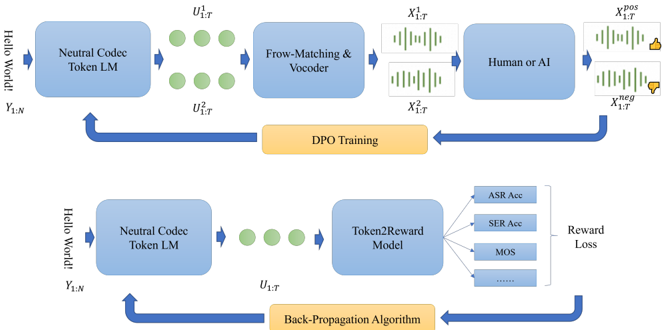
DiffRO applies RLHF to neural codec LM-based TTS by predicting rewards directly from codec tokens (bypassing the FM + vocoder), using Gumbel-Softmax to make the reward differentiable for direct backpropagation, achieving SOTA WER on seed-tts-eval and enabling zero-shot emotion/quality control via a multi-task reward model.
Problem
Applying RLHF to neural codec LM-based TTS faces three specific challenges not present in text LLM RLHF: (1) The TTS pipeline requires a flow-matching model and vocoder to convert codec tokens to audio for reward computation, creating substantial computational overhead that makes large-scale RLHF data generation expensive. (2) Diverse token sequences from the same text tend to produce highly similar audio, making it difficult to construct clearly differentiated positive/negative pairs for reward model training. (3) TTS quality is multi-dimensional (pronunciation, naturalness, speaker similarity, emotion) and cannot be adequately captured by a single binary good/bad label.
Method
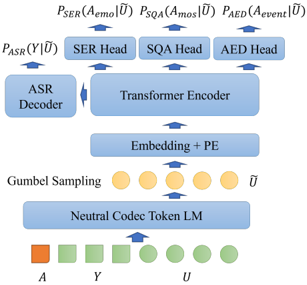
Token2Reward prediction. Instead of decoding codec tokens to audio before computing rewards, DiffRO trains a reward model that operates directly on predicted codec token sequences. The language model generates a codec token sequence Ũ via autoregressive sampling, then the reward model predicts the ASR transcript from Ũ. The reward is the log-probability that the predicted transcript matches the input text — effectively using ASR performance on the codec token space as a proxy for pronunciation quality. To make this differentiable for end-to-end optimization, Gumbel-Softmax replaces the argmax token sampling operation, allowing gradients to flow from the reward signal back through the LM parameters without PPO’s policy gradient loop.
Multi-Task Reward (MTR) model. A codec-based speech understanding model is trained jointly on four downstream tasks: ASR (WER), speech emotion recognition (SER, cross-entropy), speech quality assessment (SQA, MOS prediction via 5-class CE), and audio event detection. SenseVoice’s CNN front-end is replaced with an embedding layer that accepts codec token inputs; attention pooling heads are added per task. Training uses 13,000+ hours of in-house ASR data with pseudo-labels for emotion (cross-entropy), MOS (5-class classification), age/gender (CE/MSE), and events (binary CE). The MTR model is used as a reward to guide the LM to generate tokens that carry desired attribute information.
Training setup. The baseline system is CosyVoice 2.0-0.5B. SFT fine-tuning uses 4,000 samples from 5 speakers (mostly Mandarin). RL training uses 10,000 Internet-sourced texts (90% Chinese/English, 10% Japanese/Korean). β=0.1 KL penalty, lr=1e-5, 4 × A800 GPUs.
Instruction template for MTR control. “Your emotion is E ⟨endofprompt⟩ text ⟨s⟩ tokens ⟨/s⟩” — emotion is controlled by maximizing the SER reward log P(Aemo = E | Ũ).
Key Results
ASR-based DiffRO (pronunciation accuracy): On seed-tts-eval, CosyVoice2.0 + DiffRO-ASR achieves WER 0.78% (zh), 1.89% (en), 5.58% (hard) — compared to baseline 1.56%/2.75%/6.91%. This is SOTA on seed-tts-eval zh and hard. Applied to the SFT model, DiffRO-ASR (1.09% zh) outperforms DPO (1.27% zh). Multilingual generalization without explicit RL data: Japanese WER improves from 9.13% to 6.36%, Korean from 7.43% to 5.41%, because the ASR reward teaches the LM to produce phonetically accurate codec tokens in the codec’s implicit multilingual space.
MTR-based DiffRO (emotion control): On EmoBox benchmark (100 samples per emotion, Chinese and English), DiffRO-MTR achieves emotion accuracy: Happy zh/en 1.00/0.92, Sad zh/en 0.76/0.96, Angry zh/en 0.84/0.92 — compared to CosyVoice2.0 baseline: 0.92/0.80, 0.52/0.84, 0.76/0.80. DiffRO-MTR also outperforms F5-TTS and GPT-SoVITS in most emotion categories. Notably, the LM learns to generate laughter, sobs, and breaths to convey emotion — without any emotion-labeled training data in the RL phase.
MOS control: DiffRO can shift the codec-level predicted MOS toward a target (MOS_t=2: codec MOS drops to 2.2 from 3.82 baseline; MOS_t=4: codec MOS rises to 3.96). However, the FM and vocoder largely denoise the output, so audio MOS change is modest (3.77–3.86), highlighting that quality is mostly determined by post-LM stages.
Token2Reward model accuracy: The MTR model outperforms domain-specific models on SQA (LCC 0.65 vs DNSMOS 0.61) and Age/Gender (65.8% vs Qwen-Audio 58.8% on Age), though ASR WER is slightly worse than SenseVoice (7.7% vs 7.59% zh).
Novelty Assessment
The Gumbel-Softmax trick applied to codec token sampling to make RLHF fully differentiable is the most technically novel contribution — it eliminates the PPO/DPO loop for the LM optimization step. Computing rewards directly on codec tokens (bypassing FM+vocoder) is a practical speedup that also sidesteps the diversity problem. The MTR model as a multi-dimensional reward is a natural extension but requires substantial training infrastructure. The emergent multilingual generalization and learned paralinguistic vocalizations (laughter, breaths) from the emotion reward are interesting byproducts. The approach is built on and validated with CosyVoice 2.0 specifically.
Field Significance
Tip
High — DiffRO introduces a genuinely new mechanism for applying RLHF to codec LM-based TTS: by operating rewards directly on codec tokens and using Gumbel-Softmax to make token sampling differentiable, it removes the most expensive bottleneck in TTS RLHF pipelines (audio decoding) and enables gradient-based optimization without PPO. The multi-task reward model further provides a practical template for multi-dimensional speech quality optimization beyond simple pronunciation accuracy.
Claims
- Computing rewards directly on codec tokens rather than synthesized audio reduces the computational cost of RLHF for codec LM-based TTS systems without sacrificing reward signal quality. (§3.1)
- Differentiable reward optimization via Gumbel-Softmax can replace PPO-style policy gradient training for codec LM fine-tuning, enabling direct backpropagation through the reward model. (§3.1, §2.2)
- A multi-task reward model trained on codec tokens can simultaneously improve pronunciation accuracy, emotion expressiveness, and audio quality in a single RL training phase. (§3.2, §4.3)
- RLHF fine-tuning on Mandarin and English data generalizes to unseen languages (Japanese, Korean) when the reward signal targets phonetic accuracy rather than language-specific patterns. (§4.2, Table 2)
- Quality attributes governed primarily by the flow-matching and vocoder stages (MOS, speaker characteristics) are largely resistant to optimization by LM-level RLHF alone. (§4.3.2, Table 4)
Limitations and Open Questions
DiffRO only optimizes the LM component; the FM and vocoder are frozen, which limits the impact of rewards that primarily affect post-LM processing (e.g., speaker age/gender, which are partly determined by the FM). The MTR reward model requires a large in-house multi-task labeled corpus (13,000+ hours) that is not publicly available, limiting reproducibility. The approach is validated only on Mandarin-focused data; generalization to languages with distinct phonological properties (tonal, agglutinative) needs further study. Constructing diverse RL training data remains nontrivial.
Wiki Connections
DiffRO is a direct contribution to rlhf-speech, advancing the state of the art beyond DPO for codec LM-based TTS. It builds on autoregressive-codec-tts — specifically CosyVoice 2.0 (CosyVoice 2.0) — as the base system. The emotion control experiment connects to emotion-synthesis. The MTR model draws on ideas from evaluation-metrics by operationalizing multiple evaluation dimensions as differentiable rewards. SeedTTS (SeedTTS) provides the seed-tts-eval benchmark used for evaluation. F5-TTS (F5-TTS) is included as an emotion control baseline.
Related RLHF-for-TTS work from Interspeech 2025: DLPO applies RLHF to diffusion TTS rather than codec LM TTS, using the original DDPM loss as a reward penalty. DiffRO and DLPO together establish RLHF as applicable across both major TTS paradigms (AR codec LM and diffusion), with DiffRO’s Gumbel-Softmax differentiable sampling vs. DLPO’s task-specific loss regularization as complementary solutions to the RL credit assignment problem in TTS.