arXiv · 2024 · Preprint
Zhihao Du et al. (Alibaba Group) · → Paper · Demo: ✓ · Code: ✓
CosyVoice 2 extends CosyVoice with three key changes — FSQ for full codebook utilization, a Qwen2.5-0.5B LLM backbone replacing the custom LM, and a chunk-aware causal flow matching model — achieving human-parity synthesis quality in a unified streaming/non-streaming framework with virtually lossless streaming performance on typical test cases.
Problem
CosyVoice’s VQ-based speech tokenizer used only 23% of its 4096-code codebook, discarding semantic information. The custom text encoder + LM architecture underutilized the contextual understanding capacity of pre-trained LLMs. Most importantly, no well-established streaming solution existed for hybrid LM+flow-matching TTS systems: the flow matching model required all speech tokens before decoding, creating high latency incompatible with interactive voice chat applications. Additionally, the original CosyVoice had separate zero-shot and instruct models; CosyVoice 2 unifies them.
Method
CosyVoice 2 maintains the two-stage architecture of its predecessor (LM → flow matching → vocoder) but systematically upgrades each component:
FSQ Speech Tokenizer: Replaces VQ with Finite Scalar Quantization (FSQ) inside the SenseVoice-Large ASR encoder. FSQ projects intermediate representations into a D-dimensional low-rank space and quantizes each dimension to [-K, K] via a bounded round operation. The codebook size is (2K+1)^D = 6,561 codes. t-SNE visualization and speaker identification experiments confirm FSQ tokens are speaker-independent (SID training on quantized tokens does not converge). FSQ achieves 100% codebook utilization vs. 23% for VQ, and reduces ASR error rate from 18.26% to 10.67% on CommonVoice EN — indicating substantially more semantic content is preserved.
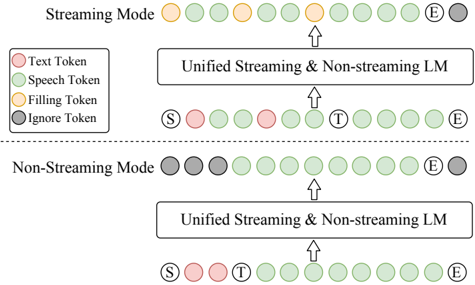
Unified Text-Speech LM: Uses Qwen2.5-0.5B as the backbone, removing the text encoder and speaker embedding from the sequence entirely. Two training modes share one model: (1) Non-streaming: [S, text tokens, T, speech tokens, E]; (2) Streaming: text and speech tokens are interleaved at ratio N:M=5:15 — every 5 text tokens are followed by 15 speech tokens, with “filling tokens” inserted when text tokens are not yet available. Both sequences are trained simultaneously, enabling a single model to handle both modes at inference.
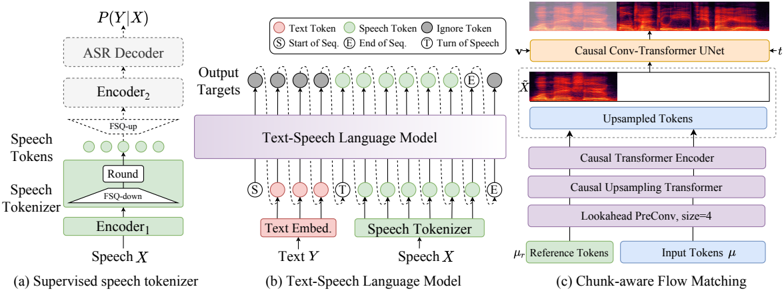
Chunk-aware Causal Flow Matching: The flow matching model is trained with four mask types simultaneously: non-causal (offline, best quality), full-causal (lowest latency), Chunk-M (past + M future frames), and Chunk-2M (near-offline quality with moderate latency). Training with all four masks provides implicit self-distillation (more-context masks teach less-context masks). The unfolded multi-step ODE (10 NFE) is treated as a stacked network to enable causal application.
Instructed Generation: 1,500 hours of instruction data integrated into base training. Natural language instructions (emotion, speaking rate, dialect, role-playing) prepended via <|endofprompt|>. Fine-grained instructions: [laughter], [breath], <strong>, <laughter>. ICL and instruction are unified in a single model.
RL Post-training: DPO with WER+SS rewards for speaker fine-tuning. A differentiable ASR reward (Gumbel-softmax sampling through FSQ indices → frozen ASR decoder) avoids the four-forward-pass overhead of standard DPO and generalizes better to out-of-domain/hard cases.
Key Results
Codebook (Table 4): FSQ: 100% utilization, ASR error 10.67% EN vs. VQ: 23% utilization, ASR error 18.26% EN.
LibriSpeech test-clean (Table 5, EN): CosyVoice 2: WER 2.47%, NMOS 3.96, SS 0.745. Human: WER 2.66%, NMOS 3.84, SS 0.697. CosyVoice 2 surpasses human on all three metrics.
SEED test sets (Table 6):
- test-zh: CosyVoice 2 CER 1.45% vs. CosyVoice 3.63%, Seed-TTS 1.12%
- test-en: WER 2.57% vs. CosyVoice 4.29%, F5-TTS 1.83%
- test-hard: WER 6.83% vs. CosyVoice 11.75%, Seed-TTS 7.59%, F5-TTS 8.67%
Streaming (Table 8): Streaming LM + streaming FM (M4): CER 1.45% zh, WER 2.38% en, WER 8.08% hard — virtually lossless on typical cases, small degradation on hard cases only.
Ablation (Table 7): Each change contributes cumulatively: LLM init (+18.46% relative CER improvement on zh), drop spk emb (further -0.4%), FSQ (further -0.89%) from CosyVoice baseline.
Instruction (Table 10): CosyVoice 2 MOS-I 4.06 vs. CosyVoice-Instruct 3.09 — major improvement.
RL (Table 11): Combining differentiable ASR reward + DPO achieves best results on both in-domain speaker and SEED test sets.
Novelty Assessment
Three concrete innovations: (1) FSQ for speech tokenization is novel in this context and the codebook utilization gain is striking (23%→100%); (2) the unified streaming/non-streaming LM via interleaved text-speech tokens is a clean engineering solution to the streaming problem, requiring only sequence construction changes; (3) the chunk-aware multi-mask flow matching training is a principled way to give a single diffusion/flow model multiple latency profiles. The differentiable ASR reward for RL is also a cleaner alternative to iterative DPO. The work is clearly positioned as a technical report and is thorough in ablation.
Field Significance
Tip
High — CosyVoice 2 introduces a principled solution to streaming in hybrid LM+flow-matching TTS, a problem that had no established answer, while simultaneously demonstrating that FSQ codebooks substantially outperform VQ in semantic content preservation. The unified streaming/non-streaming framework and the chunk-aware causal flow matching design are reusable components that subsequent work has adopted directly, making this paper a meaningful inflection point for production-oriented speech synthesis systems.
Claims
- Finite scalar quantization achieves full codebook utilization in supervised speech tokenizers, capturing substantially more semantic content than vector quantization at equivalent bitrates. (§2.2, §4.1, Table 4)
- Replacing a randomly initialized custom LM with a pre-trained LLM backbone improves content consistency in hybrid TTS systems without requiring a separate text encoder. (§2.3, §4.3, Table 7)
- Streaming and non-streaming synthesis can be unified in a single autoregressive model through interleaved text-speech token sequences, with virtually lossless quality on typical inputs relative to offline mode. (§2.3, §4.2, Table 8)
- Training a flow matching model simultaneously on multiple causal mask types — from non-causal to full-causal — enables a single model to span the latency-quality trade-off continuum at inference time, with masks providing implicit self-distillation. (§2.4, §4.3, Table 8)
- Differentiable ASR reward optimization generalizes better to out-of-domain and hard-case inputs than preference-based DPO in TTS speaker fine-tuning. (§2.8, §4.7, Table 11)
Limitations and Open Questions
- EN quality still lags CosyVoice 2 behind Seed-TTS and F5-TTS on SEED test-en (WER 2.57% vs. 2.25% and 1.83%), reflecting data imbalance toward Chinese.
- Japanese synthesis degrades due to character set overlap with Chinese (CER 18.79% test-ja vs. 7.98% test-ko).
- Cannot control timbre through text instructions.
- Singing not supported.
- Streaming still incurs a hard degradation on test-hard, suggesting that contextual information from future text is important for difficult patterns.
Wiki Connections
CosyVoice 2 is the direct successor to 2407.05407 (CosyVoice), replacing VQ with FSQ and adding streaming. Its SEED test set evaluation benchmarks directly against 2406.02430 (Seed-TTS) and 2410.06885 (F5-TTS), providing one of the most comprehensive comparative evaluations among these contemporaneous systems. The FSQ tokenizer contribution connects to the neural-codec discussion about codebook utilization. The chunk-aware causal FM design advances streaming-tts. The RL fine-tuning approach (DPO + differentiable ASR reward) extends rlhf-speech. The Qwen2.5-0.5B backbone signals the field’s adoption of publicly available LLMs as TTS semantic models.
Citing papers in this corpus: 2506.21619 (IndexTTS2) adopts the S2M flow-matching pattern; 2510.12210 (DiSTAR) and 2603.29339 (LongCat-AudioDiT) benchmark against CosyVoice 2; 2508.16332 (Vevo2) extends the AR+FM paradigm; 2508.02038 (Marco-Voice) builds on CosyVoice1 pipeline; 2604.00688 (OmniVoice) compares SIM metrics; 2512.04720 (M3-TTS) compares WER on Seed-TTS; 2512.13251 (DisCo-Speech) compares VC disentanglement; 2603.08823 (Fish Audio S2) uses CosyVoice 2 tokenizer and compares multilingual results; LLaMA-Omni 2 uses CosyVoice 2 FSQ tokenizer and chunk-aware FM decoder. Further citing papers: 2508.04141 (Parallel GPT) benchmarks MOS against CosyVoice; 2511.12347 (VoiceCraft-X) compares against CosyVoice 2 on Seed-TTS; 2601.03888 (IndexTTS 2.5) builds on CosyVoice’s LLM+FM paradigm for multilingual extension; 2603.26364 (LLaDA-TTS) replaces CosyVoice’s AR stage with masked discrete diffusion; 2604.01760 (T5Gemma-TTS) proposes an alternative encoder-decoder conditioning to address decoder-only dilution present in CosyVoice-style architectures. New citing papers (integrated 2026-05-30): interspeech-2025-0704 (DiffRO) builds directly on CosyVoice 2.0 as the base codec LM for differentiable reward optimization, achieving WER 0.78% zh on seed-tts-eval; interspeech-2025-0648 (MIKU-PAL) cites CosyVoice 2.0 as an emotion control baseline in downstream TTS evaluation. New citing papers (integrated 2026-06-03): interspeech-2025-0739 (FD-Bench) cites CosyVoice 2 in streaming dialogue context; interspeech-2025-1344 (PEFT-TTS) uses CosyVoice 2 as a multilingual baseline comparison; interspeech-2025-2447 (SSD) uses CosyVoice 2 as the target AR LM for speculative decoding, achieving 1.4× speedup; interspeech-2025-2449 (EPSS) uses CosyVoice 2 as a comparison in the step-reduction evaluation. Integration pass 7 (2026-06-05): 2508.19205 (VibeVoice) compares against CosyVoice 2 as a baseline on SeedTTS; 2508.16790 (TaDiCodec) compares its AR system against CosyVoice 2 on WER/SIM metrics.
2501.06282 — MinMo: A Multimodal Large Language Model for Seamless Voice Interaction 2502.11946 — Step-Audio: Unified Understanding and Generation in Intelligent Speech Interaction 2507.16632 — Step-Audio 2 Technical Report