arXiv · 2025 · Preprint
Siyi Zhou et al. (bilibili) · → Paper · Demo: ✓ · Code: ?
IndexTTS2 introduces a duration-embedding alignment trick for autoregressive TTS that enables precise token-count control without sacrificing naturalness, and couples it with GRL-based emotion–speaker disentanglement and a distilled LLM emotion-routing module for fine-grained emotional expression in zero-shot synthesis.
Problem
Autoregressive TTS models produce highly natural speech but have no principled way to control output duration: the token-by-token generation process does not natively support fixed-length targets. This is a blocking limitation for applications like video dubbing where audio must align to visual timing. Separately, emotional expressiveness in large-scale zero-shot TTS remains weak because high-quality emotional training data is scarce and existing emotion conditioning approaches (label-based, CLAP-based, instruction-tuned) lack robustness across the affective range. Prior work addressed duration control primarily in non-autoregressive models; the predecessor IndexTTS offered no duration control at all.
Method
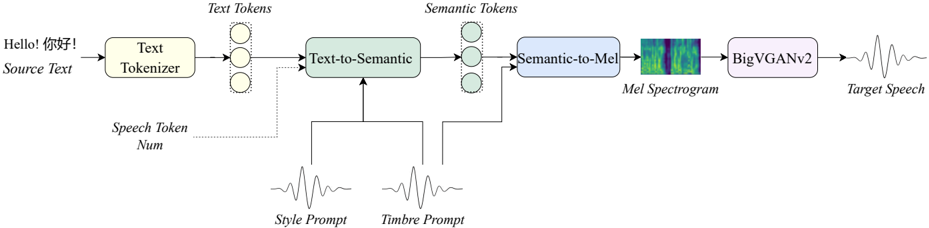
IndexTTS2 is a three-module cascade: a Text-to-Semantic (T2S) autoregressive transformer, a Semantic-to-Mel (S2M) flow-matching model, and a BigVGANv2 vocoder. It introduces two independent mechanisms layered onto this backbone.
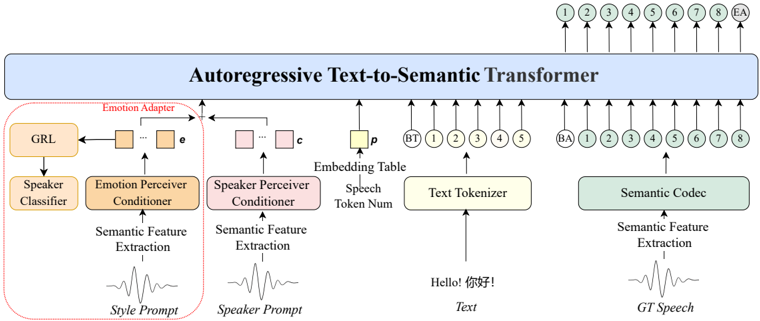
Duration control. T2S takes an optional target token count T as a duration embedding p = W_num · h(T), where h(T) is a one-hot vector over the maximum sequence length. The key constraint is W_sem = W_num: the duration embedding table is tied to the positional embedding table of the semantic tokens, so the autoregressive model naturally associates positional progress with the target endpoint. When p = 0 the model generates in free-form mode, faithfully reproducing the prosodic rhythm of the reference prompt.
Emotion disentanglement. A Conformer-based emotion perceiver extracts an emotion embedding e from the style prompt. A Gradient Reversal Layer (GRL) during training forces e to be invariant to speaker timbre, while a frozen speaker perceiver conditioner extracts c (timbre). The T2S input sequence becomes [c + e, p, E_text, E_sem]. Training uses a three-stage curriculum: (1) full dataset without emotion conditioning to establish base capability; (2) 135-hour emotional subset with emotion conditioner trainable and GRL active; (3) full dataset fine-tune with all conditioners frozen for robustness.
Text-to-Emotion (T2E) module. To lower the barrier for emotion control via natural language, the authors use DeepSeek-R1 as a teacher to generate soft 7-class emotion probability distributions over text inputs, then distill this capability into Qwen3-1.7B via LoRA with a 1000-sample training set. At inference, the student produces an emotion probability vector that is mixed over pre-extracted emotion embeddings to produce e_input.
S2M. The flow-matching S2M module fuses T2S hidden states (H_GPT, the final transformer layer output) with semantic tokens via vector addition, forming an enriched conditioning signal. Ablation shows this GPT-latent fusion significantly reduces WER in emotionally expressive speech by preserving phonetic clarity when style is strong.
The semantic codec is borrowed from MaskGCT; the model was trained on 55K hours (30K Chinese + 25K English, primarily Emilia), with 135 hours of emotional data on 8 × A100 80GB for three weeks.
Key Results
On standard zero-shot benchmarks (Table 1), IndexTTS2 achieves best-in-class WER and SMOS across most test sets against MaskGCT, F5-TTS, CosyVoice2, SparkTTS, and the original IndexTTS:
- LibriSpeech test-clean: WER 3.115% (vs. 3.436% IndexTTS, 7.759% MaskGCT), SS 0.870, SMOS 4.44
- SeedTTS test-en: WER 1.521% (best), SS 0.860
- SeedTTS test-zh: WER 1.008% (best), SS 0.865
On the custom emotional test set (Table 2), IndexTTS2 dominates all baselines across SS, ES, SMOS, PMOS, QMOS, and EMOS (EMOS 4.22 vs. 3.37 for MaskGCT). The three-stage training ablation shows that removing it causes EMOS to collapse to 2.82, confirming the importance of the emotional training curriculum.
For duration control (Table 4), token number error rate is below 0.02% at 1× scaling and below 0.07% even at 0.75× compression on SeedTTS test-zh — near-perfect precision for an autoregressive model.
Natural language emotion control (T2E, Table 3/5) outperforms CosyVoice2 on all four MOS dimensions (SMOS 3.875 vs. 2.973).
Novelty Assessment
The W_sem = W_num constraint for duration control is a clean and general insight: tying the duration target embedding to the positional table aligns what the model attends to positionally with what it is told to produce, making autoregressive length control tractable without sequence-level supervision. This is genuinely novel and potentially portable to other AR TTS models. The GPT-latent fusion in S2M is a straightforward engineering contribution (add hidden states from T2S as a conditioning signal) whose effect is empirically validated. The T2E distillation approach (DeepSeek-R1 → Qwen3 LoRA) is derivative — knowledge distillation for task-specific LLM capabilities is well established — but the application to soft emotion routing in TTS is practical. Overall, the paper is primarily an engineering contribution with one clean algorithmic idea (duration embedding).
Field Significance
Tip
High — IndexTTS2 demonstrates that precise duration control is achievable in autoregressive TTS without auxiliary sequence-level supervision, using a parameter-tying trick that is model-agnostic and directly applicable to other AR systems. Combined with GRL-based emotion–speaker disentanglement and a strong three-stage training curriculum, the paper provides a practically complete blueprint for high-expressiveness, timing-controllable zero-shot TTS, advancing the state of the art on both standard and emotional benchmarks.
Claims
- Tying the duration-target embedding to the semantic positional embedding table enables near-perfect token-count precision in autoregressive TTS without sequence-level supervision. (§ Proposed Method — Duration Control, Table 4)
- Gradient Reversal Layer training effectively disentangles emotional prosody from speaker timbre in zero-shot TTS, enabling independent control of expression and identity from separate reference signals. (§ Proposed Method — Emotional Control, Table 2)
- GPT-latent fusion between the autoregressive semantic module and the flow-matching acoustic module improves phonetic clarity under high emotional expressiveness, as measured by WER on the emotional test set. (§ Semantic-to-Mel Module, Table 2)
- A three-stage curriculum that separates base capability training from emotion-conditioner fine-tuning is essential for emotional expressiveness; removing it causes EMOS to collapse from 4.22 to 2.82. (§ Experiment Results — Emotional Performance, Table 2)
- Knowledge distillation from a large reasoning LLM into a small fine-tuned model provides a usable soft emotion routing interface for TTS that outperforms instruction-tuned baselines on naturalness and prosody. (§ Text-to-Emotion, Table 3/5)
Limitations and Open Questions
The emotional training data (135 hours across 361 speakers) is modest and partly commercial, raising questions about reproducibility and demographic coverage. The GRL-based disentanglement works for the 7 basic emotions defined, but the emotion space is discrete and limited — continuous or compositional emotion representations are not addressed. The paper notes WER degrades slightly on AISHELL-1 relative to IndexTTS, suggesting the emotional training may slightly hurt clean-speech intelligibility. Duration control is evaluated only at up to 1.25× scaling; extreme compression or expansion is untested. The code release is stated as planned but not confirmed at submission.
Wiki Connections
IndexTTS2 builds directly on the IndexTTS lineage and shares the same semantic codec and tokenizer, placing it firmly in the autoregressive-codec-tts family. The duration control mechanism is an original contribution to this family, which otherwise relies on non-autoregressive models for precise timing (e.g., F5-TTS uses text-to-speech length ratios). The GRL-based emotion–speaker disentanglement connects to disentanglement and emotion-synthesis concept pages. The S2M flow-matching module places this paper in the flow-matching lineage alongside CosyVoice and CosyVoice 2, both of which also use a cascaded AR+flow architecture. The T2E module’s use of Qwen3 fine-tuning for emotion routing is methodologically adjacent to instruction-conditioned-tts. Evaluated on SeedTTS benchmarks defined in Seed-TTS.
Citing papers in this corpus (integrated 2026-05-29): Vevo2 cites IndexTTS2 as an AR+FM baseline; OmniVoice compares CMOS against IndexTTS2 on Seed-TTS; LongCat-AudioDiT benchmarks against IndexTTS2 on Seed-ZH; DisCo-Speech compares prosody control preference against IndexTTS2. Back-linked by IndexTTS 2.5, which is the direct successor extending IndexTTS 2 to 4 languages. Integration pass 7 (2026-06-05): 2509.04072 (LibriQuote/Computational Narrative Understanding) evaluates IndexTTS2 on the LibriQuotetest benchmark, finding it achieves the highest ContextMOS and Win-Rate among all tested systems, including matching human ground-truth performance with contextual conditioning.