arXiv · 2026 · Preprint
Yunpei Li et al. (Bilibili) · → Paper · Demo: ✓ · Code: ?
IndexTTS 2.5 extends IndexTTS 2 to four languages (Chinese, English, Japanese, Spanish) with 2.28x faster inference, through semantic codec compression, a Zipformer-based flow-matching module, three cross-lingual modeling strategies, and GRPO-based reinforcement learning post-training.
Problem
IndexTTS 2 demonstrated strong zero-shot emotional TTS in Chinese and English but was limited to those two languages and suffered from slow inference unsuitable for real-time deployment. Two concrete gaps motivated this work: (1) no principled strategy for zero-shot multilingual emotional synthesis — a hard problem because character overlap across languages (e.g., Chinese characters used in Japanese) causes cross-lingual phonetic confusion during autoregressive decoding; and (2) high real-time factor (RTF) arising from the 50 Hz semantic codec and a computationally expensive U-DiT backbone in the Semantic-to-Mel (S2M) module.
Method
IndexTTS 2.5 retains the core three-stage pipeline of IndexTTS 2: a Transformer-based autoregressive language model (Text-to-Semantic, T2S) generates discrete semantic tokens from text and a conditioning context, then a non-autoregressive flow-matching module (Semantic-to-Mel, S2M) converts semantic tokens to mel-spectrograms, and a neural vocoder synthesises the final waveform. Four targeted improvements are layered on top:
Semantic Codec Compression. The semantic codec frame rate is halved from 50 Hz to 25 Hz. This cuts the target sequence length in half, reducing memory and compute for both the autoregressive T2S stage and flow-matching S2M stage, with no measurable degradation in synthesis quality. This single change reduces the T2S RTF from 0.232 to 0.119 (measured on an NVIDIA A10 GPU).
S2M Architectural Upgrade. The U-DiT backbone in the flow-matching S2M module is replaced by a Zipformer architecture. Zipformer is a parameter-efficient encoder originally developed for ASR, and its adoption here reduces the S2M RTF from 0.081 to 0.017. A subjective preference study shows listeners prefer the Zipformer variant 56% vs. 40% over U-DiT across speech quality, speaker similarity, and prosodic naturalness dimensions.
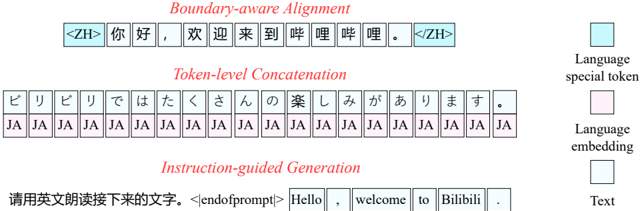
Multilingual Extension. Three strategies for zero-shot cross-lingual TTS are proposed and compared (Figure 3):
- Boundary-Aware Alignment: language-specific boundary tokens (e.g.,
<ZH>…</ZH>) bracket each utterance in the T2S input sequence, providing an explicit language segment signal. Simple and effective, but hallucination in long autoregressive sequences can cause mispronunciations. - Token-Level Concatenation: each text token embedding is fused with a language-specific categorical embedding, giving per-token language supervision. Most robust across Chinese, English, and Spanish for both WER and speaker similarity, but requires a fine-grained language identification front-end.
- Instruction-Guided Generation: structured natural-language instructions (randomly sampled from templates during training) are prepended to the input. Achieves the best WER on Japanese — presumably because the language model can exploit instruction context for phonetic disambiguation in morphologically complex languages — but is slightly less robust in code-switching scenarios.
The training corpus totals approximately 100K hours: 30K Mandarin, 25K English, 42K Japanese, 2.9K Spanish, plus 135 hours of emotional speech (29 h ESD + 106 h commercial recordings).
GRPO Post-Training. Group Relative Policy Optimization (GRPO, from DeepSeekMath) is applied to fine-tune the T2S language model. For each input prompt, four speech candidates are generated via stochastic decoding and ranked by WER computed with a frozen ASR model. The policy is updated to increase the relative probability of lower-WER candidates. The RL-refined variant (IndexTTS 2.5-RL) shows measurable WER reduction on English (1.889% → 1.732%) and Japanese (9.949% → 9.770%) without degrading speaker similarity.
Key Results
Inference efficiency (Table 4, A10 GPU): Total RTF falls from ~0.310 (IndexTTS 2) to ~0.136 (IndexTTS 2.5 with Zipformer), a 2.28x improvement. The T2S and S2M RTFs are 0.119 and 0.017, respectively.
Multilingual strategy comparison (Table 1): Token-Level Concatenation achieves the best speaker similarity and lowest WER on Chinese (WER 1.119%), English (WER 3.253%), and Spanish (WER 5.200%). Instruction-Guided Generation achieves the best WER on Japanese (9.226% vs. 10.444% for Boundary-Aware and 10.498% for Token-Level).
Cross-system comparison (Table 2): On SeedTTS test-zh, IndexTTS 2.5 achieves SS=0.848 / WER=1.426% vs. CosyVoice 3 SS=0.872 / WER=1.160% and FireRedTTS-2 SS=0.772 / WER=1.059%. On SeedTTS test-en, IndexTTS 2.5 achieves SS=0.855 / WER=1.889%, competitive with CosyVoice 3 (SS=0.811 / WER=2.020%) and FireRedTTS-2 (SS=0.782 / WER=1.652%). Neither CosyVoice 3 nor FireRedTTS-2 report Japanese results.
Emotional TTS (Table 3): On IndexTTS test-ja-emo, IndexTTS 2.5 achieves MOS=4.11 and emotional similarity (ES)=0.846 vs. CosyVoice 3 MOS=3.48 / ES=0.806. On IndexTTS test-es-emo, MOS=3.93 / ES=0.924 vs. CosyVoice 3 MOS=3.86 / ES=0.883.
Note: the Japanese and Spanish emotional test sets are internally constructed from public online resources; direct comparability to external benchmarks is limited.
Novelty Assessment
The contribution is primarily engineering and training-recipe. No fundamentally new architectural paradigm is introduced; instead, IndexTTS 2.5 applies known components (Zipformer, GRPO, codec frame-rate reduction) in a disciplined combination to improve an existing system. The most intellectually novel aspect is the systematic comparison of three multilingual conditioning strategies for autoregressive TTS — the analysis reveals complementary strengths that are language-dependent, providing practical design guidelines absent from earlier multilingual TTS papers. The GRPO application to TTS (using ASR WER as a reward signal) is noteworthy as a concrete instance of RLHF for intelligibility, though the technique is adapted directly from reasoning LM post-training. The codec compression result is a clean ablation showing that halving the codec frame rate carries negligible quality cost, a useful data point for the community.
Field Significance
Moderate — IndexTTS 2.5 provides a practical blueprint for extending an existing zero-shot TTS system to new languages while simultaneously improving inference efficiency. The systematic comparison of three cross-lingual conditioning strategies (boundary-aware alignment, token-level concatenation, instruction-guided generation) demonstrates language-dependent trade-offs that can inform design choices in future multilingual TTS work. The GRPO fine-tuning result provides a concrete instance of RL-based post-training for intelligibility improvement, reinforcing the emerging pattern of applying reasoning-LM training techniques to speech generation.
Claims
- Halving the semantic codec frame rate from 50 Hz to 25 Hz reduces autoregressive sequence length and inference cost with no measurable degradation in synthesis quality. (§3.2, Table 4)
- For zero-shot cross-lingual TTS, per-token language conditioning yields stronger speaker similarity and lower WER than utterance-level boundary tokens across most languages, but instruction-guided generation better handles morphologically complex languages such as Japanese. (§4.3, Table 1)
- Replacing a U-DiT backbone with Zipformer in a flow-matching mel-generation module achieves faster inference and higher subjective preference scores, demonstrating that ASR-optimised architectures can transfer effectively to TTS. (§3.2, §4.6, Figure 4)
- Applying GRPO with an ASR-based WER reward signal to post-train an autoregressive TTS language model produces consistent WER reductions without degrading speaker similarity. (§3.3, §4.4, Table 2)
Limitations and Open Questions
The paper does not report model parameter counts, making comparisons of compute per inference difficult. The Spanish training set is small (~2.9K hours, largely assembled from public corpora) and performance on Spanish lags all other languages. Japanese WER remains above 9% even with GRPO fine-tuning; the paper attributes some of this to ASR evaluation noise but does not fully resolve it. Emotional test sets for Japanese and Spanish are constructed internally and lack independent validation. The study covers four languages; extension to low-resource languages, tonal languages beyond Mandarin, or agglutinative languages is not addressed. The GRPO reward is WER-only; prosodic naturalness and emotional fidelity are not directly optimized by the RL signal.
Wiki Connections
- IndexTTS 2 — the system this paper directly extends, sharing the same three-stage T2S/S2M/vocoder pipeline
- CosyVoice and CosyVoice 2 — multilingual TTS baselines evaluated against in Tables 2 and 3
- VALL-E — foundational autoregressive-codec-TTS framing that motivates the T2S language model approach
- Seed-TTS — supplies the SeedTTS test-zh and test-en evaluation benchmarks used throughout
- F5-TTS — cited as a representative fully non-autoregressive alternative contrasted with the hybrid AR approach
- ZipVoice-Dialog — recent corpus paper sharing the Zipformer architectural component
- zero-shot-tts, multilingual-tts, autoregressive-codec-tts, flow-matching, emotion-synthesis, rlhf-speech