arXiv · 2024 · Preprint
Meng et al. (Microsoft) · → Paper · Demo: ✓ · Code: ?
MELLE replaces discrete codec codes with direct autoregressive prediction of continuous mel-spectrogram frames, achieving zero-shot TTS in a single stage with improved robustness and naturalness over VALL-E and its variants.
Problem
Neural codec language models (VALL-E family) introduced an influential autoregressive TTS paradigm but carry three intertwined drawbacks. Vector-quantized codec codes sacrifice fidelity relative to continuous representations because they are designed for compression, not generation quality. The random top-p sampling over discrete tokens causes robustness failures, particularly for long sequences, manifesting as stretches of silence or persistent noise. Finally, the two-pass architecture (an autoregressive model for primary tokens followed by a non-autoregressive model for residual codes) adds inference complexity and storage overhead.
Prior attempts to improve robustness, such as ELLA-V and VALL-E R, introduced explicit monotonic alignment constraints that improved WER at the cost of substantial drops in speaker similarity. Other systems, such as CosyVoice and SEED-TTS, moved computation to continuous spaces in a second stage but retained two-stage pipelines.
Method
MELLE frames TTS as autoregressive mel-spectrogram language modeling. A Transformer decoder takes the concatenation of BPE text tokens and mel-spectrogram frames as input and predicts the next mel-spectrogram frame (or a group of r frames, controlled by a reduction factor) at each step. Three modules sit on top of the language model’s output at each step.
The Latent Sampling Module, inspired by variational autoencoders, predicts a Gaussian distribution (mean and log-variance) from the decoder output and samples a latent vector via reparameterization. This replaces the top-p discrete sampling of codec language models with a learned continuous sampling mechanism, providing output diversity without requiring manual sampling configuration. A stop prediction layer determines sequence termination, and a convolutional post-net refines the coarse spectrogram.
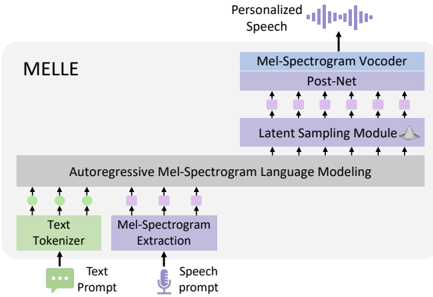
Training uses four losses jointly: L1/L2 regression on intermediate and final spectrogram predictions; KL divergence between the predicted Gaussian and a prior centered at the ground-truth frame (rather than the standard normal, which accelerates optimization); spectrogram flux loss, which penalizes low inter-frame variation in the predicted mean, discouraging silence and monotonicity; and binary cross-entropy for stop prediction. An off-the-shelf HiFi-GAN vocoder trained on LibriTTS converts the generated mel-spectrograms to waveforms. The main model is trained on 50K hours of Libriheavy; a smaller variant (MELLE-limited) uses 960-hour LibriSpeech.
The reduction factor r provides a throughput knob: r=2 halves AR steps and inference time with modest speaker similarity loss, while r=4 reduces inference time to one quarter of the baseline and still outperforms most VALL-E variants on WER.
Key Results
On LibriSpeech test-clean zero-shot continuation, MELLE achieves 1.47% WER (Conformer-Transducer) against ground truth at 1.61%, representing a 47.9% relative WER reduction over VALL-E and 8.1% over VALL-E 2. Speaker similarity (WavLM-TDNN cosine) is 0.508, comparable to VALL-E 2 (0.504) and far above VALL-E (0.508 vs. ground truth 0.668) (Table 1). For cross-sentence inference, WER matches VALL-E 2 and objective SIM is marginally lower, a gap the authors attribute partly to speaker verification model bias: under ECAPA-TDNN, MELLE’s SIM exceeds VALL-E 2 (0.680 vs. 0.662).
Subjective evaluation on 40 cross-sentence samples shows MELLE achieving MOS 4.20 vs. ground truth 4.29 (CMOS -0.032, not significantly different from ground truth at p>0.1). SMOS reaches 4.40, exceeding ground truth at 3.94, compared to VALL-E 2 at 3.88 (Table 3). Inference time for 10-second speech is 5.49s for standard MELLE, dropping to 2.76s at r=2 and 1.40s at r=4, compared to VALL-E/VALL-E 2 at 7.32s (Table 5).
Ablation confirms both the Latent Sampling Module and the spectrogram flux loss are essential: removing both degrades cross-sentence WER from 1.47% to 23.21%, with flux loss contributing most of the robustness gain (Table 4).
Subjective evaluation covers only 40 samples (one per speaker) from LibriSpeech test-clean. MELLE-limited was compared against VALL-E R rather than VALL-E 2 for the 960-hour condition, so direct comparisons are not fully controlled across training scales.
Novelty Assessment
MELLE’s core novelty is the demonstration that autoregressive speech synthesis can bypass vector quantization entirely, replacing discrete next-token prediction with direct continuous mel-spectrogram generation at human-parity quality. The idea that continuous autoregressive generation might outperform discrete codec approaches is non-trivial and was not established before this work. The specific technical innovations, namely the VAE-inspired Latent Sampling Module, the spectrogram flux loss, and the modified KL divergence prior anchored to the ground-truth frame rather than a standard normal, are each well-motivated and contribute measurably (per ablations). The architecture otherwise builds on the established Transformer decoder language model backbone from VALL-E, with standard components (post-net from Tacotron lineage, HiFi-GAN vocoder).
The paper is most strongly differentiated from the two-stage continuous alternatives (TorToiseTTS, CosyVoice, SEED-TTS) by its single-pass design. Against VALL-E 2, it achieves comparable or superior performance at similar training scale while eliminating the NAR pass and the residual codebook machinery.
Field Significance
Tip
High — MELLE establishes that autoregressive mel-spectrogram language modeling, without any vector quantization, is a viable and competitive path for zero-shot TTS. By demonstrating parity with VALL-E 2 on objective metrics and superiority on subjective metrics in a simpler single-stage architecture, it challenges the assumption that discrete codec codes are necessary for autoregressive speech generation at scale. The paper opens a line of research into continuous-token autoregressive TTS that does not depend on codec design choices.
Claims
- Continuous mel-spectrogram representations preserve more speaker-relevant acoustic information than vector-quantized codec codes at standard compression rates. (§5.1, Table 1)
- Autoregressive TTS models trained to predict continuous frames can achieve naturalness comparable to human speech while avoiding the silence and repetition failures endemic to discrete codec language models. (§5.2, Table 3)
- Variational sampling in the continuous latent space is more effective than top-p discrete sampling for improving output diversity and speaker similarity in autoregressive TTS. (§5.3, Table 4)
- A reduction factor that predicts multiple frames per autoregressive step can substantially reduce inference time with only modest degradation in speaker similarity. (§5.4, Table 5)
Limitations and Open Questions
Warning
The subjective evaluation rests on only 40 samples from a single English corpus (LibriSpeech test-clean). The naturalness and speaker similarity advantages may not generalize to noisier prompts, non-native accents, or other languages.
The model’s output quality is bounded by the HiFi-GAN vocoder, which was trained on only 585 hours of LibriTTS. Voicebox, which used a proprietary 60K-hour vocoder, showed higher SIM in part for this reason. Replacing or scaling the vocoder is identified as the most direct path to improvement.
The evaluation is English-only. Multilingual extension analogous to VALL-E X is deferred to future work. The paper also leaves open whether other continuous representations (VAE latent spaces, flow-based representations) would outperform mel-spectrograms as the target token. The model size is not reported, limiting cost comparisons with VALL-E 2 or Voicebox.
Wiki Connections
Core method: autoregressive-codec-tts, zero-shot-tts, neural-codec
Speaker modeling: speaker-adaptation
Evaluation: evaluation-metrics, subjective-evaluation
Related papers: 2301.02111 (VALL-E), 2406.05370 (VALL-E 2), 2406.07855 (VALL-E R), 2401.07333 (ELLA-V), 2305.07243 (TorToiseTTS), 2305.09636 (SoundStorm), 2403.03100 (NaturalSpeech 3), 2406.02430 (SEED-TTS), 2407.05407 (CosyVoice), 2406.18009 (E2 TTS), 2402.08093 (BASE TTS), 2303.03926 (VALL-E X)
2502.17239 — Baichuan-Audio: A Unified Framework for End-to-End Speech Interaction