arXiv · 2024 · Preprint
Hao-Han Guo et al. (Xiaohongshu) · → Paper · Demo: ✓ · Code: ?
FireRedTTS is an industry-deployed foundation TTS framework that combines a HuBERT-based semantic speech tokenizer, a 400M-parameter autoregressive language model, and a two-stage waveform generator (flow-matching or streamable decoder) trained on 150k hours of proprietary data, with applications to zero-shot voice cloning and instruction-tuned human-like speech for chatbots.
Problem
Large-scale autoregressive TTS systems have demonstrated strong in-context learning capabilities for zero-shot synthesis, but deploying them at industry scale introduces demands that research prototypes rarely address together: producing high-fidelity audio at 48 kHz (while training data is predominantly low-sampling-rate), supporting both non-streaming and low-latency streaming inference modes, and adapting to highly expressive professional voices with minimal fine-tuning data. Prior work such as CosyVoice and Seed-TTS addresses some of these requirements but leaves gaps in data quality at scale, streaming viability, and controllable paralinguistic behaviour.
Method
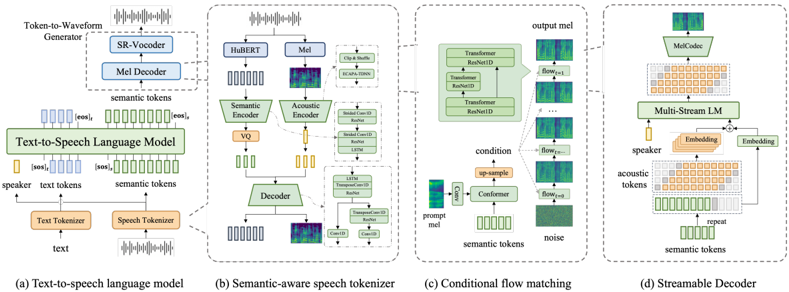
FireRedTTS decomposes the TTS pipeline into three components: a semantic-aware speech tokenizer (SAST), a text-to-speech language model, and a two-stage token-to-waveform generator.
The SAST encodes speech into discrete semantic tokens using HuBERT as a pre-trained SSL backbone, followed by ResNet-based down-sampling and VQ quantisation at 40ms frameshift with a codebook of 16,384 entries. A parallel ECAPA-TDNN acoustic encoder extracts a global utterance-level speaker embedding; the “Clip&Shuffle” strategy (randomly reordering 1-second slices from a 25–75% segment) prevents content leakage into the speaker embedding. A ResNet decoder reconstructs both SSL and acoustic features during tokenizer training.
The TTS language model is a 30-layer GPT-style decoder-only Transformer (400M parameters) trained for next-token prediction of semantic tokens given BPE text tokens and an utterance-level speaker embedding extracted from the prompt audio.
For waveform generation, the paper proposes two alternative Mel decoders. The flow-matching decoder transforms Gaussian noise into a Mel spectrogram using semantic tokens as conditions via a Conformer encoder and U-Net estimator; classifier-free guidance (CFG, alpha=0.7) is applied at inference. The streamable decoder instead trains a CNN-GAN Mel codec to produce a four-stream discrete representation at 20ms frameshift, then generates these tokens autoregressively via a multi-stream LM with a “lookahead pattern” synchronised to incoming semantic tokens. In both cases, a BigVGAN-V2-based super-resolution vocoder upsamples the 16kHz Mel spectrogram to 48kHz waveform, trained on a curated 294-hour high-sampling-rate subset.
The training corpus is a 150k-hour proprietary Chinese-English dataset derived from 624k hours of raw audio through a five-stage pipeline: music source separation and speech enhancement, TDNN-based VAD segmentation, spectral clustering for speaker labelling, two-pass Transducer ASR transcription, and multi-criteria filtering (DNSMOS, roll-off frequency, ASR confidence).
Two downstream applications are demonstrated: (1) zero-shot and few-shot voice cloning for video dubbing, where UGC scenarios use in-context learning and PUGC scenarios use 1-hour supervised fine-tuning of the LM and flow-matching decoder; (2) instruction-tuned human-like speech generation adding four emotion categories via a dedicated embedding layer and 13 paralinguistic behaviour types via token insertion or embedding injection.
Key Results
On an internal Chinese consistency MOS (CoMOS) test over 94 prompt-text pairs, FireRedTTS scores 4.32 vs. CosyVoice’s 4.15 (ground truth: 4.53), with the flow-matching decoder scoring 4.48 compared to the streamable decoder’s 4.41 (Table 2, Table 4). The streaming variant thus sacrifices 0.07 CoMOS for real-time capability.
For voice cloning, zero-shot synthesis achieves MOS 4.25 (UGC) and 3.77 (PUGC) with SPK-SIM of 73.61% and 68.63% respectively. Few-shot fine-tuning with 2 minutes (UGC) improves MOS to 4.31 and SIM to 73.85%, while 1-hour fine-tuning (PUGC) yields MOS 4.65 and SIM 78.92% (Table 5). The PUGC result highlights that zero-shot generalisation to highly expressive, distinctive voices remains limited without adaptation.
On stability (pronunciation error rate) across 2,000 utterances, FireRedTTS reduces overall sentence-level error rate to 2.09% vs. CosyVoice’s 5.68% in Chinese, but both systems show substantially higher rates in English and code-switch conditions (12% and 8.5% for FireRedTTS), attributed to the limited English proportion in training data (Table 3).
Prompt enhancement before voice cloning is beneficial at SNR 0dB and 10dB but can slightly degrade performance at SNR 20dB (Table 6), recommending selective application based on noise level.
Instruction tuning lifts emotion classification accuracy from 45–87% (pre-trained) to 97–100% across four emotion categories (Table 7), and paralinguistic behaviour synthesis achieves 45% listener preference vs. 26% without paralinguistics (Table 8).
Novelty Assessment
The SAST design combining HuBERT-derived semantic tokens with an ECAPA-TDNN speaker encoder and the “Clip&Shuffle” disentanglement strategy is a concrete contribution, addressing the content-leakage problem in speaker embeddings in a simple but effective way. The two-stage waveform generator (Mel decoder + super-resolution vocoder) to handle the mismatch between low-sampling-rate training data and 48kHz output is a practical engineering solution rather than a fundamentally new idea, but it is well-motivated and the ablation between flow-matching and streamable decoders provides useful trade-off evidence. The multi-stream “lookahead pattern” streamable decoder offers a concrete path to real-time synthesis without the latency of iterative flow-matching.
The broader system architecture (LM on semantic tokens, flow-matching spectrogram decoder) resembles CosyVoice closely; the main differentiation is the proprietary data pipeline, the semantic tokenizer design, and the paralinguistic behaviour framework. The instruction-tuning approach for paralinguistics is practical but follows established patterns from prior chatbot-focused TTS work. Overall, this is an engineering integration with several targeted innovations rather than a paradigm-shifting contribution.
Field Significance
Moderate: FireRedTTS provides evidence that foundation LM-based TTS systems can be successfully deployed at industrial scale (150k hours, 400M parameters) with both streaming and non-streaming inference paths, demonstrating a practical architecture for organisations that need to serve both low-latency chatbot and high-fidelity dubbing use cases from a single foundation model. The detailed data processing pipeline and the streaming/non-streaming trade-off analysis (Table 4) are useful engineering reference points for the field.
Claims
- Separating the waveform generation stage into a low-sampling-rate Mel decoder and a super-resolution vocoder allows a system trained predominantly on low-sampling-rate data to produce high-fidelity 48kHz output. (§3.3)
- Few-shot fine-tuning of a large foundation TTS model substantially outperforms zero-shot in-context learning for highly expressive, distinctive target voices, even with only one hour of data. (§5.2.1, Table 5)
- Prompt audio enhancement improves voice cloning quality for noisy prompts but can slightly degrade performance when prompts are already clean. (§5.2.2, Table 6)
- Instruction tuning with a small domain-specific dataset dramatically improves emotion controllability in a pre-trained TTS language model, raising accuracy from near-chance to near-ceiling. (§5.3, Table 7)
- Autoregressive TTS systems trained on predominantly one language show markedly higher pronunciation error rates on under-represented languages, even at large data scales. (§5.1.2, Table 3)
Limitations and Open Questions
Warning
All evaluations are conducted on proprietary internal test sets with no publicly released benchmarks, data, or model weights. This makes direct comparison with other systems difficult to reproduce and limits the generalisability of the reported numbers.
The streamable decoder incurs a measurable quality penalty (0.07 CoMOS) and the paper notes that Mel codec quality is a bottleneck, which the authors flag for future work. The English and code-switch pronunciation error rates remain high (12% and 8.5%), driven by limited language diversity in training data. The paralinguistic behaviour framework currently supports 13 types targeting primarily Chinese conversational speech; coverage of other languages and more complex prosodic phenomena is not addressed.
Wiki Connections
Core architectural concepts: autoregressive-codec-tts, neural-codec, self-supervised-speech, flow-matching, zero-shot-tts, instruction-conditioned-tts, speaker-adaptation
Related systems cited directly: 2406.02430 (Seed-TTS), 2407.05407 (CosyVoice — primary baseline), 2210.02747 (Flow Matching for Generative Modeling)