arXiv · 2025 · Preprint
Zhikang Niu et al. (Shanghai Jiao Tong University) · → Paper · Demo: ✗ · Code: ✓
Introduces a semantic alignment regularization loss for VAE latent spaces that mitigates the reconstruction-generation trade-off in continuous-latent zero-shot TTS.
Problem
Non-autoregressive zero-shot TTS systems built on VAE latent representations (rather than mel-spectrograms) face an optimization dilemma: increasing the latent dimensionality improves reconstruction quality and speaker similarity but degrades intelligibility, while shrinking the latent dimensionality improves intelligibility at the cost of reconstruction fidelity and speaker similarity. This mirrors a trade-off already documented in latent diffusion models for vision. Prior speech systems that adopt compact VAE latents (e.g., Seed-TTS, MegaTTS-3) either accept this trade-off implicitly or rely on architectural workarounds; no prior work had applied explicit semantic regularization to a continuous VAE latent space to resolve it directly.
Method
Semantic-VAE is a convolutional VAE (encoder, AMP-block decoder, multi-period and multi-band/multi-scale STFT discriminators, following the DAC recipe) that encodes 16kHz speech into a 64-dimensional continuous latent at 40Hz frame rate. It is trained with the standard VAE objective (multi-scale mel-spectrogram reconstruction loss plus a KL term toward a standard Gaussian prior) combined with a HingeGAN adversarial loss and feature-matching loss, exactly as in a conventional acoustic VAE.
The key addition is a semantic alignment regularization term. A frozen pre-trained self-supervised speech model (HuBERT or WavLM) extracts hidden-state features from the same input waveform; these are temporally and dimensionally aligned to the VAE latent via an interpolation layer followed by a 1D convolution. A negative cosine similarity loss between the aligned SSL features and the VAE latent at each timestep is added to the total training objective, encouraging the latent to retain semantic structure even at high dimensionality. The resulting latent representation is then substituted for the mel-spectrogram in existing NAR zero-shot TTS backbones (F5-TTS, E2 TTS) without other architectural changes: the flow-matching or diffusion transformer is trained to generate Semantic-VAE latents conditioned on text and a reference audio prompt, and the VAE decoder converts the generated latent back to a waveform.
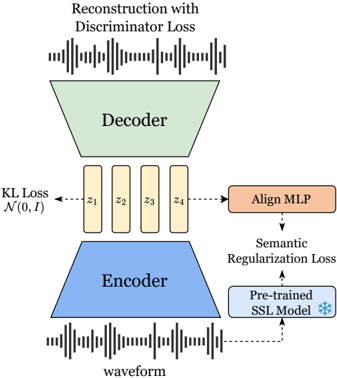
Semantic-VAE is trained for 1M iterations (600K for ablations) on 3-second segments with a global batch size of 64, using Adam with learning rate 1e-4 and exponential decay. Loss weights are set to λ_Align=1, λ_KL=0.01, λ_adv=1, λ_feat=2, λ_recon=15. Downstream TTS training follows the F5-TTS Small recipe (AdamW, warm-up plus linear decay, Euler ODE solver with sway sampling at inference), with mel-spectrograms simply replaced by the Semantic-VAE latent.
Key Results
On LibriSpeech-PC test-clean, in a matched low-resource setting (159M-parameter F5-TTS Small variants trained on 0.6k hours), Semantic-VAE reduces WER to 2.10% and raises speaker similarity (SIM) to 0.64, compared with the mel-spectrogram F5-TTS baseline (2.23% WER, 0.60 SIM) and a vanilla acoustic VAE of the same latent size (2.65% WER, 0.59 SIM). The same substitution applied to E2 TTS improves WER from 3.51% to 2.31% and SIM from 0.61 to 0.62. Training-curve comparisons (Fig. 3) show Semantic-VAE converging faster than both the vanilla VAE and mel-based baselines at matched training steps.
On reconstruction quality (LibriTTS test-other), Semantic-VAE (PESQ 3.74, STOI 0.96, UTMOS 3.56) is essentially tied with the unregularized vanilla VAE (PESQ 3.75, STOI 0.97, UTMOS 3.57) and clearly ahead of a Vocos mel-vocoder baseline (PESQ 3.57, STOI 0.96, UTMOS 3.24), indicating the semantic constraint does not measurably cost reconstruction fidelity. Ablations show negative cosine similarity alignment substantially outperforms L1 or L2 alignment losses (2.10% WER / 0.64 SIM vs. 3.12–4.37% WER / 0.47–0.48 SIM), and that WavLM layer 23 gives the best joint WER/SIM trade-off among the SSL layers tested, while final-layer features markedly hurt speaker similarity. The high-resource comparisons in Table 1 (CosyVoice, FireRedTTS, E2 TTS, F5-TTS trained on 100k-580k hours) are quoted from prior papers for context only and are not run under matched training data, so they are not a controlled comparison against Semantic-VAE.
Novelty Assessment
The core contribution is a training-recipe/architectural addition: applying semantic alignment regularization (cosine similarity to frozen SSL features), previously used to regularize discrete audio codec tokens and diffusion transformer inputs, directly to a continuous VAE latent space for speech. The authors state this specific application had not been explored before. The individual ingredients (SSL-feature alignment, VAE-based latent TTS, cosine similarity losses) are all established elsewhere; the novelty is in combining them to resolve the reconstruction-generation dilemma in continuous latents without changing the downstream TTS architecture. The empirical validation is thorough for a short-paper scope (two backbones, a systematic layer/loss ablation) but is confined to English, a single VAE configuration (64-dim, 40Hz), and a comparatively small 6k-hour training budget relative to industrial-scale systems referenced for context.
Field Significance
Moderate — this paper provides a clean, low-cost mechanism (a single added cosine-alignment loss term) for resolving a known optimization trade-off between reconstruction and generation quality in VAE-based latent TTS, and demonstrates it transfers across two different NAR backbones (F5-TTS, E2 TTS). It is an incremental but well-isolated technique contribution rather than a new architecture or paradigm.
Claims
- supports: Regularizing a continuous VAE latent space toward semantic structure derived from self-supervised speech features mitigates the reconstruction-generation trade-off in latent-based non-autoregressive TTS.
Evidence: At a fixed 64-dimensional latent size, adding cosine-similarity alignment to WavLM features reduces WER from 2.65% (vanilla VAE) to 2.10% while raising speaker similarity from 0.59 to 0.64 on LibriSpeech-PC test-clean. (§4.1, Table 1)
- supports: Semantic alignment regularization of the generation target accelerates training convergence of latent diffusion/flow-matching TTS models.
Evidence: Training-step comparisons show Semantic-VAE-based F5-TTS reaching lower WER and higher SIM than both the vanilla-VAE and mel-spectrogram baselines at the same number of training steps. (§4.1, Figure 3)
- refines: The intelligibility-versus-speaker-similarity trade-off in VAE latent representations is governed by which layer of a self-supervised model is used for semantic supervision, not eliminated outright by adding semantic alignment.
Evidence: Ablating SSL layer choice shows the final layer of WavLM/HuBERT substantially degrades SIM (0.50-0.58) despite comparable WER, while an intermediate layer (WavLM layer 23) gives the best joint WER/SIM balance. (§4.3, Table 3)
- supports: Cosine-similarity alignment losses to self-supervised speech features preserve useful semantic structure in a latent space more effectively than L1 or L2 distance losses to the same features.
Evidence: Negative cosine alignment achieves 2.10% WER / 0.64 SIM, compared to 3.12% WER / 0.47 SIM for L1 alignment and 4.37% WER / 0.48 SIM for L2 alignment under otherwise identical settings. (§4.3, Table 3)
- complicates: Adding a semantic regularization objective to a VAE’s training loss does not necessarily degrade the representation’s reconstruction fidelity, contrary to the general expectation that additional regularization terms cost reconstruction quality.
Evidence: Semantic-VAE reconstruction metrics on LibriTTS test-other (PESQ 3.74, STOI 0.96, UTMOS 3.56) are nearly identical to an unregularized vanilla VAE of the same architecture (PESQ 3.75, STOI 0.97, UTMOS 3.57). (§4.2, Table 2)
Limitations and Open Questions
The high-resource baseline numbers in Table 1 (CosyVoice, FireRedTTS, E2 TTS, F5-TTS at 100k-580k training hours) are quoted directly from their original papers rather than re-run under matched data and compute, so any comparison against Semantic-VAE’s low-resource (0.6k-hour) results is illustrative context only, not a controlled comparison. The method is validated on English speech only, at a single latent configuration (64 dimensions, 40Hz), and on two NAR backbones (F5-TTS, E2 TTS); generalization to AR codec-token TTS systems, other languages, or other latent dimensionalities/frame rates is untested. The paper also does not report inference latency or discuss how the added SSL model changes deployment cost of the VAE training pipeline (inference itself is unaffected, since the SSL branch is training-only).
Wiki Connections
- Flow Matching — Semantic-VAE latents are substituted directly into flow-matching TTS backbones (F5-TTS) without changing the flow-matching objective itself.
- Zero-Shot TTS — the downstream evaluation task is zero-shot voice cloning via reference audio prompts, using WER and speaker similarity as the primary metrics.
- Neural Audio Codec — Semantic-VAE is itself a continuous audio codec/representation learner, trained with a DAC-style reconstruction and adversarial objective before being used as a TTS generation target.
- Self-Supervised Speech — frozen HuBERT and WavLM features are the supervisory signal for the semantic alignment loss that regularizes the VAE latent space.
- F5-TTS — used as the primary zero-shot TTS backbone; Semantic-VAE latents replace F5-TTS’s original mel-spectrogram target with no other architectural changes.
- E2 TTS — used as a second backbone to test whether Semantic-VAE’s gains transfer across NAR TTS architectures.
- MegaTTS 3 — cited as prior work using VAE latent representations with a sparse alignment strategy for latent diffusion TTS, motivating the choice of continuous latents over mel-spectrograms.
- NaturalSpeech 3 — cited as prior NAR latent-space TTS work using factorized codec and diffusion models.
- Vocos — used as the mel-spectrogram vocoder baseline in the reconstruction quality comparison (Table 2).
- CosyVoice — used as a high-resource autoregressive baseline comparison in the zero-shot TTS results table.
- FireRedTTS — used as a second high-resource autoregressive baseline comparison in the zero-shot TTS results table.
- SpeechTokenizer — related prior work on aligning discrete codec tokens with SSL features, which this paper extends to continuous VAE latents.