Interspeech · 2025 · Conference
Hu et al. (Hithink RoyalFlush AI Research Institute) · → Paper · Demo: ✓ · Code: ?
A zero-shot voice conversion system that trains a content encoder from scratch using phoneme supervision with speaker normalization and content restoration (SNCR) modules, combined with a consistency-loss speaker encoder and an attention-enhanced GAN discriminator that integrates self-attention into a convolutional backbone.
Problem
Zero-shot voice conversion requires cleanly disentangling linguistic content from speaker identity — a notoriously difficult problem. Supervised approaches based on phonetic posteriorgrams (PPGs) tend to produce neutral-sounding speech by discarding accent and expression. Unsupervised methods using information bottleneck, instance normalization, or vector quantization often degrade linguistic content while removing speaker traits. SSL-based approaches retain speaker information in their representations and require additional filtering passes, while their large parameter footprints slow inference. Meanwhile, CNN-based discriminators in GAN vocoders struggle to capture long-range spectral dependencies, limiting reconstruction quality. This paper addresses the content-purity, speaker-robustness, and generation-quality problems together without relying on SSL feature extractors.
Method
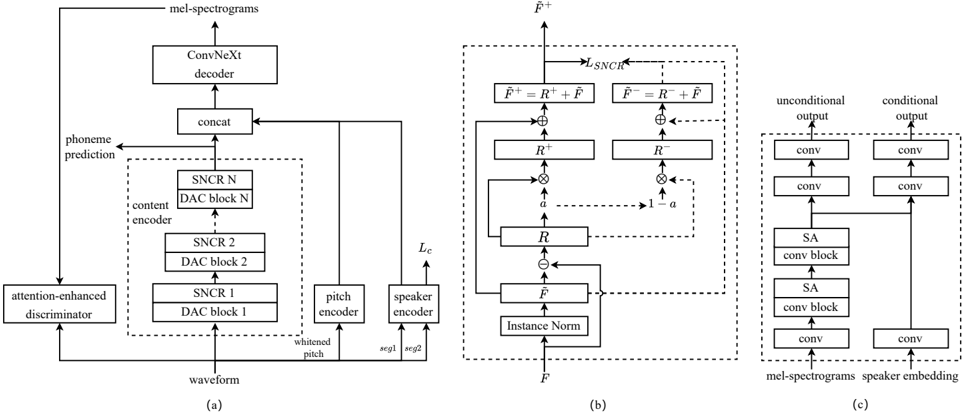
The system uses a DAC encoder as the content encoder backbone, trained from scratch on a phoneme-level prediction task rather than initialized from a pretrained model. A pitch-shift transformation removes fundamental frequency speaker cues before the signal enters the encoder. After each DAC block, a Speaker Normalization and Content Restoration (SNCR) module applies instance normalization (IN) to strip speaker-dependent statistics, then recovers content-relevant information via a channel-attention mechanism. The SNCR module decomposes the residual between the pre- and post-IN features into content-relevant and content-irrelevant parts using a dual restoration loss based on phoneme-prediction entropy: the content-relevant branch is pushed toward lower prediction entropy (more discriminative), while the content-irrelevant branch is pushed toward higher entropy. This dual constraint encourages the encoder to retain precisely the phonetic information that IN erases.
Speaker embeddings are extracted by ECAPA-TDNN with a consistency loss: two random segments from the same utterance are encoded independently, and cosine similarity is maximized between them. This encourages the speaker encoder to produce stable, content-agnostic representations without relying on a pretrained speaker verification model or contrastive mining across utterances.
The decoder follows the Vocos generator architecture, reconstructing mel-spectrograms from the concatenated content, pitch, and speaker representations. A HiFi-GAN vocoder converts mel-spectrograms to waveforms. For adversarial training, an attention-enhanced discriminator extends the GANSpeech architecture by replacing its second and third convolutional layers with residual convolutional blocks followed by L2-distance self-attention layers. Using L2 distance in place of dot-product attention avoids Lipschitz violations that cause training collapse with standard self-attention in discriminators. The discriminator operates both unconditionally and conditionally on a speaker embedding.
The full training loss combines GAN loss, feature matching loss, mel reconstruction loss (L1), phoneme prediction loss, SNCR dual restoration loss, and speaker consistency loss.
Key Results
On a zero-shot VC task converting to 20 unseen VCTK speakers (10 male, 10 female), the proposed method achieves nMOS 3.86, sMOS 3.52, WER 3.78%, and SECS 0.25. Compared to DDDM-VC (the strongest baseline), the system matches speaker similarity (SECS 0.25 vs. 0.27) while substantially improving naturalness (nMOS 3.86 vs. 3.52) and word error rate (WER 3.78% vs. 10.61%). The proposed system uses 50M parameters versus DDDM-VC’s 366M and runs at RTF 0.11 versus 0.29 on an NVIDIA 3090 GPU, a 7x parameter reduction and approximately 2.6x speed improvement at comparable speaker similarity. (Table 1)
VQMIVC achieves competitive SECS (0.23) but at much higher WER (21.4%), likely because its training set (VCTK) overlaps with the test speakers, inflating similarity scores without reflecting genuine zero-shot generalization. (§3.2)
The ablation study shows each component contributes positively: removing the dual restoration loss increases WER by 1.03 points; removing both dual restoration loss and instance normalization further degrades sMOS by 0.69; removing consistency loss additionally reduces SECS; and replacing the attention-enhanced discriminator with a standard CNN discriminator reduces nMOS and increases WER. (Table 2)
Novelty Assessment
The three core contributions each combine existing ideas in ways that are not individually new but work together effectively. Instance normalization for speaker removal is established (AGAIN-VC, related work). The idea of restoring content lost by normalization via a disentangled residual with an entropy-based loss is the most novel element, drawing inspiration from domain-generalization techniques (Jin et al., 2021) applied to the VC content-speaker disentanglement problem. The speaker consistency loss is straightforward (cosine similarity on random utterance segments), simpler than contrastive approaches but functional. The attention-enhanced discriminator addresses a real limitation of CNN-only discriminators; using L2-distance self-attention for Lipschitz stability is a meaningful design choice borrowed from the GAN image generation literature (Kang et al., 2023). Overall, this is solid applied engineering within the GAN-based VC paradigm rather than a new paradigm, but the combination delivers a favorable accuracy-efficiency trade-off over heavier diffusion-based competitors.
Field Significance
Moderate — The system demonstrates that a from-scratch trained content encoder with phoneme supervision and an instance-normalization-based SNCR module can match the speaker similarity of a much larger SSL-dependent diffusion model (DDDM-VC) while running 2.6x faster with 7x fewer parameters. This provides evidence that GAN-based approaches remain competitive with diffusion for zero-shot VC on standard benchmarks, particularly when parameter efficiency is a concern. The SNCR module’s dual restoration loss mechanism introduces a useful design pattern for recovering content information lost during speaker normalization that may generalize to other disentanglement contexts.
Claims
-
supports: Explicit content-restoration mechanisms can compensate for linguistic information degraded by instance normalization in speaker disentanglement, preserving intelligibility without SSL feature extractors.
Evidence: The SNCR dual restoration loss, which decomposes the IN residual into content-relevant and content-irrelevant parts via phoneme-entropy constraints, reduces WER from 5.57% (without SNCR) to 3.78% compared to a baseline trained with neither IN nor dual restoration loss. (§2.1, Table 2)
-
supports: GAN-based zero-shot voice conversion systems can match the speaker similarity of diffusion-based systems at substantially lower parameter count and faster inference.
Evidence: The proposed 50M-parameter GAN system achieves SECS 0.25 versus DDDM-VC’s SECS 0.27, while running at RTF 0.11 versus 0.29 and using 366M fewer parameters; naturalness (nMOS 3.86 vs. 3.52) also favors the GAN system. (§3.2, Table 1)
-
supports: Integrating self-attention layers into CNN-based discriminators improves adversarial training quality for mel-spectrogram reconstruction in voice conversion.
Evidence: Ablation Base4 (discriminator without self-attention) degrades nMOS and WER compared to the full system, confirming that attention-enhanced discrimination contributes to speech quality gains beyond the convolutional baseline. (§3.3, Table 2)
-
complicates: Speaker similarity metrics in zero-shot VC evaluations can be inflated when the test set speakers overlap with a baseline system’s training set, making fair cross-system comparison difficult.
Evidence: VQMIVC achieves SECS 0.23 (close to the proposed 0.25) but was trained on VCTK, which overlaps with the VCTK test speakers; its WER of 21.4% reveals its conversions are not actually intelligible, suggesting its SECS reflects in-distribution behavior rather than genuine zero-shot capability. (§3.2)
Limitations and Open Questions
The system trains and evaluates on English only (LibriLight and VCTK). Whether the SNCR mechanism generalizes to cross-lingual voice conversion or languages with different phonological properties is untested. The ablation evaluates components one at a time, leaving interactions between SNCR and consistency loss unexplored. The mel-spectrogram reconstruction approach limits the system to fixed-rate synthesis, and no streaming or low-latency deployment scenario is discussed. Inference speed is reported on GPU only; embedded or CPU deployment characteristics are not assessed.
Wiki Connections
- Voice Conversion — proposes a complete zero-shot VC system targeting the content-speaker disentanglement problem with a from-scratch trained encoder.
- Disentanglement — introduces the SNCR module as an explicit mechanism for decomposing instance-normalized residual features into content-relevant and content-irrelevant components.
- Zero-Shot TTS — addresses zero-shot generalization to unseen speakers at inference time using a reference embedding, bridging to zero-shot synthesis paradigms.
- GAN Vocoder — uses GAN adversarial training with an attention-enhanced discriminator extending the GANSpeech architecture for high-fidelity mel-spectrogram generation.
- Evaluation Metrics — reports nMOS, sMOS, WER, SECS, and RTF across compared systems, providing a multi-dimensional view of zero-shot VC quality.
- Subjective Evaluation — uses MOS listening tests (naturalness and speaker similarity) to compare the proposed method against three baseline systems with 95% confidence intervals.
- Seed-TTS — cited as a representative high-quality speech generation system in the adversarial training literature context.