arXiv · 2025 · Preprint
Tuochao Chen et al. (University of Washington / Meta AI) · → Paper · Demo: ✓ · Code: ?
Introduces the first streaming spoken dialogue framework that fuses audio and video of the target speaker to track who is talking, detect turn-taking, and generate coherent responses under noisy, multi-speaker interference.
Problem
Full-duplex spoken dialogue models such as Moshi and SyncLLM rely solely on the acoustic signal, typically encoded with speaker-invariant semantic tokenizers. In clean, single-speaker recordings this is adequate, but in real-world “cocktail party” conditions, background noise, overlapping talk, and competing speakers, these models lose track of the target speaker, misjudge when to take a turn, and produce responses grounded in the wrong voice. Prior audio-visual speech recognition (AVSR) systems address speaker robustness with lip-reading cues, but they are built for offline transcription, not for generative, streaming, full-duplex dialogue with turn-taking. No existing system combines audio-visual understanding with generative dialogue and explicit turn-taking control in a streaming setting.
Method
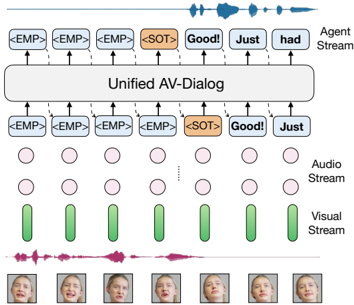
AV-Dialog fine-tunes a pretrained text LLM (LLaMA3-8B) to jointly consume streaming audio and visual input from the target user and to output a time-aligned transcription stream and a turn-taking event stream. At each 40ms timestep, the model embeds 16 Descript Audio Codec (DAC) token streams and a continuous AV-HuBERT visual feature stream (derived from dlib-detected, lip-centric first-person video), sums them with the previous timestep’s text and turn-event embeddings, and predicts, via two linear heads, the next text token and the next turn-taking token. Turn events follow PairwiseTurnGPT’s taxonomy: normal turns, overlapping turns, and backchannels, marked with <SOT> and <SOB> special tokens interleaved with the transcription and silence (<EMP>) tokens.
The paper explores two system architectures. In the dual architecture, the audio-visual understanding module streams its transcription and turn-event tokens into a separate text-LLM backbone (also LLaMA3-8B, either prompted with in-context dialogue examples or instruction-tuned on real conversational data) that generates the response once a turn-taking token fires; the response text is converted to speech with Moshi’s streaming Mimi TTS module. In the unified architecture, a single model removes the intermediate transcription stream and instead interleaves turn-taking tokens directly with time-aligned response tokens, generating full-duplex dialogue end to end without a separate backbone.
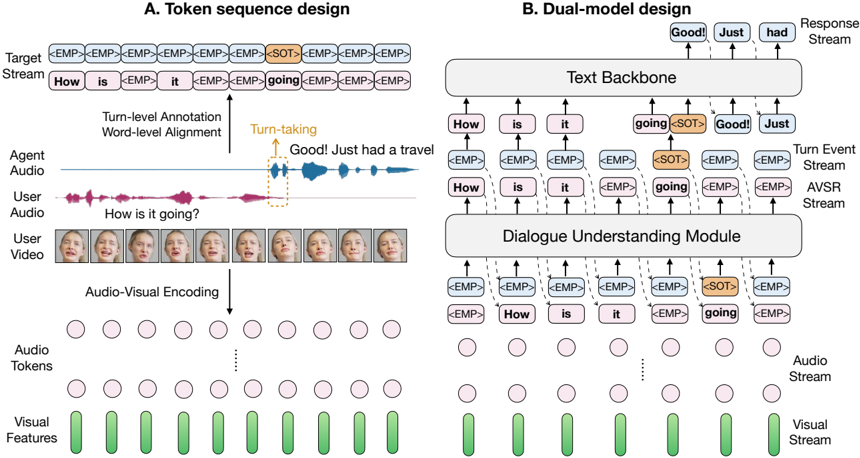
Training uses a two-stage, multi-task recipe on a base LLaMA3-8B checkpoint. Stage 1 aligns text, audio, and visual modalities via text continuation, ASR (LibriLight, MLS, VP400k), audio captioning (AudioSet), and AVSR alignment (VoxCeleb2). Stage 2 fine-tunes on real dyadic conversational data, audio-only Fisher and audio-visual InterAct, for streaming AVSR and turn-taking prediction jointly. Throughout, synthetic mixing augmentation samples clean audio (20%), audio mixed with MUSAN background noise (40%), or audio mixed with 1-4 interfering speakers (40%) at SNRs between -8dB and 8dB, to teach robustness to noisy, multi-speaker conditions.
Key Results
On streaming AVSR, AV-Dialog’s audio-visual variant reaches 17.4% WER on VoxCeleb2 (clean) versus 26.8% for the state-of-the-art streaming AVSR baseline Auto-AVSR, and its advantage widens under noise: 35.6% versus 48.2% (background noise) and 38.8% versus 71.8% (interfering speakers). On the InterAct test set, the audio-visual model reaches 16.3% (clean) to 30.8% WER (interference), far below the audio-only variant (28.6% to 92.2%).
For turn-taking, measured as Response Ratio (fraction of floor-transfer offsets within the human-typical -2s to 3s range), AV-Dialog’s audio-visual dual model reaches 74.5% (clean), 78.3% (background noise), and 78.8% (interference), compared to 54.0%, 53.8%, and 52.5% for the Moshi baseline across the same conditions, and 55.9-56.0% for a speech-enhancement-plus-Moshi cascade. Adding the visual modality over an audio-only version of AV-Dialog itself improves response ratio by 1.3-13 points depending on condition.
Human evaluation (N=18, ITU-T P.808 protocol) rates the dual model with in-context learning at 4.14 naturalness MOS and 4.09 helpfulness MOS, versus 2.39 and 2.10 for the speech-enhancement-plus-Moshi baseline, and above ground-truth human responses on this metric (3.92 N-MOS, 3.62 H-MOS). The unified model trails the dual model in both human evaluation (3.54/3.02) and an LLM-judge pickup-ratio metric, though it achieves the lowest floor-transfer-offset error among all variants.
Novelty Assessment
The individual components, a LLaMA text backbone, DAC acoustic tokenization, an AV-HuBERT visual encoder, and a Mimi TTS module, are all pre-existing. What is new is the system design that couples them: a multi-stream token embedding that fuses audio, video, prior text, and prior turn-event state at every 40ms step; an explicit, jointly-supervised turn-taking token stream trained alongside transcription; and the systematic comparison of a cascaded dual-model design against a single unified model for full-duplex audio-visual dialogue. The paper is explicit that this is the first spoken dialogue model to condition on audio-visual input for turn-taking and response generation, as distinct from prior offline AVSR work and prior audio-only full-duplex dialogue systems. The ablations isolating the acoustic-versus-semantic tokenizer choice and the effect of explicit turn-event supervision are a genuine empirical contribution beyond the architecture itself, not just a repackaging of known parts.
Field Significance
Tip
High.
The paper opens audio-visual input as a design axis for full-duplex spoken dialogue systems, a space previously restricted to audio-only semantic-token models such as Moshi and SyncLLM. It demonstrates, with a controlled ablation against a strong audio-only baseline, that visual cues and acoustic (rather than semantic) tokenization jointly and substantially improve robustness to interfering speakers, a failure mode that audio-only dialogue systems have not resolved. Its dual-versus-unified comparison also provides direct evidence, external to the speech-to-speech-translation literature, that cascading a pretrained text LLM for response generation can outperform a single end-to-end model on response quality in the full-duplex dialogue setting.
Claims
- supports: Fusing visual cues (e.g. lip movement) with acoustic input substantially improves the robustness of streaming spoken dialogue systems to interfering speakers and background noise, compared to relying on audio alone.
Evidence: Turn-taking Response Ratio under interference rises from 54.0% (Moshi, audio-only baseline) to 78.8% (AV-Dialog, audio-visual); streaming AVSR WER under interference drops from 76.3% (AV-Dialog, audio-only) to 38.8% (AV-Dialog, audio-visual) on the same test set. (§4.1, Table 1; §4.2, Table 3)
- supports: General-purpose acoustic tokenizers that retain raw acoustic detail, rather than speaker-invariant semantic tokenizers, give spoken dialogue models better speaker differentiation and robustness in multi-speaker or noisy conditions.
Evidence: Replacing DAC acoustic tokens with DinoSR semantic tokens raises streaming AVSR WER under interference from 30.8% to 67.0% (audio-visual) and lowers the turn-taking response ratio from 78.8% to 47.8% under the same condition. (§4.5, Table 6)
- complicates: Joint models that predict turn-taking and generate responses from a single stream require explicit supervision on discrete turn-event tokens; without it, both turn-detection accuracy and downstream response quality degrade.
Evidence: Removing explicit
<SOT>turn-change supervision in the unified model drops response ratio from 75.6% to 35.1% (background noise) and from 75.9% to 38.0% (interference), and the LLM-evaluator pickup ratio falls in parallel. (§4.5, Table 8) - complicates: When a spoken dialogue system separates understanding from generation via a text intermediary, cascading a separately pretrained, instruction-tuned or in-context-prompted text LLM for response generation yields higher response quality by both automatic and human judgment than a single unified model generating turn-taking decisions and response text jointly from the raw multimodal stream, at the cost of running a second model.
Evidence: The dual model with in-context learning scores 4.14 naturalness MOS and 4.09 helpfulness MOS in human evaluation with 18 participants, versus 3.54 and 3.02 for the unified model; the LLM-judge pickup ratio also favors the dual in-context-learning variant over the unified model across clean, background-noise, and interference conditions. (§4.4, Table 5; §4.3, Table 4)
Limitations and Open Questions
Warning
Visual robustness depends on face and lip visibility: the paper’s own limitations section notes that poor lighting, occlusions (e.g. a hand covering the mouth), and extreme head poses impair lip-movement extraction, degrading speaker tracking and speech understanding exactly in the conditions the system is meant to help with.
The system does not model non-verbal auditory cues (laughter, sighs) or non-lip visual cues (facial expressions, gestures) beyond lip movement, which the authors note could make interactions more human-like if incorporated. The dual architecture runs two 8B-parameter models in parallel, adding memory and latency overhead relative to a single-model system, and the visual encoder’s lookahead window increases algorithmic latency to about 120ms versus roughly 80ms for the audio-only Moshi baseline. Evaluation is confined to English dyadic conversational datasets (Fisher, InterAct) and a single controlled human study with 18 participants rating 15 sampled dialogues; generalization to other languages, group conversations with more than two participants, or larger-scale human evaluation is not established.
Wiki Connections
- Spoken Language Model — adapts a pretrained text LLM (LLaMA3-8B) to consume streaming external audio and visual speech signals from the target user for real-time dialogue understanding and response generation.
- Speech-to-Speech — implements a full-duplex spoken dialogue agent, in both dual and unified variants, that receives spoken (and visual) input and produces spoken responses via a downstream TTS module.
- Self-Supervised Speech — uses a pretrained AV-HuBERT encoder, trained via masked multimodal cluster prediction, to extract lip-centric visual features as a core input stream to the dialogue model.
- Neural Audio Codec — tokenizes speech into 16 Descript Audio Codec (DAC) codebooks per 40ms chunk instead of relying on a speaker-invariant semantic speech tokenizer.
- Subjective Evaluation — validates dialogue naturalness and helpfulness with an 18-participant Mean Opinion Score study following the ITU-T P.808 protocol.
- Moshi — used as the primary state-of-the-art audio-only full-duplex dialogue baseline, compared directly on turn-taking accuracy, response quality, and human-rated naturalness under noise and interference.
- Spirit LM — cited as a related multimodal dialogue model that accepts speech or text input but does not model turn-taking, contrasted with AV-Dialog’s explicit turn-event supervision.
- SALM-Duplex — cited as consistent external evidence that cascaded response generation can outperform unified duplex models, aligning with AV-Dialog’s own dual-versus-unified comparison.