arXiv · 2025 · Preprint
Jiatong Shi et al. (Carnegie Mellon University, Shanghai Jiao Tong University) · → Paper · Demo: ? · Code: ?
Guides the first residual-vector-quantization stage of a neural speech codec with a pre-trained speech enhancement model, so that stage learns low-entropy denoised content and later stages learn residual high-entropy detail, stabilizing RVQ training on noisy or low-quality speech.
Problem
Residual vector quantization (RVQ) is the dominant multi-stream design for neural speech codecs, letting successive quantization stages progressively refine the approximation left by earlier stages. In practice, however, RVQ training is often unstable: late-stage quantizers frequently fail to learn meaningful representations because the residual signal they receive is poorly decomposed, and without strong inductive guidance the codebooks can encode overlapping, redundant information. Prior extensions to RVQ (cross-scale RVQ, group RVQ, multi-scale RVQ) address representational capacity through architectural modifications or training heuristics, but none explicitly aligns the quantization stages with the underlying entropy structure of the speech signal itself. This gap becomes especially damaging when training data is noisy or low quality (e.g. crowdsourced or artificially degraded corpora), where standard RVQ-based codecs can collapse outright.
Method
PURE Codec (Progressive Unfolding of Residual Entropy) keeps the standard codec skeleton of an encoder, a multi-stage RVQ quantizer, and a decoder, but changes what the first quantization stage is trained to reconstruct. In parallel with the normal encoder path, an optional pre-trained speech enhancement model (TFGridNet, trained for the URGENT 2024 Challenge) denoises the input waveform to produce an enhanced signal, which is passed through the same encoder to produce a low-entropy “enhanced embedding.” The first RVQ stream is explicitly supervised to approximate this enhanced embedding rather than the raw (noisy) embedding, while subsequent streams model the residual between the enhanced-guided reconstruction and the original signal, capturing progressively higher-entropy content (noise, fine acoustic detail). The paper motivates this design with a perceptual-entropy analysis: on 5,000 URGENT Challenge utterances, enhancement reduces perceptual entropy by 57.80% on average, indicating that denoised speech is substantially more compressible.
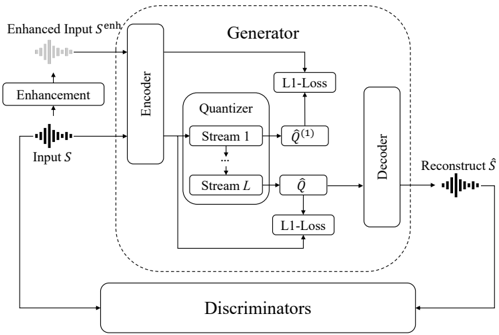
Training happens in two stages. First, the encoder-decoder pair is pre-trained as a variational autoencoder (VAE) with a waveform L1 loss, a multi-resolution mel loss, and a KL-divergence penalty, giving the latent space a smooth structure before any discrete bottleneck is introduced. Second, RVQ and the enhancement-guided supervision are added; a stochastic scheduler chooses with fixed probability p_enh whether the first-stage target is the enhanced embedding or the original embedding, balancing robustness against flexibility. The full objective combines this enhancement loss with waveform/mel reconstruction, VQ codebook loss, and a GAN adversarial loss against a multi-scale, multi-period, multi-band discriminator; the encoder is frozen during this second stage to preserve stability. The backbone matches a DAC-style baseline (hidden/codebook dimension 512, L=8 codebooks of 1024 entries, quantization dropout to support 0.5-4 kbps bitrates), so architectural gains are isolated to the enhancement-guided decomposition rather than a larger or different backbone.
Key Results
Trained and evaluated (via the VERSA toolkit, on LibriSpeech test-clean) across three corpora spanning clean-to-noisy conditions (OWSM-v3.2, CommonVoice v13, URGENT 2024), PURE Codec consistently outperforms a retrained DAC-style baseline on reconstruction and downstream metrics. On OWSM-v3.2, PURE improves WER from 2.26% to 2.05%, UTMOS from 3.42 to 3.64, and speaker similarity from 0.64 to 0.71, while SDR is lower than the baseline (2.17 vs. 4.01), which the authors attribute to codec-induced amplitude shifts that do not track perceptual quality (Table II). The clearest result is training stability under noisy data: the DAC baseline collapses on CommonVoice and URGENT (SDR as low as -6.79, PESQ below 1.4), while PURE remains stable across all three corpora (SDR above 1.3, PESQ above 2.5 in every setting) (Table II).
The ablation study (Table III) shows the sampling probability p_enh matters most: p_enh = 0.25 (Abl.F) outperforms the default 0.5 setting on PESQ (2.85) and UTMOS (3.79), suggesting sparser but consistent guidance works better than constant supervision. Freezing the encoder after VAE pretraining is essential; allowing it to fine-tune jointly with the quantizer (Abl.H) causes SDR to collapse to 0.74. Swapping the enhancement front end for smaller or larger models (Abl.A-C) has only a modest effect, and moving the enhancement target to the second quantization stream instead of the first (Abl.E) slightly hurts perceptual quality, indicating the benefit comes from anchoring the earliest stage rather than from the specific enhancement backbone.
For downstream usability, the authors train a decoder-only SpeechLM-based TTS system on LibriSpeech-960h using PURE Codec tokens as both speaker prompt and synthesis target, with a delay-interleave token pattern. Table IV reports WER 10.5, SPK-SIM 0.68, and UTMOS 3.95 for PURE Codec versus WER 10.8, SPK-SIM 0.70, and UTMOS 3.68 for the DAC baseline: UTMOS and WER improve, but SPK-SIM is marginally lower than the baseline in this table. The surrounding prose in Section IV-F reports different figures entirely (WER improving from 2.91% to 2.46%, SPK-SIM “reaching 0.76”), which do not match Table IV and appear to be an inconsistency in the source paper; the table numbers are used here as the traceable source.
Novelty Assessment
The core idea, using a pre-trained speech enhancement model to define what the first RVQ stage should reconstruct, is a genuine and fairly simple architectural insight: it reframes RVQ stage decomposition around signal entropy rather than around unsupervised residual minimization alone. This differs from prior RVQ extensions (cross-scale, group, multi-scale RVQ), which add structural complexity without an explicit alignment target. The contribution is incremental rather than a new codec paradigm: the backbone, quantizer, and adversarial training recipe are otherwise a standard DAC-style codec, and the main technical additions are the enhancement-guided first-stage target, a stochastic scheduling mechanism, and a two-stage VAE-then-RVQ training recipe. The strongest evidence for the idea’s value is the training-stability result on noisy corpora, where the RVQ baseline collapses outright and PURE does not; the OWSM-v3.2 clean-condition gains are more modest and mixed across metrics (SDR regresses).
Field Significance
moderate — This paper contributes a targeted fix for a specific, well-documented failure mode of RVQ-based codecs (training instability and poor stage decomposition under noisy or low-quality training data) and demonstrates it generalizes across three training corpora and into a downstream SpeechLM-based TTS setting. The comparison is limited to a single retrained DAC-style baseline rather than a broader set of contemporary codecs, and the downstream TTS evaluation contains an internal inconsistency between the reported table and the surrounding prose, which tempers confidence in the size of the downstream benefit.
Claims
- supports: Anchoring the earliest residual-quantization stage to a denoised (low-entropy) reconstruction target, rather than the raw noisy embedding, stabilizes RVQ-based codec training under noisy or low-quality speech data.
Evidence: The DAC-style baseline collapses when trained on CommonVoice or URGENT 2024 data (SDR as low as -6.79, PESQ below 1.4), while PURE Codec, trained identically except for the enhancement-guided first-stage target, stays stable across all three corpora (SDR above 1.3, PESQ above 2.5). (§IV-D, Table II)
- complicates: Enhancement-guided quantization does not uniformly improve every reconstruction metric; waveform-level fidelity can regress even as perceptual and application-level metrics improve.
Evidence: On OWSM-v3.2, PURE Codec’s SDR is lower than the DAC baseline (2.17 vs. 4.01) despite improvements in WER, UTMOS, and speaker similarity, which the authors attribute to codec-induced amplitude shifts rather than genuine quality loss. (§IV-D, Table II)
- refines: In an enhancement-guided RVQ codec, the frequency of enhancement supervision during training matters more than the capacity or architecture of the enhancement model providing the guidance target.
Evidence: Varying the enhancement supervision probability p_enh (0.25, 0.5, 0.75) produces the largest ablation swings, with p_enh = 0.25 achieving the best PESQ (2.85) and UTMOS (3.79), while swapping the enhancement front end for smaller or larger models (TFGridNet vs. BSRNN variants) produces only modest differences. (§IV-E, Table III)
- complicates: Freezing the encoder after VAE pretraining is necessary for training stability in enhancement-guided RVQ codecs; allowing the encoder to continue updating during quantizer training can be catastrophic.
Evidence: The encoder fine-tuning ablation (Abl.H) drops SDR to 0.74, the worst result in the entire ablation table, compared to 2.17 for the default frozen-encoder configuration. (§IV-E, Table III)
Limitations and Open Questions
The paper's own Section IV-F narrative (WER 2.91% to 2.46%, SPK-SIM "reaching 0.76") does not match its own Table IV (WER 10.8 to 10.5, SPK-SIM 0.70 to 0.68) for the downstream SpeechLM-TTS evaluation. Table IV is used as the traceable source in this page; the prose figures could not be reconciled with any table in the paper and should be treated with caution.
The authors state the method’s central limitation directly: PURE relies on a speech-specific enhancement model and is not directly applicable to general (non-speech) audio, since the entropy-reduction argument depends on a denoising model that targets speech specifically. The evaluation is also limited to a single baseline architecture (a retrained DAC-style codec) rather than a broader field of contemporary neural codecs, and the “Original DAC” row included for reference operates at a different bitrate and training setup, so it is explicitly not a fair comparison. The downstream SpeechLM-TTS evaluation uses only one training/evaluation setup (LibriSpeech-960h, LibriSpeech test set) and reports SPK-SIM regressing slightly relative to baseline in Table IV, which qualifies the downstream generation claims made in the text.
Wiki Connections
- Neural Audio Codec — introduces a new RVQ decomposition strategy that directly targets a documented training-stability failure mode in multi-stream neural codecs.
- Autoregressive Codec TTS — validates the codec’s downstream utility by training a decoder-only SpeechLM-based TTS system on its tokens and reporting intelligibility, speaker-similarity, and quality metrics.
- GAN Vocoder — trains its decoder with a multi-scale, multi-period, multi-band GAN discriminator and adversarial loss, following the RVQGAN-style training recipe used by its DAC baseline.
- Evaluation Metrics — evaluates reconstruction quality with a wide battery of objective metrics (SDR, PESQ, UTMOS, DNSMOS, VISQOL, WER, SPK-SIM) via the VERSA toolkit.
- CosyVoice 2 — cited as an example of neural codecs playing a foundational role in scalable speech-language-model-based generation, motivating why codec design quality matters for downstream TTS.
- CosyVoice — cited alongside CosyVoice 2 as an example system that depends on discrete codec tokens for large-scale speech synthesis.