arXiv · 2026 · Preprint
Haowei Lou et al. (University of New South Wales / CSIRO’s Data61) · → Paper · Demo: ? · Code: ?
A representation-learning framework that projects speech into dedicated, prototype-anchored subspaces for each paralinguistic style (emotion, gender, age, language), reducing inter-task interference for classification and enabling fine-grained, single-attribute style control in TTS.
Problem
Learning representations of paralinguistic speaking styles (emotion, age, gender) serves both recognition (affective computing, human-computer interaction) and generation (style-controllable TTS) applications, but existing approaches force a trade-off. Single-task models trained separately per style attribute are accurate but computationally expensive and hard to scale. Multi-task models that share parameters across style attributes are efficient but suffer from inter-task interference and negative transfer, where learning one style (e.g., emotion) degrades performance on another (e.g., age). CLAP-style contrastive language-audio pretraining, increasingly used to guide both classification and generation, compounds this: aligning speech to a single unified text embedding entangles all style attributes described in the caption together, so dominant attributes overshadow others, making it hard to isolate or independently control individual style dimensions. Existing unified text/speech style-control systems like UniStyle face a related coupling problem, generating speech that retains reference-speech characteristics even when a conflicting text prompt is given.
Method
ParaMETA is a model-agnostic representation-learning framework (evaluated with CNN, LSTM, Q-Former, and Transformer speech encoder backbones) built around a two-stage embedding structure. First, a shared META embedding space is learned via a graded contrastive regularization: rather than treating all non-identical style-label pairs as equally dissimilar, pairs that share more style attributes (e.g., two “female” samples that differ only in emotion) are pulled closer together than pairs sharing none, via a weighted negative log-likelihood loss (L_META) over batch pairs.
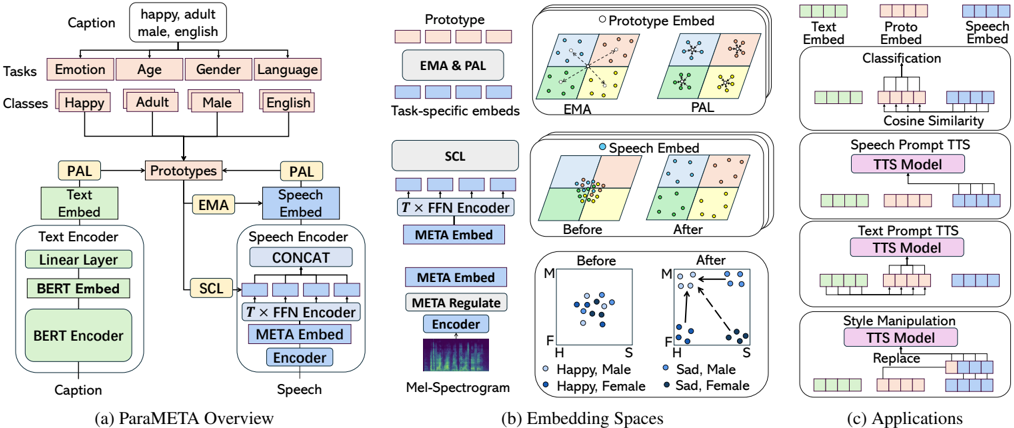
Second, the shared META embedding is projected through independent linear layers into task-specific subspaces, one per style attribute (emotion, gender, age, language), each optimized with its own supervised contrastive loss (L_SCL) so that same-class samples cluster within that subspace regardless of their values on other attributes. Each subspace also maintains a prototype matrix, one EMA-updated class centroid per style value (e.g., a “happy” prototype in the emotion subspace), toward which a prototype alignment loss (L_PAL) pulls sample embeddings, giving each class an explicit anchor usable for classification (nearest-prototype matching) and for generation (as a conditioning target). Text-based style control is supported by projecting a pretrained text encoder’s caption embedding into the same task-specific subspaces via the same prototype alignment loss, giving speech- and text-based prompts a shared target space without a heavier joint cross-modal embedding. The four losses (META, task-specific SCL, and speech/text PAL) are summed for the total training objective. Downstream, the disentangled task-specific embeddings condition a separately trained TTS model (ParaStyleTTS), support single-attribute style manipulation (replacing only one task’s embedding with a different class’s prototype while holding others fixed), and drive classification via nearest-prototype matching.
Key Results
Classification: across four style-recognition tasks (emotion, gender, age, language) and four encoder backbones (16 backbone-task combinations), ParaMETA achieves the best result in 12 of 16 cases, outperforming both a cross-entropy multi-task baseline and a CLAP-style joint contrastive baseline, and substantially outperforming pretrained CLAP/ParaCLAP models used off-the-shelf (e.g., general CLAP: 14.3% emotion balanced accuracy, 25% age; ParaCLAP: 9.2% emotion, 10.8% age). CLAP-style objectives show the most severe negative transfer (strong emotion recognition but collapse on gender/age/language); cross-entropy training reduces but does not eliminate this pattern, with 10-18% accuracy drops on age relative to ParaMETA depending on backbone.
Generation: conditioning a downstream TTS model (ParaStyleTTS) on ParaMETA embeddings produces statistically significant (p<0.05) improvements in both naturalness (N-MOS) and expressiveness (E-MOS) over text-only and raw-speech-embedding prompting, for both text-based (N-MOS 3.06 vs. 2.02, E-MOS 2.91 vs. 2.33) and speech-based (N-MOS 3.41 vs. 2.89, E-MOS 3.41 vs. 3.19) prompting.
Manipulation: changing a single style attribute while holding others fixed achieves 100% target-class accuracy for gender and 90% for emotion, with large similarity shifts toward the target prototype, but only 70% for age and 55% for language, the latter attributed to language identity being tightly bound to textual/phonetic content rather than a purely acoustic style attribute.
Efficiency: ParaMETA’s lightweight encoders (1.86M-3.77M parameters) run up to 30x faster than CLAP (RTF 0.003 vs. 0.091 for the LSTM variant) and use roughly 70% less GPU memory (~440MB vs. 1966MB for CLAP), while using 1.3-1.9% of the parameters of ParaCLAP and CLAP respectively.
Novelty Assessment
The core mechanism, projecting a shared representation into independent, prototype-anchored task-specific subspaces with a graded (rather than binary) similarity regularization, is a genuine architectural contribution to disentangled representation learning for paralinguistic attributes, distinct from prior single-task, multi-task-shared, or CLAP-joint-embedding approaches. The evaluation is unusually broad for a representation-learning paper: it validates the disentanglement claim through classification accuracy across four backbones, t-SNE visualization of the learned subspaces, downstream generative TTS quality with a listening study, direct single-attribute manipulation experiments, and a computational efficiency comparison. The one clear gap is language manipulation, which the paper’s own results show is only weakly controllable, an honest negative finding embedded within an otherwise strongly positive result set.
Field Significance
Field Significance
high — This paper demonstrates, with unusually thorough validation, that explicitly structuring a representation space into prototype-anchored, task-specific subspaces reduces the negative transfer that plagues both multi-task classifiers and CLAP-style joint embeddings for paralinguistic attributes, and that the resulting disentangled embeddings transfer directly to improving controllability and quality in downstream style-controllable TTS, at a small fraction of the computational cost of CLAP-based alternatives.
Claims
- supports: Projecting a shared speech representation into independent task-specific subspaces, each anchored by class prototypes, reduces inter-task interference relative to a single joint embedding space optimized for multiple paralinguistic attributes simultaneously.
Evidence: ParaMETA achieves the best result in 12 of 16 backbone-task combinations versus cross-entropy and CLAP-style joint-embedding baselines, which show pronounced negative transfer, e.g. CLAP-style objectives collapse on gender/age/language despite strong emotion recognition (§Speaking Styles Classification, Table 1).
- supports: Disentangled, task-specific style embeddings enable more precise single-attribute manipulation of synthesized speech than would be achievable from an entangled joint style representation.
Evidence: Replacing only the emotion or gender embedding while holding other style embeddings fixed achieves 90% and 100% manipulation accuracy respectively, with large similarity shifts toward the target prototype (§Speaking Styles Manipulation, Table 3).
- complicates: Style-embedding-based attribute manipulation is far less effective for style attributes intrinsically tied to textual/phonetic content (e.g., language identity) than for purely paralinguistic attributes (e.g., emotion, gender).
Evidence: Language manipulation achieves only 55% accuracy with a minimal similarity shift (0.481 to 0.485) toward the target prototype, versus 90-100% for emotion and gender, since language identity is bound to the input text rather than a purely acoustic style attribute (§Speaking Styles Manipulation, Table 3).
- supports: Lightweight, disentangled paralinguistic style embeddings can condition a downstream TTS model to produce more natural and expressive speech than raw or jointly-learned style embeddings, at substantially lower computational cost than large-scale contrastive language-audio pretraining.
Evidence: TTS conditioned on ParaMETA embeddings achieves statistically significant (p<0.05) N-MOS/E-MOS gains over text-only and raw-speech-embedding prompting, while ParaMETA’s encoders run up to 30x faster and use ~70% less GPU memory than CLAP (§Style-Controllable TTS Generation, §Computational Resource Comparison, Table 2, Table 4).
Limitations and Open Questions
The generative-quality claims (N-MOS/E-MOS improvements from ParaMETA-conditioned TTS) rest on a subjective listening study with only five raters, a small panel for statistically comparing four prompting conditions.
META-space regularization’s benefit is inconsistent and modest for most backbones (typically within 3%, and helping in only 8 of 16 backbone-task settings), with clearer gains only for the Transformer backbone on harder multi-class tasks (emotion, age); the authors describe this evidence as “not yet conclusive” and defer further analysis to future work. Language-attribute control is a clear weak point (55% manipulation accuracy, minimal prototype shift), which the paper attributes to language identity being bound to text/phonetic content rather than a purely acoustic style dimension, an open problem the framework does not solve. The classification comparison partly contrasts off-the-shelf, zero-shot CLAP/ParaCLAP models against encoders trained from scratch on this paper’s own dataset, which is not a fully matched-data comparison.
Wiki Connections
- Disentanglement — introduces an explicit two-stage training mechanism (graded META-space contrastive regularization plus per-task prototype-anchored contrastive loss) with direct ablation and manipulation-accuracy evidence for disentangling emotion, gender, age, and language in a shared speech representation.
- Emotional and Expressive Speech Synthesis — demonstrates targeted emotion-attribute manipulation (90% accuracy) in synthesized speech by substituting a single task-specific embedding while preserving other speaking-style attributes.
- Instruction-Conditioned Text-to-Speech — supports natural-language style captions (e.g., “happy adult female”) as an alternative to speech-based prompting, projected into the same prototype-anchored subspaces used for speech-driven style control.
- ParaStyleTTS — the downstream TTS model ParaMETA’s disentangled style embeddings are used to condition, from the same research group, in the paper’s generative evaluation.
- VALL-E — cited as an example of speech-prompt-based style control that extracts style embeddings directly from reference speech, the paradigm ParaMETA’s speech-prompted variant builds on.
- F5-TTS — cited as an example of speech-prompt-based style control using reference speech to guide generation, contrasted with ParaMETA’s disentangled embedding approach.
- Spark-TTS — cited as an example of speech-prompt-based style control using decoupled speech tokens, part of the design space ParaMETA situates itself against.
- CosyVoice — cited as an example of descriptive text-prompt-based style control for guiding speaking style in generated speech.