arXiv · 2025 · Preprint
Yin et al. (USTC / Kuaishou Technology) · → Paper · Demo: ? · Code: ?
Introduces a flow-matching diffusion transformer TTS system that disentangles speaker timbre from speaking style using a contrastively-trained multi-modal style encoder, then exposes each attribute (content, timbre, style) to independent inference-time control through a chained classifier-free guidance mechanism.
Problem
Controllable TTS systems that let users independently adjust speaker timbre and speaking style tend to entangle the two: conditioning on a reference audio clip for style often leaks timbre information into the output, shifting the synthesized voice away from the intended target speaker, and most systems accept only a single style-prompting modality (audio or text) rather than both. The closest prior multi-modal disentanglement system, ControlSpeech, is tightly coupled to one specific backbone (NaturalSpeech3) and its textual style prompts can themselves carry identity-related cues (e.g., gender), which undermines strict style-timbre separation and is English-only, precluding direct comparison on Chinese data.
Method
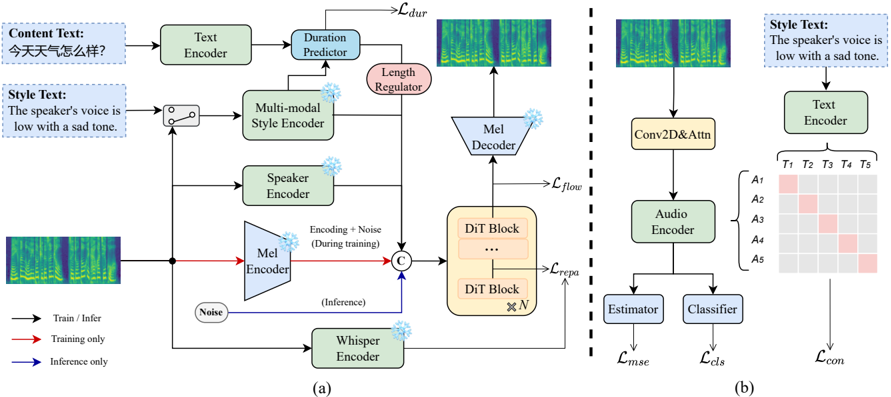
DMP-TTS is a latent diffusion transformer (DiT) trained with Conditional Flow Matching (CFM), following the F5-TTS backbone configuration, operating on mel-VAE latents (40-dim, 43Hz, from a Kling-Foley-style mel encoder). Three conditioning streams feed the DiT: a text encoder for content, a speaker encoder (initialized from CosyVoice’s pretrained cam++ model) for timbre, and a new style encoder called Style-CLAP for speaking style. Style-CLAP fine-tunes a pretrained CLAP model to align reference-audio and descriptive-text style cues (curated over emotion, energy, and speech-rate categories, explicitly excluding age/gender/pitch descriptors to avoid speaker-identity leakage) in a shared embedding space, using a contrastive InfoNCE loss plus multi-task supervision (cross-entropy for the discrete emotion label, MSE for continuous energy and rate).
For inference-time control, the paper introduces chained classifier-free guidance (cCFG): rather than the standard all-or-nothing conditional/unconditional dropout of ordinary CFG, training uses hierarchical condition dropout, treating style as the highest-level (most likely to be dropped) attribute, then timbre, then content text, so that each attribute has its own conditional/unconditional branch. At inference this yields separate guidance-scale terms for text, speaker, and style, which can each be tuned independently rather than moving together under a single global scale. Style perturbation (feeding the speaker encoder a different utterance from the same speaker during training) further regularizes the timbre branch against style leakage. Finally, Representation Alignment (REPA) distills features from a frozen pretrained Whisper Large-v3 encoder into an intermediate (6th) DiT block via a cosine-similarity alignment loss, intended to stabilize and speed up training convergence. Waveform synthesis uses a BigVGAN vocoder. Training used an internal ~300-hour, 250k-utterance, ~1,000-speaker Chinese corpus with automatically annotated emotion, energy, and speech-rate labels.
Key Results
On a 100-utterance, style-balanced held-out test set using cross-speaker style transfer (timbre from one speaker, content and style from another), DMP-TTS outperforms open-source Chinese-capable zero-shot baselines (CosyVoice, CosyVoice2, IndexTTS2) on style controllability: with text prompts, emotion/energy/rate accuracy reach 0.64/0.85/0.73, and with audio prompts 0.55/0.82/0.74, exceeding the best baseline’s 0.54/0.40/0.70. Intelligibility (WER) is 0.038 (text prompt) and 0.043 (audio prompt), second only to IndexTTS2’s 0.028. Naturalness and quality MOS under audio prompting (3.82/3.83) are close to ground-truth recordings (3.86/3.89). Speaker similarity (0.71-0.72) trails CosyVoice2 (0.80) and IndexTTS2 (0.76), which the authors attribute to those models’ larger-scale pretraining and to information loss from mel-spectrogram compression. Ablations show multi-task style supervision is chiefly responsible for style-attribute accuracy (removing it drops emotion accuracy from 0.64 to 0.54), while REPA is chiefly responsible for intelligibility (removing it raises WER from 0.038 to 0.046) with minimal cross-effects between the two.
Novelty Assessment
The individual components draw on established techniques, CLAP-based contrastive alignment, classifier-free guidance, and representation alignment, but their combination is new: extending CFG to a hierarchical, chained form trained via nested condition dropout for genuinely independent per-attribute guidance is a real mechanism-level contribution not previously demonstrated for TTS timbre/style disentanglement at this granularity, and applying REPA (previously used to stabilize image diffusion transformers) to a TTS DiT with a speech-domain teacher (Whisper) is a reasonable but incremental adaptation. The comparison set is limited to open-source zero-shot baselines rather than the most directly comparable prior system (ControlSpeech), which the authors could not evaluate due to a language mismatch (English-only) with their Chinese training data.
Field Significance
moderate — DMP-TTS provides a concrete, ablated mechanism (chained CFG with hierarchical condition dropout) for independently controlling content, timbre, and style in a diffusion-transformer TTS system, addressing a real limitation (style-timbre entanglement, single-modality style prompting) in multi-modal controllable TTS. The empirical validation is solid within its scope (ablations isolate each component’s contribution, human NMOS/QMOS ratings are reported), but the evaluation is confined to a single internal Chinese dataset and does not include a comparison against the most architecturally similar prior system, leaving open how the disentanglement mechanism performs relative to that closest baseline.
Claims
- supports: Combining multi-task attribute supervision with contrastive audio-text alignment in a style encoder yields stronger downstream style control than contrastive alignment alone.
Evidence: Removing multi-task supervision (keeping only the contrastive loss) drops emotion control accuracy from 0.64 to 0.54 and energy accuracy from 0.85 to 0.80, while speaker similarity and WER change negligibly. (§4.3.2, Table 2)
- supports: Distilling acoustic-semantic features from a pretrained ASR encoder into intermediate diffusion-transformer layers can improve TTS intelligibility with little effect on style or speaker control.
Evidence: Removing Whisper-based representation alignment (REPA) raises WER from 0.038 to 0.046, while style-accuracy and speaker-similarity metrics remain nearly unchanged, and REPA is reported to reach intelligible speech earlier in training. (§4.3.2, Table 2)
- supports: Hierarchical condition dropout during classifier-free guidance training enables each conditioning attribute’s guidance strength to be tuned independently at inference, rather than a single scale strengthening all conditions together.
Evidence: Independently varying the speaker or style guidance scale from 6.0 to 21.0 produces a corresponding upward trend in speaker similarity or emotion accuracy respectively, without requiring joint adjustment of the other attributes’ guidance scales. (§4.3.3, Figure 2)
- complicates: Per-attribute guidance decomposition does not fully eliminate cross-attribute interaction: pushing a single attribute’s guidance scale too high still degrades overall naturalness and can slightly reduce accuracy on attributes not being adjusted.
Evidence: Excessively high guidance scales were observed to introduce over-conditioning that degrades naturalness and can slightly reduce the non-target attribute’s accuracy, even under chained CFG’s nominal per-attribute decomposition. (§4.3.3)
- complicates: Choice of style-prompting modality (audio vs. descriptive text) trades off stability of attribute control against perceived naturalness, rather than one modality dominating the other.
Evidence: Text-prompted synthesis gives more stable, generally higher style-attribute accuracy, while audio-prompted synthesis gives higher naturalness MOS (3.82 vs. 3.73), attributed to audio carrying richer prosodic and acoustic information than discrete text labels. (§4.3.1, Table 1)
Limitations and Open Questions
The paper does not compare against ControlSpeech, the prior system most directly targeting the same style-timbre disentanglement problem, because ControlSpeech is English-only and the authors’ training data is Chinese; the comparison set instead consists of large-scale zero-shot baselines pretrained on far more data (~100k hours) than DMP-TTS’s ~300-hour training set. Speaker similarity trails the strongest baselines (CosyVoice2, IndexTTS2), which the authors attribute to less large-scale pretraining and to information loss from mel-spectrogram compression, rather than to the disentanglement mechanism itself. The style taxonomy (emotion, energy, rate) is built from static, manually curated discrete labels; the authors identify extending to dynamic, temporally varying style descriptors and scaling to multilingual data and larger backbones as future work.
Wiki Connections
- Disentanglement — trains a style encoder with contrastive and multi-task objectives plus hierarchical condition dropout specifically to separate speaker timbre from speaking style, with ablations isolating each mechanism’s contribution.
- Instruction-Conditioned TTS — supports descriptive-text style prompting as an alternative to reference-audio prompting, aligned to the same embedding space via Style-CLAP.
- Emotion Synthesis — treats emotion as one of three explicitly disentangled and independently controllable style attributes, evaluated with a dedicated emotion-accuracy metric.
- Zero-Shot TTS — evaluates cross-speaker timbre transfer to unseen speaker pairings and compares against zero-shot baselines (CosyVoice, CosyVoice2, IndexTTS2).
- Prosody Control — exposes speech rate as an explicit, independently controllable style attribute via chained guidance, separate from content and timbre.
- Subjective Evaluation — reports human-rated naturalness (NMOS) and quality (QMOS) mean opinion scores alongside objective metrics.
- CosyVoice — used as a zero-shot TTS baseline in the style-controllability and intelligibility comparison (Table 1).
- CosyVoice 2 — used as a zero-shot TTS baseline; achieves the highest speaker similarity among compared systems.
- IndexTTS2 — used as a zero-shot TTS baseline; achieves the lowest WER among compared systems.