arXiv · 2026 · Preprint
Bin Lin et al. · → Paper · Demo: ✗ · Code: ✗
Introduces DSFlow, a distillation framework that converts multi-step flow-matching TTS teachers into one-step (or few-step) students by combining endpoint and mean-velocity supervision with a lightweight discrete step-conditioning mechanism, closing most of the quality gap to the teacher while cutting parameters and inference latency.
Problem
Flow-matching TTS models produce high-quality speech but require tens of iterative ODE integration steps at inference, making them too slow for real-time deployment in voice assistants and dialogue systems. Existing acceleration approaches distill a multi-step teacher into a few-step student, but the paper identifies two specific weaknesses in prior distillation recipes. First, endpoint-only distillation (progressive distillation) supervises only the final output of the sampling trajectory, so small prediction errors accumulate across integration steps and produce high training variance. Trajectory-level alternatives such as MeanFlow reduce this variance by supervising the mean velocity field, but require Jacobian-vector product (JVP) computation, which is memory-expensive and incompatible with common CUDA kernels; IntMeanFlow avoids JVPs but can still exhibit endpoint drift at very low step counts. Second, distilled students conventionally keep the teacher’s continuous-time conditioning architecture (e.g., adaLN-Zero), even though the student only ever operates at a small, fixed set of discrete step counts, leaving much of that conditioning capacity structurally unused.
Method
DSFlow reformulates few-step and one-step generation as a discrete prediction task and adapts both the training objective and the architecture to that regime, rather than reusing the teacher’s continuous-time design unmodified.
Dual supervision combines two complementary loss terms. An endpoint-matching term anchors the student’s final output to the teacher’s final output under the target step count K. A velocity-alignment term supervises the student’s instantaneous velocity at the midpoint of each integration sub-interval against a deterministic estimate of the teacher’s mean velocity over that sub-interval, computed as the finite difference between the teacher’s states at the interval start and end (no JVP required). The two terms are combined as a weighted sum with coefficient α = 0.7 favoring endpoint accuracy while retaining intermediate trajectory guidance, and the loss is averaged across all K sub-intervals for a given target step count.
Step-aware tokenization replaces the teacher’s adaLN-Zero timestep-conditioning modules with a small set of learnable tokens, one group per discrete inference step n ∈ {1, 2, 4}, prepended to the input sequence and integrated via self-attention. The paper motivates this with an information-theoretic argument: after distillation the conditioning variable ranges over only K discrete values (entropy log2(K) bits) rather than a continuous t ∈ [0, 1] (unbounded entropy), so a compact per-step embedding table suffices in place of the adaLN MLPs. In the paper’s setting (K=3 target step counts, L=16 layers, D=512), this reduces the number of step-conditioning parameters from roughly 38M to 1.5K and removes adaLN-Zero from the student entirely, shrinking the overall student from 154M to 118M parameters (a 24% reduction). A formal parameter-complexity comparison (O(K·D) for step tokens vs. O(L·D²) for adaLN) is given in the paper’s Appendix B.
A weak classifier-free guidance (CFG) regularizer is added because the student, trained on teacher targets generated with CFG enabled (w=0.7), implicitly absorbs the teacher’s guidance behavior; without further constraint its unconditional branch can collapse, making any inference-time CFG on the student ineffective. The regularizer penalizes the (stop-gradient) discrepancy between the student’s conditional and unconditional velocity predictions, preserving a usable unconditional branch and enabling a small amount of inference-time CFG (w ∈ [0, 0.1], with w=0.05 found optimal) for quality adjustment.
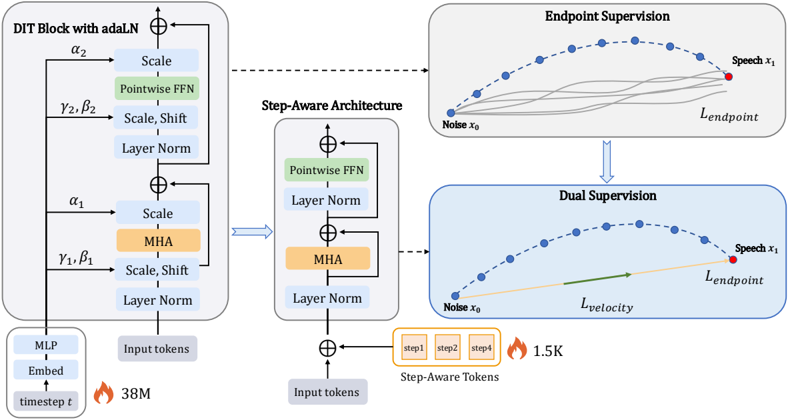
The teacher is a 154M-parameter DiT-style Transformer (16 layers, hidden dim 512, 8 heads) trained with flow matching, adaLN-Zero timestep conditioning, and Euler ODE sampling; the student shares the same backbone minus adaLN-Zero, plus the step-aware tokens. Both operate on 80-dim mel-spectrograms (16 kHz audio, 1024-pt FFT, 256-sample hop); there is no neural audio codec in the pipeline. Training uses AdamW, batch size 32, FP16 mixed precision, and roughly 72 hours on 8 NVIDIA A100 (40GB) GPUs. Training data is the Emilia corpus, filtered to about 95k hours of English and Mandarin speech from over 9,400 speakers.
Key Results
On LibriSpeech test-clean, the 1-step DSFlow student (StepTTS backbone, 118M params) reaches MOS-N 4.32 / MOS-Q 4.29 / SMOS 4.27 / SIM-o 0.66 / WER 3.1%, versus the 10-step StepTTS teacher’s MOS-N 4.43 / MOS-Q 4.39 / SIM-o 0.66 / WER 2.8% (Table 1). This closes most of the gap to the teacher while cutting real-time factor from 0.303 to 0.012 and reducing parameters by 24%. Against other 1-step distillation baselines built on the same teacher, DSFlow outperforms Endpoint Distillation (MOS-N 3.56), Progressive Distillation (MOS-N 3.92), and IntMeanFlow (MOS-N 4.10) by a substantial margin at equal or lower step count, and does so with fewer parameters (118M vs. 154M for the other baselines, which retain adaLN-Zero).
Cross-architecture experiments apply DSFlow to F5-TTS (DiT with RoPE), CosyVoice2 (U-Net, no adaLN), and E2-TTS (U-Net) in addition to StepTTS. All four backbones produce competitive 1-step students (MOS-N 4.11-4.23 for the non-StepTTS backbones), and for CosyVoice2/E2-TTS, where adaLN is absent and step-aware tokenization does not apply, dual supervision plus weak CFG alone still yield most of the improvement (Table 1, Table 7). The ablation in Table 2 attributes the largest single gain to dual supervision (MOS-N 3.56 → 4.21), a further increment to weak CFG (4.21 → 4.25), and a final increment to step-aware tokens while simultaneously cutting parameters from 154M to 118M (4.25 → 4.32). An exhaustive 2³ combination ablation on StepTTS (Table 6) confirms the components are synergistic rather than additive: individual components alone reach at most MOS-N 4.15, while the full combination reaches 4.32. Prosodic-correlation analysis (Table 3) shows the 1-step student tracks the teacher’s F0, HNR, jitter, and shimmer correlations with the prompt more closely than endpoint distillation does, and multi-benchmark evaluation (Table 8, Appendix C.5) shows a stable ~0.10-0.12 MOS-N gap to the teacher across LibriSpeech, Seed-TTS test-en, and Seed-TTS test-zh, including the cross-lingual Mandarin setting despite no Chinese-specific optimization.
Novelty Assessment
The contribution is architectural and training-recipe rather than a new generative paradigm: both flow matching and knowledge distillation are established techniques, and the individual ingredients (endpoint matching, mean-velocity supervision, token-based conditioning, weak CFG regularization) each have precedent in prior consistency-model, MeanFlow, and multimodal-conditioning work. What is new is the specific combination and its justification: a JVP-free deterministic mean-velocity estimate that gives MeanFlow-style dense supervision without its computational cost, an information-theoretic argument (with a formal parameter-complexity proof) for replacing continuous-time modulation with discrete step tokens once the conditioning space collapses to a handful of values, and a regularizer that keeps a distilled model’s unconditional branch usable for post-hoc CFG adjustment. The cross-architecture experiments (DiT with and without RoPE, U-Net with and without adaLN) are a genuine strength: they show the dual-supervision and weak-CFG components transfer across backbone families even when the step-aware tokenization component (which is adaLN-specific) does not apply, supporting the claim of a modular rather than architecture-specific framework.
Field Significance
moderate — DSFlow provides a concrete, well-ablated recipe for closing the quality gap between multi-step and one-step flow-matching TTS, validated across four different backbone architectures rather than a single system, and backed by a large-scale (501-rater) subjective evaluation. It is best read as a solid engineering and training-recipe advance for an active efficiency problem (few-step flow-matching distillation) rather than a new generative paradigm; its central techniques recombine and extend existing distillation and conditioning ideas rather than introducing a fundamentally new class of model.
Claims
- supports: Combining endpoint matching with a deterministic (JVP-free) estimate of the teacher’s mean velocity over each sampling sub-interval reduces training variance and improves one-step distillation quality relative to endpoint-only supervision.
Evidence: Adding dual supervision to an endpoint-distillation baseline raises MOS-N from 3.56 to 4.21 and MOS-Q from 3.42 to 4.11 on the StepTTS teacher, the largest single-component gain in the ablation; removing dual supervision from the full model causes a “catastrophic” drop to MOS-N 3.95 and SMOS 3.38. (§4.4, Table 2; Appendix C.1, Table 4)
- supports: When a distilled student is restricted to a small, fixed set of discrete inference steps, replacing continuous-time modulation-based conditioning (adaLN-Zero) with a compact set of learnable per-step tokens can match or exceed distilled quality while substantially reducing parameter count.
Evidence: Removing adaLN-Zero (38M step-conditioning parameters) in favor of 3 step-aware tokens per step (1.5K parameters) improves MOS-N from 4.25 to 4.32 while cutting overall student parameters from 154M to 118M; a formal complexity argument shows adaLN requires O(L·D²) parameters versus O(K·D) for step tokens (10,923x more in this configuration). (§3.3.3, §4.4; Appendix B.1, Table 2)
- supports: A distilled few-step flow-matching TTS model can retain most of a multi-step teacher’s speaker-similarity and prosodic fidelity, not just its naturalness/quality scores.
Evidence: The 1-step StepTTS student matches the teacher’s objective speaker similarity (SIM-o 0.66 for both) on LibriSpeech test-clean and shows F0/HNR/jitter/shimmer correlations with the prompt comparable to or slightly above the 10-step teacher, while endpoint distillation shows markedly lower correlations across the same features. (§4.1.4, Table 1; §4.5, Table 3)
- complicates: A student distilled from teacher targets generated under strong classifier-free guidance internalizes that guidance, so its optimal inference-time CFG strength is not the same as the teacher’s and further guidance at teacher-like strengths can substantially harm quality.
Evidence: The teacher performs best at guidance weight w=0.7, but the distilled student’s optimal setting is w=0.05 (MOS-N 4.32); increasing to w=0.20 drops MOS-N to 4.10 and w=0.50 collapses it to 3.78, and the paper notes these w values are not directly comparable to guidance scales (w≥1) used in some other TTS systems such as F5-TTS. (§4.1.2; Appendix C.2, Table 5)
- complicates: Architectural adaptations designed for one backbone family’s conditioning mechanism may not transfer to backbones that lack that mechanism, limiting how uniformly a distillation framework’s components apply across architectures.
Evidence: Step-aware tokenization is only applicable to adaLN-based DiT backbones (StepTTS, F5-TTS); for U-Net backbones without adaLN (CosyVoice2, E2-TTS) the technique is architecturally inapplicable, and only the dual-supervision and weak-CFG components could be evaluated on those systems. (§4.3; Appendix C.4, Table 7)
Limitations and Open Questions
The paper’s own Conclusion flags that DSFlow has not been evaluated under extremely large-scale multilingual training settings (the training corpus is bilingual English/Mandarin, not broadly multilingual), and that its applicability to autoregressive architectures with different inductive biases than the flow-matching backbones tested here is untested. The distillation targets are restricted to a small, fixed set of step counts (K ∈ {1, 2, 4}) chosen as powers of two; behavior at intermediate or larger step counts is not characterized. Step-aware tokenization is explicitly inapplicable to non-adaLN backbones, so the full three-component framework is only demonstrated on adaLN-based DiT architectures, with the other two components carrying the CosyVoice2/E2-TTS results. The rater-recruitment and sample-selection methodology described in Appendix A.2 explicitly scopes its 50-utterance, 501-rater sample to LibriSpeech test-clean; the paper does not clarify whether the MOS-N figures reported for the Seed-TTS test-en/test-zh robustness benchmark (§Appendix C.5, Table 8) come from the same listening protocol or a separate evaluation run.
Wiki Connections
- Flow Matching — proposes a distillation and step-conditioning framework specifically for converting multi-step flow-matching TTS teachers into one-step or few-step students.
- Zero-Shot TTS — the teacher and distilled students perform prompt-based (voice-cloning) synthesis, with speaker similarity and cross-lingual zero-shot generalization reported as key evaluation axes.
- Multilingual TTS — trains on a bilingual English/Mandarin corpus (Emilia) and evaluates cross-lingual generalization on Seed-TTS test-zh alongside English test sets.
- Subjective Evaluation — conducts a large-scale, anchor-validated four-dimension MOS/SMOS listening study with 501 Prolific raters to assess distilled model quality.
- StepTTS — the flow-matching teacher model that DSFlow’s primary results distill from.
- F5-TTS — one of four backbone architectures used to test DSFlow’s cross-architecture generalization (DiT with RoPE).
- CosyVoice2 — a U-Net backbone without adaLN-Zero used to test DSFlow’s modularity when step-aware tokenization is architecturally inapplicable.
- E2-TTS — a second non-adaLN U-Net backbone used for the same cross-architecture generalization test as CosyVoice2.
- Emilia — the training corpus (approximately 95k hours, English and Mandarin) used to train all teacher and student models.
- Seed-TTS — source of the Seed-TTS test-en and test-zh evaluation sets used to assess cross-domain and cross-lingual robustness.
- IntMeanFlow — the closest prior JVP-avoiding trajectory-supervision distillation method, used as a direct one-step distillation baseline in Table 1.